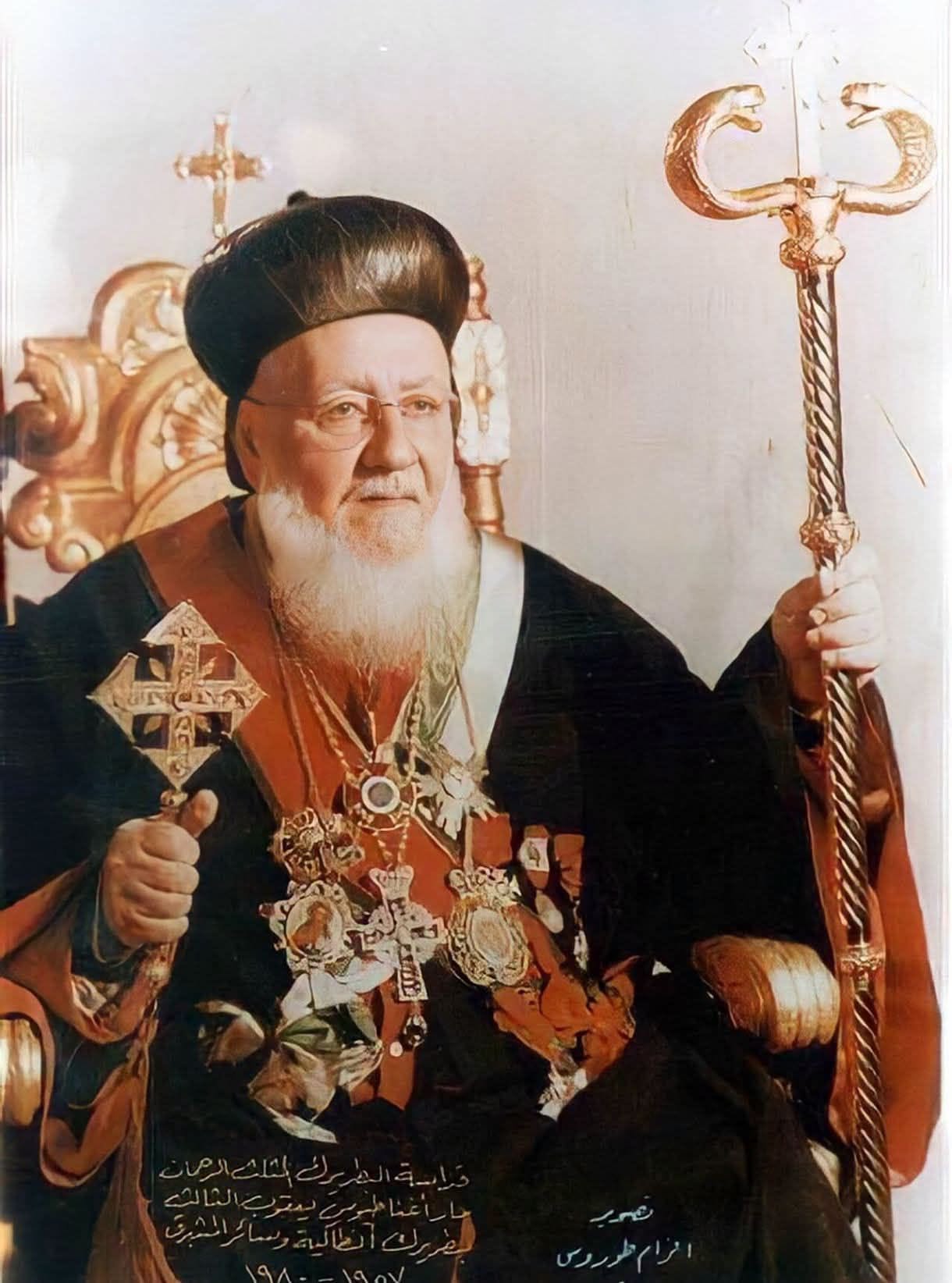
📖Early Life and Formation
His Holiness Moran Mor Ignatius Yaqub III, who gave unforgettable chapters to the Syrian Church of
Malankara that can never be forgotten, was born on October 13, 1912, in the village of Bartelli
near Mosul in Iraq—the ancient land once known as Mesopotamia. He was born into an ancient and
most distinguished family as the son of Thoma and Shemuni.
In his childhood, he was called by the name "Sabha." His primary education took place in his own
village of Bartelli. At the age of 11, in 1923, recognizing that his life's calling was something
different, he joined St. Mathew's Monastery (Mor Mattai Dayro) in Mosul through divine vocation.
There he received his theological education. Gifted with a talent for chanting, he internalized the
Syriac melodies (eqaroth) and gained profound scholarship in the Syriac language and history.
In 1924, he received the order of Korooyo (lector) from Mor Clemis Yuhanon Metropolitan, and in
1929, he received the order of Yauphdiyaqno (full deacon) from His Holiness Patriarch Elias III.
✝️Theological Formation and Scholarship
From 1931 to 1933, he served as a Syriac professor (Malpan) at the theological seminary in
Beirut. He was also well-versed in Arabic, English, and French languages. On July 20, 1933, the
Reverend Abdul Ahad Ramban came to Malankara along with Mor Yulios Elias Bava, the representative
of the Holy Apostolic See of Antioch who had come from Malankara to participate in the election of
His Holiness Patriarch Aphrem I.
He resided at Manjinikkara Dayro along with Mor Yulios Bava. In 1934, Mor Yulios Elias Bava
ordained Abdul Ahad Ramban as a priest (Kassisso). Ramachan lived at Manjinikkara for a long
period of 13 years, from 1933 to 1946, ministering at the holy tomb of His Holiness Patriarch
Elias III—who had ordained him as a full deacon—and taught the Syriac language to numerous
theological students, serving as their Malpan (teacher).
During this period, he learned the Malayalam language well, and would celebrate the Holy
Qurbana in Malayalam. The Holy Father, who spoke Malayalam with ease, maintained excellent
relationships with everyone at Manjinikkara.
⛪Episcopal Ministry
In 1946, Abdul Ahad Ramachan, much to his sorrow, departed from the beloved Manjinikkara Dayro and
returned to Mosul. There, until 1950, Ramachan oversaw the responsibilities of Mor Aphrem
Theological Seminary in Mosul.
In 1950, His Holiness Patriarch Aphrem I consecrated Abdul Ahad Ramachan as Metropolitan of the
Beirut-Damascus dioceses, giving him the name Yakub Mor Severios. When His Holiness Patriarch
Aphrem I departed this life on June 23, 1957, the General Holy Synod convened under the
presidency of the Locum Tenens, the Reverend Kuriakose Mor Osthatheos Thirumeni, on October 14,
1957. This Synod elected Metropolitan Yakub Mor Severios as Patriarch, and his enthronement as
Patriarch took place on October 27, 1957.
👑Enthronement as Patriarch of Antioch
Immediately after His Holiness Patriarch Yaqub III's enthronement, demonstrating his desire for
peace within the Church, he issued Encyclical No. 82 on November 11, 1957. This encyclical came at
a time when the Patriarchal faction had achieved complete victory in the High Court.
By Encyclical No. 497, dated December 16, 1958, Mor Baselios Geevarghese II was accepted as
Catholicos. On January 3, 1963, Catholicos Mor Baselios Geevarghese II departed this life.
Subsequently, on May 22, 1964, His Holiness Patriarch Yaqub III consecrated Mor Augen Timotheos as
Catholicos at Kottayam.
Later, Catholicos Mor Augen I adopted an independent church stance and was excommunicated.
Following this, in 1975, His Holiness the Patriarch consecrated the Most Reverend Baselios Paulose
II as Catholicos.
🏛️23 Years of Patriarchal Ministry
His Holiness Yaqub III's 23 years of ministry as Patriarch are a matter of great pride for the
Syriac Orthodox Church. During this period, he consecrated two Catholicos Bavas and 13
Metropolitans. For the sake of Malankara, during the period 1973-75, he consecrated 6
Metropolitans.
Among those consecrated to provide courageous leadership during the most critical period of
crisis for the Church in the 1970s were the Most Reverend Baselios Thomas I Catholicos (then a
Metropolitan), the blessed Perumpally Thirumeni, and Kuriakose Mor Kurilos Thirumeni.
🎵Scholarship and Ecumenical Legacy
His Holiness Yaqub III's vocal sweetness is praiseworthy. The Eqarot (Syriac liturgical melodies)
that he sang for many hours are still in circulation today on cassette recordings. In October
1971, the paper he presented on the Syriac Orthodox Church at the University of Göttingen in West
Germany brought recognition both to His Holiness's scholarship and to the Syriac Church.
In 1971 and again in 1980, he conducted ecumenical dialogues with the Roman Catholic Church,
visiting the Pope and engaging in conversations that strengthened ecclesiastical relations between
the two churches.
Through His Holiness's efforts, the following institutions were nurtured and developed: a
modern-style orphanage built in Atchaneh, Lebanon, a theological seminary, Mor Severios College in
Beirut, the Episcopal residence at Sahlieh, the Patriarchal headquarters in Damascus, and the Mor
Ephrem Library. His Holiness, who authored numerous books, also wrote the history of the Syriac
Church of Malankara.
In 1960, the Syriac Church became a member of the World Council of Churches (WCC), and His
Holiness made great efforts to send many priests and Metropolitans abroad for higher studies and
to send representatives to ecclesiastical conferences, thereby working to elevate the glory of the
Church.
🕊️Repose and Burial
On June 25, 1980, His Holiness Patriarch Yaqub III departed this life at the age of 68. On June
28, he was laid to rest on the eastern side of the altar of St. George's Cathedral, adjoining the
Patriarchal residence in Damascus. The Syriac Church observes the memorial feast of His Holiness
on June 25 each year.
The sacred relics of His Holiness were later transferred by His Holiness Patriarch Aphrem II on
June 29, 2016, to a specially prepared tomb at St. Peter and St. Paul Cathedral in Ma'arrat
Saidnaya.
🌟Legacy and Remembrance
His Holiness Patriarch Yaqub III, who provided decisive leadership to the Syriac Church during the
second half of the twentieth century, was a capable administrator, possessed a blessed and
distinctive voice, was gifted with grace in liturgical celebration, was a scholarly author, an
ecumenical figure who strengthened the Church, and a Malayali Patriarch who handled the Malayalam
language with effortless ease.
His legacy lives on through the institutions he established, the scholars he trained, the
ecumenical bridges he built, and the courageous bishops he consecrated to guide the Church through
its most trying times. The Malankara Church remembers him with profound gratitude for his role in
preserving the apostolic faith during a turbulent era.
🙏Commemoration
Annual Feast Day Observance
The Holy Church observes the memorial feast of His Holiness Patriarch Ignatius Yaqub III on June 25
each year, commending the faithful to the intercession of this blessed Father who gave
unforgettable chapters to the history of the Syriac Church of Malankara.