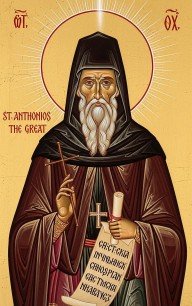
📖Early Life and Divine Calling
Among the shining luminaries of Christian holiness, St. Anthonios the Great stands as a towering
figure whose life transformed the spiritual landscape of the Church. Born around 251 AD in the
village of Coma near Heracleopolis Magna in Upper Egypt, he was raised by devout Christian parents
of noble lineage who nurtured in him a profound love for Scripture and prayer.
The course of his life changed dramatically when he was approximately twenty years old. After the
death of both his parents, he inherited considerable wealth and the responsibility of caring for his
younger sister. One day, entering the church for divine worship, he heard the Gospel words that
would become his life's compass: "If you wish to be perfect, go, sell what you have and give to the
poor, and come, follow Me." These words from Matthew 19:21 pierced his heart with divine force.
In immediate obedience to this heavenly call, Anthonios distributed his entire inheritance among the
poor, entrusted his sister to a community of consecrated virgins, and withdrew into the wilderness.
His response to the Gospel was not merely an act of charity, but a complete surrender to God's
will—a pattern that would inspire countless souls for centuries to come.
🏜️Retreat into the Desert
St. Anthonios began his ascetic journey in relative solitude near his village, dedicating himself to
prayer, fasting, and manual labor. Yet his spiritual thirst intensified, compelling him to seek even
greater isolation. He ventured deeper into the Eastern Desert of Egypt, first to areas near the
banks of the Nile, and eventually to the remote desert regions near the Red Sea, where he lived in
profound seclusion for many years.
In the profound stillness of the desert, Anthonios entered into intense spiritual warfare. The enemy
of mankind assailed him with visions, terrors, and physical torments of every kind. The demons
appeared to him in various forms, attempting to break his resolve through fear, through temptations
of the flesh, and through false visions. Yet through his unwavering faith in Christ, constant
prayer, vigils, and the invocation of the Holy Cross, he emerged victorious from every trial.
These spiritual battles were not merely personal struggles, but cosmic confrontations that
demonstrated the power of faith over the principalities of darkness. His victories became legendary
throughout Egypt, and word of this holy man who had conquered the demons spread far and wide,
drawing seekers and disciples to witness his sanctity.
St. Anthonios transformed the desert from a place of desolation into a garden of holiness, where
silence became a language of prayer and solitude became communion with God. His life demonstrated
that true freedom is found not in the world, but in complete surrender to the Divine Will.
⛪The Formation of Monasticism
Although St. Anthonios lived as a hermit, the radiance of his holiness could not remain hidden.
Groups of ascetics began gathering near his dwelling, seeking his spiritual guidance and counsel.
Without intending to establish an institution, Anthonios became the spiritual father of an entire
movement that would reshape Christian life—the monastic vocation.
He organized his followers into small communities of prayer and asceticism, teaching them the
fundamental principles that would become the pillars of monastic life: obedience to God and to one's
spiritual elder; poverty as detachment from worldly possessions; chastity as purity of body and
soul; unceasing prayer and fasting as the breath of spiritual existence; and charity coupled with
humility as the crown of all virtues.
Through St. Anthonios, monastic life took concrete form—not as an escape from the world, but as a
higher path of union with God and service to humanity through intercession. The desert fathers who
followed him would carry this tradition throughout the Christian world, from Egypt to Syria, from
Palestine to Mesopotamia, and eventually to every corner of Christendom.
✝️Teacher and Defender of Orthodox Faith
The fame of St. Anthonios spread throughout Egypt, Syria, and the entire Christian East. He became a
spiritual father not only to monks, but to bishops, clergy, and laypeople who sought his counsel.
Pilgrims journeyed from distant lands to his hermitage, seeking healing for their bodies, wisdom for
their souls, and blessings for their lives.
During the great Arian controversy that threatened to tear apart the Church, St. Anthonios emerged
as a steadfast defender of Orthodox faith. He stood firmly alongside St. Athanasius the Great,
Patriarch of Alexandria, in defending the full divinity of our Lord Jesus Christ against heretical
teachings. Though Anthonios was unlettered in worldly wisdom, he possessed profound spiritual
discernment granted by the Holy Spirit.
He publicly opposed heresies, wrote letters to emperors and bishops, and encouraged the faithful to
remain anchored in the apostolic truth handed down from the beginning. His testimony carried immense
weight, for here was a man who spoke not from books, but from intimate communion with God—a living
witness to the power of Orthodox faith.
✨Miracles and Divine Gifts
Countless miracles were attributed to St. Anthonios during his earthly life. By the grace of God
working through his prayers, he healed the sick, cast out demons with a word, and revealed hidden
things through divine inspiration. His very presence brought peace to the troubled and comfort to
those afflicted in body or soul.
Yet despite these extraordinary gifts, St. Anthonios remained clothed in profound humility. He
attributed all power to Christ alone, seeing himself as merely an unworthy servant. His life was
marked by simplicity, gentleness, and unwavering trust in God's providence. He lived on bread and
water, wore the same garment for years, and possessed nothing beyond what was absolutely necessary.
☩His Blessed Departure and Hidden Tomb
St. Anthonios lived to the extraordinary age of 105 years, departing this life on January 17, 356
AD, in the deep desert near the Red Sea. Before his blessed repose, he called his two closest
disciples and gave them final instructions. He commanded them to bury his body secretly in an
unmarked grave, so that it would not become an object of veneration that might lead to division or
improper honor being paid to his mortal remains rather than to God.
His disciples faithfully fulfilled his wish, and his tomb remained hidden for centuries. Only later,
through divine guidance, was his resting place discovered, and his holy relics became a source of
blessing to the faithful. Even in death, St. Anthonios continued to teach the lesson of humility
that had characterized his entire life.
📜Legacy and Universal Veneration
The influence of St. Anthonios transcended the deserts of Egypt and reached every corner of the
Christian world. His life, recorded by St. Athanasius of Alexandria in the "Life of St. Antony,"
became one of the most widely read and influential books in Christian history. This biography
inspired generations of monks and faithful across all traditions—Syriac, Greek, Latin, Coptic,
Armenian, and Ethiopian.
In the Syriac Orthodox tradition, he is venerated with supreme honor as Mar Anthonios Rabbo d-Dayro
(ܡܳܪܝ ܐܰܢܛܽܘܢܺܝܳܘܣ ܪܰܒܳܐ ܕܕܰܝܪܳܐ)—St. Anthonios the Great, Father of the Monastery. His feast is
celebrated
with great solemnity on January 17th, a day when the faithful remember his ascetic labors, his
victorious spiritual warfare, and his enduring witness to the transforming love of Christ.
The monastic tradition he established spread throughout Syria and Mesopotamia, giving birth to
countless monasteries that became centers of prayer, learning, and spiritual formation. The Syriac
fathers—from St. Ephrem to St. Isaac of Nineveh—walked in the footsteps of St. Anthonios, carrying
his vision of consecrated life to new heights of mystical theology and ascetic practice.
💭His Spiritual Message to Every Generation
The life of St. Anthonios speaks with timeless relevance to every generation. To the proud, he
teaches humility; to the worldly, detachment; to the anxious, faith in divine providence; to all,
the necessity of silence, prayer, and spiritual watchfulness. His wisdom remains a living guide for
the Church.
Among his prophetic words that resonate powerfully in our times: "A time is coming when men will go
mad, and when they see someone who is not mad, they will attack him, saying, 'You are mad, you are
not like us.'" This warning calls us to maintain spiritual sobriety in an age of confusion.
He also taught: "I saw the snares that the enemy spreads out over the world and I said groaning,
'What can get through such snares?' Then I heard a voice saying to me, 'Humility.'" In these few
words, St. Anthonios revealed the key to spiritual victory—the humble heart that trusts not in its
own strength, but in the power of God.
Prayer for Intercession
O Holy Father Anthonios, great champion of the faith and victor over the demons, you who transformed
the wilderness into a dwelling place of angels and taught us the path of true discipleship,
intercede for us before the throne of grace. Grant us strength to overcome the temptations of our
age, wisdom to discern the spirits, and courage to follow Christ without compromise. Through your
prayers, may we be delivered from the snares of the enemy and walk faithfully in the narrow way that
leads to eternal life. Amen.