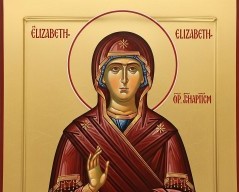
👑Life and Sacred Memory of St. Elizabeth
In the sacred memory of the Syriac Orthodox Church, St. Elizabeth—known in Syriac as
Eliˇsabā (ܐܶܠܺܝܫܒܰܥ)—holds a venerable and deeply honored place among the righteous
women of the Old and New Covenants. She stands at a threshold most significant and mysterious: the
threshold where the long expectation of Israel meets the dawning light of the Gospel of Jesus
Christ, where the shadows of the Law give way to the radiance of Grace. Her life, interwoven with
divine grace, abiding faith, and humble obedience, mirrors the fulfillment of the Law and the
Prophets in a manner that prefigures the very coming of the Savior.
The Syriac Fathers of our Church, those holy theologians whose writings preserve the wisdom of the
Eastern Christian tradition, often portray Elizabeth as a living symbol of faithful Israel—that
remnant of God's people who awaited the Messiah with unwavering hope and pure heart. Unlike those
who looked for a worldly liberator, Elizabeth and her righteous husband Zechariah looked for the
spiritual transformation that comes through divine redemption. She recognized the coming of the
Messiah even before His birth, and she became the first among women after the Theotokos to proclaim
this mystery aloud.
🏛️Priestly Lineage and the Heritage of Aaron
According to the Gospel of St. Luke (1:5–7), Elizabeth was of priestly descent, specifically
described as being "of the daughters of Aaron" (ܡܶܢ ܒܢܳܬ݂ ܐܰܗܪܽܘܢ). This designation is far more
than a matter of genealogical record; it speaks to the very nature of her calling and sanctity. Her
husband, Zechariah (Zakariya in Syriac, ܙܟܰܪܝܳܐ), was also a priest serving in the Temple of
Jerusalem, belonging to the priestly order of Abijah, one of the twenty-four courses of the Aaronic
priesthood.
In the Syriac Orthodox tradition, this priestly lineage is understood as far more than a matter of
ancestry—it signifies a life consecrated wholly to divine service and holiness. The priestly
families of Israel were set apart by divine command, sanctified through their descent from Aaron,
and devoted to the service of God's sanctuary. Elizabeth, as a daughter of Aaron, represents the
spiritual continuity of this holiness that prepared the way for the incarnation of Christ. Through
her family's dedication to priestly service, the will of God was being prepared across generations.
The Syriac Fathers, particularly the great Mar Jacob of Sarug (St. Jacob of Serugh, d. 521 AD),
whose hymnographic genius illuminated our tradition, poetically described Elizabeth as "the barren
garden that blossomed at the fragrance of the Word" (ܓܰܢܬ݂ܳܐ ܕܥܶܡܪܳܐ ܕܶܐܥܡܰܪܬ݂ ܒܪܺܝܚܳܐ ܕܡܶܠܬ݂ܳܐ).
Her barrenness and her subsequent miraculous conception serve as a profound divine sign that God's
mercy and power revive what is lifeless and impossible by human measure, eternally prefiguring the
greater miracle of the Virgin Birth and the Incarnation of the Son of God.
🕯️Barrenness, Prayer, and Divine Promise
For many long years, Zechariah and Elizabeth lived together in righteousness and devotion, yet
remained without children. In ancient Jewish culture, barrenness was often perceived and spoken of
as a reproach, a stigma that brought shame and sorrow to a household. The Law of Moses itself did
not explain why some women remained barren, leaving many to wonder whether they had fallen into
divine disfavor. Yet the Syriac Church, in its profound theological wisdom rooted in patristic
tradition, interprets Elizabeth's barrenness quite differently: her womb's emptiness was not a curse
or evidence of divine displeasure, but rather a deliberate divine preparation—a blank canvas upon
which God would write a new chapter of salvation history.
Elizabeth and Zechariah, though grieved by their childlessness, did not abandon their faith. Rather,
they persevered in prayer and righteousness before God. The Gospel records that "they were both
righteous before God, walking blamelessly in all the commandments and statutes of the Lord" (Luke
1:6). This testimony to their virtue is essential: they did not lose faith despite their affliction.
Many in their position might have grown bitter, questioning God's justice; but Elizabeth and
Zechariah remained steadfast in their devotion, understanding that God's ways are mysterious and His
purposes often hidden from human comprehension.
It was during one of Zechariah's turns to serve in the Temple, while performing the sacred duty of
offering incense in the Holy Place, that the angel Gabriel appeared to him with a message that would
transform their lives eternally. The angel announced that his wife Elizabeth would bear a son—a son
who would be "great in the sight of the Lord" and "filled with the Holy Spirit even from his
mother's womb" (Luke 1:15). This child would turn the hearts of many to the Lord and would prepare a
people prepared for the Lord. The name given to this child would be John—Yohannan in Syriac
(ܝܽܘܚܰܢܳܢ).
✨The Silence of Prophecy and the Renewal of
Prophecy
In the Syriac hymns and liturgical texts, particularly in the Beth Gazo (the treasury of Syriac
hymns, ܒܶܝܬ݂ ܓܰܙܳܐ), this singular moment—the announcement to Zechariah and the promise of
Elizabeth's conception—is celebrated as the awakening of prophecy after centuries of silence. The
Syriac Fathers understood the period between the last of the canonical prophets and John the Baptist
as a time when the voice of God had fallen silent in Israel. No new prophets arose; no new words
from the Lord came to the people. The heavens seemed sealed.
The Syriac Fathers frequently compare Zechariah's muteness to the silence of prophecy before Christ.
When Zechariah doubted the angel's word, he was struck speechless—not as a punishment merely, but as
a sign. His silence symbolized the silence of the prophetic voice in Israel. Yet this silence was
not permanent; it was preparation. Just as Zechariah's tongue would be loosed, so too would the
voice of prophecy return—through his son, John, who would be the last and greatest of the prophets,
the forerunner and herald of the Messiah.
Elizabeth's conception was thus understood as "the renewed voice of divine revelation" after long
centuries. In her womb would be carried the one who would be "more than a prophet" (Matthew 11:9),
the one of whom the Lord Jesus Himself would say: "Among those born of women there has not arisen
anyone greater than John the Baptist" (Matthew 11:11).
🙏The Visitation: Elizabeth Meets the Theotokos
One of the most cherished and theologically profound episodes in the life of St. Elizabeth is her
sacred encounter with the Holy Virgin Mary. When Mary, newly filled with the Holy Spirit after the
Annunciation by Gabriel, set out to journey from Nazareth to the Judean hills where Elizabeth dwelt,
she came to visit her kinswoman. This visitation is recorded in the Gospel of St. Luke (1:39–45) and
remains a cornerstone of Marian piety and Christological understanding in the Syriac Orthodox
Church.
As Mary entered the home of Zechariah and Elizabeth and greeted her cousin, something miraculous
occurred. The child in Elizabeth's womb—the unborn John—leapt with joy. The Gospel tells us: "And
when Elizabeth heard the greeting of Mary, the babe leaped in her womb; and Elizabeth was filled
with the Holy Spirit" (Luke 1:41). Elizabeth, filled with the Holy Spirit's inspiration, then
proclaimed those sacred and prophetic words recorded in Luke 1:42–43:
"Blessed are you among women, and blessed is the fruit of your womb. And why is this granted to me,
that the mother of my Lord should come to me?"
In the profound theological understanding of the Syriac Orthodox Church, this scene is no mere
historical anecdote—it is a moment of extraordinary spiritual and theological significance. It marks
the first public recognition and proclamation of Jesus Christ as "Lord" (Mran in Syriac, ܡܳܪܰܢ), and
that recognition came from Elizabeth, a woman filled with the Holy Spirit, and through the response
of her unborn son. The child in the womb of Elizabeth, though not yet born, acknowledged his Savior
and the fulfillment of all the promises of Israel.
The great Syriac Father St. Jacob of Sarug called Elizabeth "the first prophetess of the New
Covenant" (ܦܰܓܪܺܝܬ݂ܳܐ ܩܰܕܡܳܝܬܳܐ ܕܕܺܝܰܬ݂ܺܝܩܺܐ ܚܕܰܬ݂ܳܐ). For she discerned and declared the mystery of
the Incarnation—that Mary carried within her the very Son of God—before the world knew it. Her words
echo across the centuries and remain the testimony of all faithful generations that call Mary
"Blessed" and recognize her as the Theotokos, the God-bearer, the Mother of God.
👶The Birth of St. John and Elizabeth's
Prophetic Declaration
When the time came for Elizabeth to give birth, she bore a son in her old age—a son who would grow
to be "great in the sight of the Lord." Her neighbors and relatives, witnessing this miracle,
rejoiced with her, recognizing that "the Lord had shown His mercy upon her" (Luke 1:58). The barren
woman had become fruitful; the aged Elizabeth had borne a child. Word of this miracle spread
throughout the Judean hills, and all who heard of it were filled with wonder.
On the eighth day, according to the Law of Moses, the child was brought for circumcision. The
neighbors and relatives gathered, intending to name the child Zechariah after his father, as was the
custom of the time. But Elizabeth, with prophetic authority and obedience to the divine command
given to Zechariah, firmly declared: "He shall be called John" (Luke 1:60, ܝܽܘܚܰܢܳܢ ܢܶܬ݂ܩܪܶܐ). Her
relatives were astonished: "None of your kinfolk is called by this name," they protested. Yet
Elizabeth's word stood firm.
This moment is extraordinarily rich in Syriac patristic interpretation. Elizabeth's declaration,
made with such authority and conviction, is viewed as a profound prophetic act. The Syriac Fathers
understood that in this moment, Elizabeth was not merely naming her son according to her own will or
whim—she was proclaiming a divine truth. The name "John" (Yohannan in Syriac, ܝܽܘܚܰܢܳܢ) derives from
the Hebrew meaning "The Lord has shown grace" (Yah-hanan, "God has been gracious"). Thus, through
her obedience to the angelic word and her faithful declaration, Elizabeth herself became a vessel
and instrument of divine revelation, proclaiming the very nature of the grace that God was about to
show to all humanity through her son.
The Gospel then records that Zechariah, confirming the name by writing "John is his name" on a
tablet, had his tongue immediately loosed, and he was able to speak. He broke into praise of God,
prophesying concerning his son: "And you, child, will be called the prophet of the Most High; for
you will go before the Lord to prepare His ways" (Luke 1:76). The Syriac Fathers interpret this as a
profound symbol: the Law (represented by the old priest Zechariah, bound in silence) gives way to
Grace. As prophecy renewed itself in the birth of John and the voice of Zechariah was restored, so
too was the ancient covenant preparing to give way to the New Covenant inaugurated by Christ.
⛑️Elizabeth's Faith in Trial: The Flight and
Protection of the Forerunner
According to ancient Syriac traditions preserved in the writings of the Church Fathers, and as
recorded in early Christian sources including the Syriac Synaxarion (the Book of Saints), after the
birth of John, dark times fell upon the land. When King Herod the Great learned of the birth of a
child whom some called the "King of the Jews," his paranoia drove him to attempt to eliminate all
potential threats to his throne. Fearing the fulfillment of Messianic prophecies, Herod issued a
terrible decree: the slaughter of all male children of Bethlehem and its vicinity who were two years
old and younger.
The Gospel of Matthew records this tragedy, calling it the "Massacre of the Innocents." Yet the
Syriac tradition, as preserved by the great historian Mar Michael the Great (Mor Mikhael al-Kabir,
d. 1199 AD) and others, expands upon this account to describe how Elizabeth, with remarkable courage
and maternal devotion, protected her infant son from Herod's murderous soldiers. Understanding the
danger that threatened her child—for John was destined to be the forerunner of the Messiah—Elizabeth
fled with the baby into the wilderness regions of the Judean mountains.
The Syriac Synaxarion and liturgical commentaries narrate that Elizabeth, pursued by Herod's
soldiers through mountain passes and desert terrain, continued to flee with her precious charge. As
the pursuers closed in, cornering mother and child with no escape seemingly possible, a miracle
occurred: the mountain, by God's providence and power, miraculously opened before them, creating a
sanctuary and shelter within the rock. Elizabeth and her infant son were concealed within the
mountain's protection, hidden from their pursuers. This divine intervention preserved the life of
John the Baptist, ensuring that the forerunner would live to fulfill his mission.
This miracle—known in Eastern traditions as "the hiding of the Forerunner" (ܩܽܘܪܳܝܣܳܐ ܕܡܰܥܡܕܳܢܳܐ)—is
commemorated in several Eastern Christian traditions and is remembered in Syriac liturgical poetry
and hymns as a testament to God's protection and Elizabeth's heroic faith. In this narrative,
Elizabeth is seen not merely as a passive recipient of divine blessing, but as an active protector,
a courageous mother who preserved the prophetic voice at great personal risk. She became, in this
moment, a guardian of the testimony of God, even as she would later understand that her son's path
would lead to martyrdom.
🌟Elizabeth's Later Years and Spiritual Legacy
Though the canonical Gospel accounts are largely silent concerning the later life of Elizabeth, the
Syriac Orthodox Church honors her memory as a woman of extraordinary faith and piety who continued
to live righteously throughout her remaining years. Having fulfilled her primary role—bearing and
protecting the forerunner of Christ—Elizabeth lived in awareness of her son's growing ministry and
ultimate sacrifice.
It is recorded in certain ancient sources that Elizabeth came to understand, even before John's
public ministry began, that her son was called to a martyr's death. The sword that Simeon had
prophesied would pierce Mary's soul likewise grieved Elizabeth's heart. Yet, like the Theotokos
herself, Elizabeth bore this knowledge with faith, surrendering her son fully to God's purpose. She
would die knowing that her son had become the greatest of the prophets, the voice crying in the
wilderness, the one who pointed to the Lamb of God who takes away the sins of the world.
The Syriac Orthodox Church venerates Elizabeth on the Second Day of the Nativity Fast, known as "the
Feast of St. Elizabeth," on December 6 (according to the Syriac calendar), alongside her husband
Zechariah and her son St. John the Baptist. Her memory is invoked in prayers and intercessions,
particularly for mothers, for the barren who seek conception, and for all who face trials of faith.
✝️Theological Significance and Spiritual Meaning
In the profound theological and spiritual tradition of the Syriac Orthodox Church, the life and
witness of St. Elizabeth carry deep and enduring significance that extends far beyond her historical
existence. She embodies and represents several crucial truths of salvation history:
First, Elizabeth represents the faithful remnant of Israel—those who waited for the
Messiah in purity of heart and unwavering obedience to the covenant. In her righteousness, we see
the best of the Old Covenant, those righteous souls who maintained faith even when prophecy seemed
silent. She is a bridge between the ages, standing at the threshold where the Law awaits its
fulfillment.
Second, her conception in old age, her barrenness transformed into fruitfulness,
prefigures and illuminates the greater miracle of the Virgin Birth. As God made the aged Elizabeth
pregnant through divine power, so too did God bring forth the Savior from the Virgin Mary. Both are
signs of God's transcendent power over the limitations of nature and human expectation.
Third, Elizabeth's recognition of Mary as "the mother of my Lord" constitutes the
first public proclamation of the Incarnation after Mary's Annunciation. She anticipated the Church's
confession of Mary as the Theotokos, the God-bearer, and her words have echoed through all
generations of Christians who venerate and honor the Mother of God.
Fourth, Elizabeth's courage during persecution—her protection of her son at the
risk of her own life—reflects the steadfast faith and courage of the early Church, which preserved
and proclaimed the Gospel truth even in the face of terrible danger and opposition. She embodies the
martyr's spirit, the willingness to suffer rather than betray the truth of God.
The great Syriac Fathers frequently draw a spiritual parallel between Elizabeth and the Church
itself. As Elizabeth rejoiced when the Lord visited her in the mystery of the Incarnation—when her
son recognized and honored the coming Messiah—so too does the Church rejoice when Christ visits the
hearts of the faithful through the indwelling of the Holy Spirit. Elizabeth's womb became a
sanctuary; the Church is likewise a sacred vessel in which Christ dwells.
In the Syriac Liturgical Prayer of Commemoration: "O Holy Elizabeth, mother of the
Forerunner, you who bore in your womb the one who went before the Light of the world, intercede for
us sinners before the throne of grace. As you recognized the Lord in your kinwoman Mary, so may we
recognize Him in our hearts, and may we prepare for Him a dwelling place through repentance and
faith. Remember us in your holy prayers, O righteous mother, that we may be counted worthy to see
the salvation of God. Amen."
⛪Veneration and Commemoration in the Syriac
Orthodox Church
In the liturgical life of the Syriac Orthodox Church, St. Elizabeth is venerated with great honor
and affection. Her feast day is commemorated on December 6, the Second Day of the Nativity Fast
(Soumow d'Eeth—ܨܰܘܡܳܐ ܕܥܺܕܬ݂ܳܐ). This placement within the Nativity season is theologically
significant: Elizabeth's remembrance prepares the faithful's hearts for the celebration of Christ's
birth by reminding us of how the birth of John the Baptist, and all the miracles surrounding it,
were preparations for the coming of the Messiah.
Throughout the Syriac liturgical tradition, Elizabeth is honored in hymns and prayers. The Beth Gazo
contains numerous beautiful liturgical poems celebrating her faith, her courage, and her role in
salvation history. In the Qurbana (the Divine Liturgy), she is mentioned among the righteous women
of the Old Testament and the early Church, her name invoked as the faithful remember the communion
of saints and the cloud of witnesses that surrounds the Church.
Prayers to St. Elizabeth are offered particularly by women seeking to conceive, by mothers in labor,
and by those facing trials and persecutions. She is remembered as an intercessor for the afflicted,
for those who suffer in faith, and for all who seek to remain steadfast in their commitment to God
through times of difficulty.
💎Conclusion: A Bridge Between the Testaments
St. Elizabeth stands, in all her righteous dignity and faith, as a bridge between the old and the
new, a mother whose unwavering faith and obedience opened the way for the voice that would announce
to the world the coming of the Savior. She is a testimony to the faithfulness of God, who never
abandons His people, and who fulfills His promises in His appointed time.
In the Syriac Orthodox Church, the life and legacy of Elizabeth are not merely historical memories
recorded in ancient texts—they are living testimonies of divine mercy, sacrificial love, and
enduring faithfulness. She reminds us that what appears barren and hopeless to human eyes may be the
very place where God prepares His greatest works. She teaches us that suffering and trial, when
borne with faith, become instruments of God's redemptive purposes.
Through Elizabeth, we see that God fulfills His promises in His time, transforming human
impossibility into divine reality. Through her son, St. John the Baptist, the world was prepared to
receive the Lamb of God. And through her faithful witness, we are reminded that the God we serve is
a God of mercy, a God who remembers the prayers of the righteous, and a God whose grace abounds
toward all who place their trust in Him.
Glory be to God in the highest, and on earth peace among those of good will. Amen.