⚔️Early Life and Military Service
St. George was born in 280 AD into a Christian family in the city of Cappadocia, in Asia Minor
(modern-day Turkey). Born into nobility, the young George grew up in an atmosphere of both
privilege and faith. His family's Christian heritage was deep and sincere, providing him with a
strong foundation in the teachings of Christ from his earliest years.
As a young nobleman, St. George followed the ancient tradition of the Roman Empire by joining
the Roman army. This was not merely a career choice but a path expected of young men of his
social standing. He proved himself an exemplary soldier, rising through the ranks with
distinction. His courage, leadership abilities, and integrity earned him respect among his
fellow soldiers and his superiors.
But George was not simply a soldier of Rome; he was first and foremost a soldier of Christ. Even
while serving in the imperial army, he remained steadfast in his Christian faith. He struggled
courageously to spread the Christian message among his fellow soldiers and to live according to
Gospel principles in the midst of a pagan military culture. His witness was powerful, and many
were drawn to Christianity through his example and teaching.
St. George embodied the ideal of the Christian warrior—courageous in battle, faithful in service,
and unwavering in his commitment to Christ even when it meant standing against the most powerful
emperor in the world.
👑The Great Persecution Under Diocletian
When Emperor Diocletian came to fully recognize the growing influence of Christianity within the
empire, and particularly the presence of Christians like George within his own military ranks,
he determined to destroy the Church once and for all. Diocletian believed that Christianity
threatened the unity and stability of the Roman Empire, and he used all his imperial power to
attempt its eradication.
On February 23, 303 AD, Emperor Diocletian issued a series of edicts that would launch what
became known as the Great Persecution—the most severe and systematic persecution Christians had
yet faced. These directives were published in the public marketplace for all to see, announcing
the imperial policy toward the Christian community.
Diocletian's Edicts Against Christians
- All Christian churches should be torn down and destroyed
- All Christian sacred books and Scriptures should be burned
- Christian people should be deprived of all civil rights and legal protections
- Christian leaders should be arrested immediately
- Those who refused to renounce their faith should be killed
✊Act of Defiance
When St. George saw the propaganda papers of Diocletian posted in the public square, announcing
these cruel measures against his fellow Christians, he could not remain silent. In a bold act of
protest that he knew would cost him everything, George tore down the imperial edicts, ripping
them into pieces before the astonished crowd.
This was no mere act of vandalism—it was a deliberate and public rejection of imperial
authority, a declaration that Christ's law was higher than Caesar's decree. George knew exactly
what he was doing. He knew the consequences would be immediate and severe. Yet his love for
Christ and his brothers and sisters in the faith compelled him to this act of courageous
witness.
As he expected, George was arrested immediately and taken to Emperor Diocletian's palace. Rather
than cowering before the most powerful man in the world, George used this opportunity to try to
reason with the emperor, appealing to his conscience and attempting to persuade him to cease his
persecution of innocent Christians.
⚖️Trial Before Diocletian
When George stood before Diocletian in the imperial palace, the emperor saw in him a man of
exceptional qualities—young, noble, brave, and distinguished in military service. Diocletian did
not want to destroy such a promising young officer. Instead, he tried to win George back through
temptation rather than torture.
The emperor offered George extraordinary inducements: high positions of power in the kingdom,
wealth beyond imagination, honors and titles, advancement to the highest ranks of imperial
service. All George had to do was renounce his Christian faith, offer sacrifice to the pagan
gods, and return to loyal service of the empire.
But St. George was not attracted by these promises. He had counted the cost long before this
moment. He understood that eternal life with Christ was worth infinitely more than all the
temporal honors Rome could offer. He refused categorically to abandon his Christian faith for
anyone or anything.
When Diocletian saw that bribes and promises would not work, his demeanor changed. The
benevolent offer became an angry threat. He warned George of the terrible pain and torture that
awaited those who defied imperial authority. Still George remained unmoved. The emperor,
frustrated and furious, ordered him thrown into prison.
The Martyr's Response
"I will not exchange the eternal kingdom of Christ for your temporary honors. No torture you
devise can separate me from the love of God. Do what you will; my faith is unshakeable."
🔥Tortures and Miracles
Emperor Diocletian knew that nothing except sin could destroy the integrity and spiritual life
of St. George. But the saint was so strong in his faith that no trial the emperor devised could
break him. Regardless of how much St. George suffered, he continued to proclaim the Christian
faith and to bear witness to the power of Christ.
Diocletian subjected George to a series of increasingly severe tortures, each designed to either
force him to renounce Christ or to kill him. Yet time and again, something miraculous occurred.
Even when the emperor believed George was dead from the tortures, through the power of the Lord,
he came back to life, his body restored and his spirit unbroken.
At one point, Diocletian even tried to poison George, believing that if torture could not kill
him, perhaps poison would succeed. But once again, Christ protected His faithful servant. The
poison had no effect. Diocletian began to believe that George was performing magic, unable to
comprehend how any man could survive such ordeals. But it was not magic—it was the power of
Jesus Christ who repeatedly revived His faithful martyr.
In a remarkable turn of events, Diocletian decided to test George's power. He challenged George
to prove his God's might by bringing back to life a close friend of the emperor who had recently
died. George accepted the challenge, not to prove anything to the emperor, but to glorify
Christ. He prayed earnestly to the Lord Jesus, and to the amazement of all present, the dead man
came back to life.
Throughout all these sufferings and miraculous deliverances, St. George never ceased speaking to
Diocletian and to all who witnessed these events about the powers of the Christian faith, about
the reality of Christ's resurrection, and about the eternal life that awaits those who believe.
The emperor could torture George's body repeatedly, but he could never touch his soul. Each
miraculous recovery became a powerful testimony to Christ's power over death, converting many
who witnessed these events.
⚔️Final Martyrdom
After exhausting every method of torture and assassination, after seeing George survive
poisoning, fatal wounds, and what should have been death-dealing injuries, Emperor Diocletian
finally realized that he could not overcome this Christian soldier through any conventional
means. The miracles were undeniable, and George's witness was converting people throughout the
empire.
In his frustration and rage, Diocletian made a final decree: St. George would be beheaded with a
sword. This swift execution would prevent any further miraculous survivals, any further
testimonies, any further conversions. The emperor wanted George silenced permanently.
On April 23, 303 AD, St. George's earthly life ended. He was only 23 years old—a young man who
had lived more faithfully and courageously in his brief years than most men do in long
lifetimes. His body was taken and buried in his mother's home, which was situated by the beach
at Lydda in Palestine (present-day Lod, Israel).
St. George became a martyr for the Christian people, having died for his faith. He had refused
to compromise, refused to deny Christ, refused to save his life by betraying his Lord. His death
was the ultimate witness—the word "martyr" literally means "witness"—and his testimony continues
to inspire Christians to this day.
👑Imperial Recognition and Veneration
When Emperor Constantine the Great ascended to power and ended the persecution of Christians,
one of his first acts was to honor the martyrs who had died for the faith. Constantine
specifically proclaimed that St. George was the true role model for the young Christian man—the
perfect example of courage, faith, and integrity.
Constantine ordered that a magnificent church be built over St. George's tomb in Lydda. This
church became one of the most important pilgrimage sites in the Christian world, drawing
believers from across the empire who came to venerate the relics of the great martyr and to seek
his intercession.
The veneration of St. George spread rapidly throughout the Christian world. Different traditions
gave him titles that reflected their particular understanding of his greatness and their
devotion to his memory.
Prince of Martyrs
Coptic Egyptian Christians
The Great Martyr
Greek Orthodox Church
Mor Geevarghese Sahado
Syriac Orthodox Church
Patron Saint
England, Georgia, and many nations
The Coptic Egyptians were particularly devoted to St. George, calling him "The Prince of
Martyrs" and building over 200 churches named in his honor throughout Egypt. This extraordinary
number testifies to the deep love and reverence the Egyptian Christians had for this
soldier-saint who had given everything for Christ.
🐉The Dragon and the Princess
One of the most famous episodes associated with St. George is his legendary fight against a
dragon. While this story has been embellished through centuries of retelling, historians
recognize its spiritual significance as a powerful allegory of the Christian's battle against
evil.
According to the account, this event took place when George was stationed with the Roman army
near the city of Salone in Libya, North Africa. A fearsome dragon—described as a large
crocodile-like creature with wings and deadly breath—had taken up residence outside the city
walls. The beast was so terrifying and dangerous that no one could safely enter or leave the
city.
The Battle Against the Dragon
The dragon had already devoured many people from the surrounding areas. In desperation, the
frightened populace had fled within the city walls, seeking shelter from the monster. The
situation had become so dire that they had begun sacrificing people to appease the beast,
hoping to satisfy its hunger and protect the majority.
On the day St. George arrived, a young princess had been chosen as the next victim. She was
being led out to be sacrificed to the dragon. When George saw this injustice—an innocent
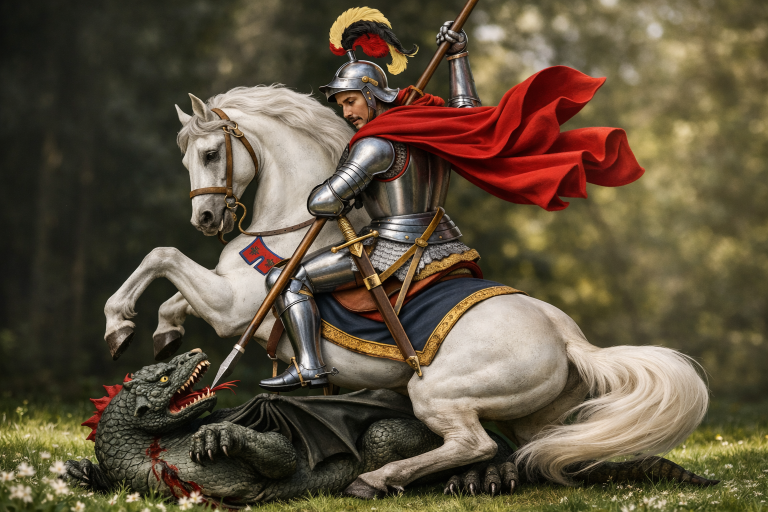
maiden about to be killed to appease a monster—he could not stand by. Mounting his white
horse, sword in hand and faith in his heart, he charged toward the dragon.
In the ensuing battle, St. George, through the power of Christ and making the sign of the
Cross, defeated and killed the dragon. The princess was saved, the city was freed from
terror, and the grateful citizens witnessed an incredible miracle. The impact was immediate
and profound: thousands of people, inspired by George's courage and faith, were baptized
into Christianity following this miraculous deliverance.
When the king offered George payment in gold and treasures for saving his daughter and the city,
George refused all material reward. Instead, he made two requests: that the king maintain and
support the churches, and that he help the poor. This response revealed George's true
character—he sought neither glory nor wealth, but only the advancement of God's kingdom and the
welfare of those in need.
The story of St. George and the dragon has become one of the most popular and enduring tales in
Christian tradition. Its popularity stems from its profound spiritual significance: St. George
defeating the dragon symbolizes the Christian warrior defeating the devil through the power of
the Cross and righteousness in Christ. The dragon represents Satan, sin, and evil; George
represents the faithful Christian armed with faith; and the victory represents Christ's triumph
over death and hell.
Spiritual Meaning of the Dragon
"The dragon is not merely a beast but a symbol of the ancient serpent, Satan himself. St.
George's victory over the dragon represents every Christian's battle against evil, fought not
with earthly weapons but with faith, prayer, and the sign of the Cross."
🌍Universal Veneration
St. George's veneration has spread to virtually every Christian tradition and across the globe.
He is honored not only in the Syriac Orthodox Church but also among Roman Catholics, Eastern
Orthodox, Oriental Orthodox, and even some Protestant communities. His image appears on icons,
in stained glass windows, in sculptures, and in paintings throughout the Christian world.
Numerous nations have adopted St. George as their patron saint, including England, Georgia
(which is named after him), Ethiopia, and many others. The image of St. George on horseback,
slaying the dragon, appears on countless flags, coats of arms, and national emblems. Military
orders, knightly orders, and organizations dedicated to courage and service have taken his name.
Historians recognize that St. George is indeed a true historical figure—a genuine hero who dared
to challenge the might of the Roman Empire for the sake of Christ. He held his spirit pure and
untouched until death, maintaining his integrity when torture, bribery, and threats all failed
to move him. Through his witness, he converted many to the true Christian doctrine, and his
martyrdom inspired countless others to stand firm in their own trials.
🙏Feast Day and Commemoration
On April 23 of each year, the day of St. George's martyrdom, Christians around the world
celebrate his memory as a great feast. In many churches, this is one of the most important feast
days of the liturgical calendar. Special liturgies are celebrated, hymns are sung in his honor,
and his icon is venerated with particular solemnity.
In the Syriac Orthodox Church, St. George holds a place of special honor. Churches dedicated to
Mor Geevarghese Sahado (St. George the Martyr) can be found throughout the Syriac Christian
world. His feast day is marked with great celebration, and many faithful ask for his
intercession in times of danger, persecution, or spiritual warfare.
The prayers to St. George often invoke his courage in the face of persecution, his steadfastness
under torture, his victory over evil (symbolized by the dragon), and his ultimate triumph
through martyrdom. Christians ask him to intercede for them in their own battles against
temptation, evil, and persecution.
St. George's life teaches us that true courage is not the absence of fear but faithfulness to
Christ despite fear. His witness reminds us that no earthly power can ultimately harm those who
belong to God, and that even death becomes a victory when we die faithful to Christ.
Prayer to St. George
"O Holy Great-Martyr George, brave soldier of Christ and victor over evil, intercede for us
before the throne of God. Grant us your courage in facing the trials of life, your steadfastness
in maintaining our faith, and your triumph over the spiritual enemies that seek to destroy us.
Through your prayers, may we too become faithful witnesses to Christ, even unto death. Amen."