📖Early Life and Ministry in the Middle East
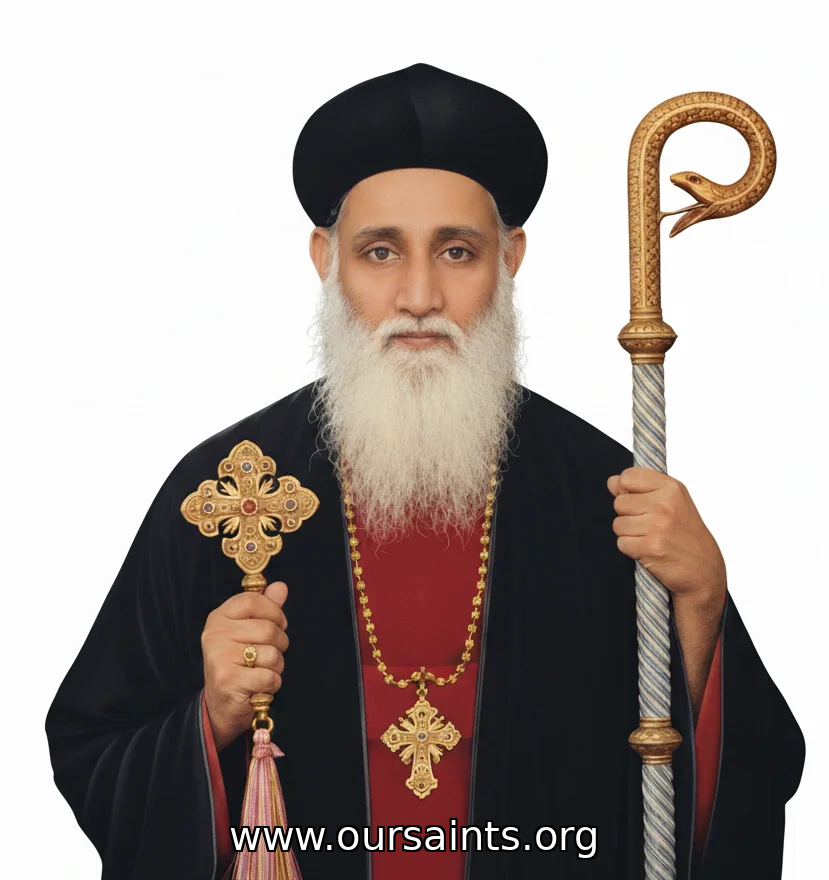
Saint Mor Gregorios Abdul Jaleel, whom the Malankara Church venerates with profound gratitude as
"Yakub Burdana" (Jacob of the Cloak), was born in the ancient and historic city of Mosul in Iraq.
This blessed city, situated on the banks of the Tigris River across from the ruins of ancient
Nineveh, has been a center of Syriac Christianity since apostolic times, producing countless saints,
scholars, and martyrs who have enriched the treasury of our Holy Church.
Born into a family deeply rooted in the Syriac Orthodox tradition, the future saint grew up immersed
in the rich liturgical and spiritual heritage that has characterized our Church from its foundation
by the Prince of Apostles, St. Peter, in Antioch. From his earliest years, he demonstrated
exceptional piety, profound love for the Church's liturgical life, and remarkable intellectual gifts
that marked him for ecclesiastical leadership.
His education in the theological schools of Mesopotamia provided him with mastery of the Syriac
language, deep knowledge of the Holy Scriptures, and thorough grounding in the patristic theology
that forms the foundation of our Orthodox faith. He studied the works of the great Syriac
Fathers—St. Ephrem the Syrian, St. Jacob of Serugh, St. Isaac the Syrian—and absorbed their wisdom,
making it the foundation of his own spiritual life and future pastoral ministry.
The young scholar's gifts did not go unnoticed by the Church hierarchy. His combination of
theological acumen, personal holiness, and administrative capability made him an ideal candidate for
episcopal ministry. In the year 1654 AD, during the patriarchate of His Holiness Mor Ignatius
Shemoun (Ignatius XXII), he was consecrated as Metropolitan with the name Mor Timotheos and was
appointed to oversee the diocese of Amid (also known as Ameed or Diyarbakir) in what is now
southeastern Turkey.
As Metropolitan of Amid, Mor Timotheos distinguished himself as a faithful shepherd who cared deeply
for his flock. He celebrated the Divine Liturgy with profound reverence, preached with power and
clarity, defended the Orthodox faith against various heresies and external pressures, and
administered his diocese with wisdom and justice. His reputation for holiness, learning, and
pastoral effectiveness spread throughout the Syriac Orthodox world.
✝️Elevation as Archbishop of Jerusalem
After ten years of faithful service as Metropolitan of Amid, in the year 1664 AD, Mor Timotheos
received an elevation to one of the most prestigious positions in the Syriac Orthodox Church. His
Holiness Patriarch Mor Ignatius Abdul Mesiha I (Ignatius XXIII, 1662-1686) appointed him as the
Archbishop of the Holy City of Jerusalem, the place where our Lord Jesus Christ accomplished our
salvation through His holy Passion, Death, and Resurrection.
The position of Archbishop of Jerusalem held unique significance within the hierarchy of the Syriac
Orthodox Church. Due to the supreme historical and theological importance of Jerusalem—the city
where the Church was born at Pentecost, where the first Christian community was established under
the leadership of St. James the Brother of the Lord, and where the holy sites of our redemption are
located—the Metropolitan of Jerusalem was accorded special honor and was often referred to as the
"Fifth Patriarch" of the Church.
This honorary title of "Fifth Patriarch" indicated that the Archbishop of Jerusalem, while remaining
under the spiritual authority of the Patriarch of Antioch, held a position of particular dignity
within the Church, ranking after the four ancient Patriarchates of Antioch, Alexandria,
Constantinople, and Rome. The title "Mor Gregorios" was the traditional honorific bestowed upon the
holder of this ancient and venerable see.
Thus, from the moment of his elevation to the See of Jerusalem, Metropolitan Mor Timotheos became
known as Mor Gregorios, and with the addition of his family name, he is remembered in history as Mor
Gregorios Abdul Jaleel. The name "Abdul Jaleel" itself carries theological significance, meaning
"Servant of the Glorious One," reflecting his understanding of episcopal ministry as service to
Christ the King and to His people.
In his capacity as Archbishop of Jerusalem, Mor Gregorios had oversight of the holy places
associated with our Lord's earthly ministry, the responsibility of caring for the Syriac Orthodox
community in the Holy Land, and the duty of welcoming pilgrims from throughout the Christian world
who came to venerate the sites where our salvation was accomplished. It was a position of immense
spiritual responsibility, and one that he discharged with distinction.
⛪The Crisis in Malankara and the Call to Mission
While Mor Gregorios was faithfully serving as Archbishop of Jerusalem, events of momentous
significance were unfolding thousands of miles away in the land of Malankara (Kerala, India). The
ancient Syrian Christian community of India, which traced its origins to the apostolic preaching of
St. Thomas in the first century, found itself in a desperate crisis that threatened its very
existence as an Orthodox Church.
Since the arrival of the Portuguese in India at the end of the fifteenth century, the Syrian
Christians of Malankara had faced relentless pressure to abandon their ancient Syriac Orthodox
traditions and submit to the authority of Rome. This pressure reached its culmination in 1599 AD
with the infamous Synod of Diamper (Udayamperoor), convened by the Roman Catholic Archbishop Alexis
de Menezes. At this synod, with the backing of Portuguese military power, the Roman Catholics
forcibly attempted to Latinize the Malankara Church, burning ancient Syriac manuscripts, destroying
historical records, and imposing Latin practices alien to the Syriac tradition.
For decades, the Syrian Christians of Malankara groaned under this oppression. They sent numerous
appeals to the Patriarchate of Antioch, begging for help to restore their ancient faith and
traditions. In response to these desperate pleas, His Holiness Patriarch Mor Ignatius Ahatulla
undertook the dangerous journey to India to minister to his afflicted flock. However, this holy
mission ended in tragedy when the Portuguese, determined to prevent any contact between Malankara
and Antioch, captured the Patriarch.
The martyrdom of Patriarch Mor Ignatius Ahatulla in 1653 AD—whether he was drowned in the Arabian
Sea with a millstone tied to his neck or burned alive in Goa, accounts vary—became the spark that
ignited the resistance of the Malankara faithful. Word of the Patriarch's murder spread rapidly, and
the Syrian Christians, led by their administrator Thomas Arkadiyokon and the courageous priest
Anjilimoottil Itty Thommen Kathanar, assembled at the ancient stone cross in Mattancherry, Cochin.
There, on January 3, 1653 (the third day of Makaram in the Malayalam calendar), approximately 25,000
faithful gathered around the ancient cross. So many people held onto a rope tied around the cross
that the cross leaned to one side from their weight—hence the name "Koonan Kurishu" (the Leaning
Cross). With their hands on this sacred rope, they took a solemn oath before God that they would
never submit to Roman Catholic authority, that they would remain forever loyal to the Holy Apostolic
See of Antioch, and that they would preserve their ancient Syriac Orthodox faith and traditions.
This historic event, known as the "Koonan Kurishu Satyam" (the Oath of the Leaning Cross), marked
the beginning of the Malankara Church's organized resistance to Portuguese oppression.
Following the Koonan Kurishu Oath, Thomas Arkadiyokon, with special permission reportedly given by
the martyred Patriarch before his death, was elevated to the position of Episcopa (Bishop) by twelve
priests of the Syrian community, taking the name Mar Thoma. However, the Malankara Church was
acutely aware that this elevation, performed in emergency circumstances without proper canonical
consecration by a validly consecrated bishop, was irregular. They desperately needed a properly
consecrated Metropolitan from the Mother Church to regularize the episcopal succession and to guide
them back to authentic Syriac Orthodox practice.
The faithful sent repeated appeals to the Patriarch of Antioch, explaining their desperate situation
and begging for a Metropolitan to be sent to restore proper episcopal governance and to guide them
in recovering their ancient traditions. One such appeal, written in Syriac and sent through a
merchant named Stephanous from Amid who had come to Malankara, eventually reached the Patriarchal
Monastery at Tur'Abdin in Turkey, where Patriarch Mor Ignatius Abdul Mesiha I was residing.
🌊The Perilous Journey to India
Upon receiving the desperate appeals from Malankara and learning of the crisis facing the Syrian
Christians of India, Patriarch Mor Ignatius Abdul Mesiha I summoned the Holy Synod of the Church in
1665 AD at the Patriarchal Monastery of Tur'Abdin. The assembled bishops deliberated on how best to
respond to this urgent need. The mission would be extraordinarily dangerous—whoever went would have
to evade Portuguese authorities both at sea and upon arrival in India, face possible imprisonment or
martyrdom, and work in a hostile environment to rebuild a Church that had been under severe
oppression for over half a century.
When the nature of the mission was explained to the assembled bishops, one Metropolitan immediately
volunteered to undertake this perilous journey. Mor Gregorios Abdul Jaleel, the Archbishop of
Jerusalem, stepped forward and offered himself for this dangerous mission. Despite having been
elevated to the prestigious See of Jerusalem only one year earlier, despite the comforts and honors
of his position, and despite the near certainty that he would face tremendous hardships and dangers,
the holy Archbishop volunteered without hesitation.
His motivation was purely pastoral. He had heard of the sufferings of his fellow Orthodox Christians
in distant India, of their faithfulness under persecution, of their determination to preserve the
faith received from the Apostles, and of their desperate need for a shepherd to guide them. How
could he, as a successor of the Apostles, remain in comfort while fellow members of the Body of
Christ were suffering? How could he refuse to go when the Patriarch called for volunteers? His heart
burned with apostolic zeal to serve these suffering faithful.
The Patriarch, recognizing both the necessity of sending someone of Mor Gregorios's caliber and the
Archbishop's sincere desire to serve, blessed this mission and issued to him a Sushthathikon—an
official letter of appointment granting him full patriarchal authority to act as the delegate of the
Apostolic See of Antioch in Malankara. This document, which authorized him to ordain bishops,
establish proper church governance, and reform practices as necessary, would later prove crucial in
establishing his authority in India.
The journey from the Middle East to India in the seventeenth century was perilous under the best of
circumstances. Ships could be lost to storms, pirates prowled the sea routes, diseases could spread
rapidly in the cramped conditions aboard vessels, and the voyage typically took many weeks or
months. But for Mor Gregorios, these normal dangers were compounded by the need to avoid Portuguese
authorities who had standing orders to prevent any Syrian prelates from reaching Malankara.
The holy Archbishop undertook this journey with the spirit of the ancient missionaries and martyrs.
He carried little with him beyond the essential vestments needed for celebrating the Divine Liturgy,
some precious liturgical vessels and books, and most importantly, holy relics including a portion of
the True Cross of our Lord. His greatest treasure, however, was the Sushthathikon from the
Patriarch, which he guarded carefully, knowing that it was the documentary proof of his authority to
act on behalf of the Apostolic See.
After a long and difficult voyage across the Arabian Sea, evading Portuguese patrols and facing
numerous dangers, Mor Gregorios finally reached the coast of Kerala in 1665 AD. He landed near
Ponnani, an important port town in northern Kerala. However, even after reaching his destination,
his trials were not over. The Portuguese maintained a strong presence in Kerala, and Catholic
authorities were on alert for any Orthodox prelates who might try to reach the Syrian Christian
community.
For this reason, Mor Gregorios initially remained in disguise, staying in the Ponnani area and
nearby regions for several months, not revealing his true identity or his mission. He lived simply,
perhaps as a merchant or traveler, while carefully observing the situation and seeking a safe way to
contact the Syrian Christian leadership. His patience and prudence during this period demonstrated
his wisdom—he knew that a premature revelation of his identity could lead to his arrest or martyrdom
before he could accomplish his mission.
⛪Recognition and the Restoration of Episcopal
Succession
Divine Providence arranged for Mor Gregorios's identity to be revealed at the proper time. Some
parishioners from St. Thomas Jacobite Syrian Church in North Paravur, a major center of the Syrian
Christian community, happened to visit the area where the Archbishop was staying in disguise.
Through circumstances orchestrated by God, they encountered this stranger and entered into
conversation with him. Perhaps they noticed something unusual about him—his bearing, his knowledge
of theology, his familiarity with Syriac prayers, or some other sign that indicated he was not an
ordinary traveler.
When Mor Gregorios discerned that these were genuine Syrian Orthodox Christians who could be
trusted, he revealed his true identity to them. He showed them the Sushthathikon bearing the seal of
His Holiness the Patriarch, proving that he was indeed the Archbishop of Jerusalem sent by the
Apostolic See to minister to the Malankara Church. The joy and amazement of these faithful can
hardly be imagined. For twelve years since the Koonan Kurishu Oath, they had been praying and
waiting for help from Antioch. Now, at last, their prayers were answered!
The parishioners from North Paravur immediately took Mor Gregorios to their church and sent urgent
word to Thomas Arkadiyokon (Mar Thoma) and other leaders of the Malankara Church. When Thomas
Arkadiyokon learned that a Metropolitan from Jerusalem, sent by the Patriarch himself, had arrived,
he rushed to North Paravur along with other prominent priests and laypeople. The meeting between Mar
Thoma and Mor Gregorios must have been deeply moving—here was the shepherd from the Mother Church,
come at last to guide and strengthen the flock in Malankara.
The very first priority for Mor Gregorios was to establish proper canonical order by conferring
valid episcopal consecration on Thomas Arkadiyokon. While Mar Thoma had been functioning as the
leader of the Malankara Church since the Koonan Kurishu Oath in 1653, and while he had received some
form of elevation by twelve priests acting in emergency circumstances, this was not a proper
episcopal consecration according to the canons of the Church. True episcopal authority can only be
conferred through the laying on of hands by bishops who themselves stand in the apostolic
succession.
Therefore, in 1665 AD, shortly after his arrival in Malankara, Mor Gregorios Abdul Jaleel
consecrated Thomas Arkadiyokon as Metropolitan with the name Mar Thoma I, making him the first
canonically ordained native Metropolitan of the Malankara Jacobite Syrian Church. This act was of
immeasurable historical and ecclesiological significance. Through this consecration, the apostolic
succession—that unbroken chain of episcopal ordinations reaching back through the centuries to the
Apostles themselves—was firmly established in Malankara.
With this single act, Mor Gregorios reestablished the relationship between the Malankara Church and
the Apostolic See of Antioch that had been disrupted by Portuguese interference. He restored proper
episcopal governance to a Church that had been struggling without it for over a decade. He validated
the faithfulness of those who had taken the Koonan Kurishu Oath and had refused to submit to Roman
Catholic authority. He ensured that the Malankara Church would have valid sacraments, proper church
order, and canonical legitimacy going forward.
🚶Missionary Journey Throughout Kerala
Following the consecration of Mar Thoma I, the two hierarchs—Mor Gregorios Abdul Jaleel and Mar
Thoma I—embarked together on an extensive missionary journey throughout Kerala. They traveled the
length and breadth of Malankara, visiting churches in villages and towns throughout the region,
bringing the message of restoration and renewal to the Syrian Christian faithful who had endured so
much suffering under Portuguese oppression.
These visitations were not ceremonial or superficial. Mor Gregorios and Mar Thoma came to each
parish as true shepherds, spending time with the people, celebrating the Divine Liturgy according to
the authentic Syriac Orthodox rite, preaching the orthodox faith, hearing confessions, resolving
disputes, providing spiritual counsel, and instructing both clergy and laity in the proper practices
and traditions of the Church. The holy Archbishop was particularly concerned with education—he
wanted to ensure that the faithful truly understood their faith and their heritage.
One of Mor Gregorios's primary tasks was to undo the damage inflicted by the Synod of Diamper. For
over sixty years, the Portuguese and their Roman Catholic successors, the Carmelite missionaries,
had been systematically suppressing Syriac Orthodox practices and imposing Latin customs. Images and
statues had been introduced into churches, practices foreign to the Syrian tradition had been
mandated, ancient Syriac liturgical books had been burned or confiscated, and the faithful had been
taught doctrines contrary to Orthodox theology.
With courage and determination, Mor Gregorios set about removing these unauthorized innovations. He
ordered the removal of images and statues that had been introduced by the Catholics, recognizing
that while the Orthodox Church venerates holy icons, the particular forms of religious art being
promoted by the Portuguese were not in keeping with Eastern Christian tradition. He restored the
ancient Syriac liturgy in its purity, teaching the priests the proper order and prayers of the Holy
Qurbono as it had been celebrated for centuries in the Syriac Orthodox Church.
He also addressed the requirement that had been imposed by the Roman Catholics mandating clerical
celibacy for all priests. The Syriac Orthodox Church, faithful to the ancient discipline of the
Eastern Churches, has always permitted the ordination of married men to the priesthood (though
requiring celibacy for bishops). Parish priests are generally married, as this is seen as beneficial
for their pastoral ministry and as protection against temptation. Mor Gregorios restored this
traditional practice, recognizing that the forced celibacy imposed by the Portuguese had caused many
problems and was contrary to the tradition of the Church.
Throughout these reforms, Mor Gregorios demonstrated both firmness and pastoral sensitivity. He was
uncompromising when it came to matters of Orthodox faith and essential ecclesial practices. However,
he also showed wisdom in understanding that the Malankara faithful had been under Portuguese
influence for many decades, and that some things would take time to change. He focused on restoring
the most important elements first—the liturgy, the episcopate, the sacraments—while patiently
educating the faithful about other aspects of Orthodox tradition.
The holy Archbishop also had to contend with active opposition from Roman Catholic authorities and
those Syrian Christians who had been persuaded to join the Catholic fold. The Carmelite
missionaries, who had taken over from the Jesuits and were attempting a more subtle approach to
winning the Syrian Christians to Rome, were alarmed by Mor Gregorios's arrival and success. They
used their influence with local rulers, spread rumors and accusations against the Orthodox bishops,
and tried various means to undermine the restoration of Orthodox Christianity in Malankara.
Yet despite all these obstacles, despite the dangers and hardships, despite the active opposition of
powerful forces, Mor Gregorios and Mar Thoma I persevered in their mission. The authenticity of
their faith, the purity of their intentions, their obvious love for the faithful, and above all the
grace of God working through them, won over vast numbers of Syrian Christians. Those who had been
confused by competing claims now saw clearly which path was authentic. Those who had been
intimidated by Portuguese power now found courage to stand for the Orthodox faith. The tide was
turning in favor of the ancient tradition.
👑The Famous Encyclical of 1668
One of the most important historical documents to survive from Mor Gregorios's ministry in Malankara
is his encyclical letter dated the 5th of Kumbam (February-March) in the year 1668 AD. This letter,
addressed to the priests of several prominent churches in Malankara including St. Thomas Church in
North Paravur, the ancient Mar Thoman Church in Mulanthuruthy, and the historic church at Kandanad,
provides invaluable insight into both the state of the Malankara Church at that time and the nature
of Mor Gregorios's reforming work.
The encyclical is written in Syriac, the sacred liturgical language of our Church, demonstrating
both Mor Gregorios's mastery of this ancient tongue and his determination to restore its proper use
in Malankara. In this letter, the holy Archbishop addresses various matters of church governance,
liturgical practice, and pastoral care. He gives instructions for the proper celebration of the Holy
Qurbono, clarifies questions about canonical discipline, and provides guidance on how to deal with
various pastoral situations that had arisen during the decades of disruption.
What makes this encyclical particularly valuable historically is that it provides clear evidence of
the relationship between the Malankara Church and the Apostolic See of Antioch in the period before
Portuguese interference. Mor Gregorios refers to ancient practices and traditions that had been
maintained in Malankara, indicating that the Church there had indeed been following authentic Syriac
Orthodox customs before the Synod of Diamper. This document thus serves to refute later claims by
some historians that the Malankara Church had been Nestorian or had lacked connection to Antioch
before the seventeenth century.
The tone of the encyclical reflects Mor Gregorios's pastoral heart. While he addresses serious
matters and gives clear directives, he does so with evident love for the faithful and respect for
the local leadership. He commends the priests and faithful for their perseverance under trial and
encourages them to continue growing in their understanding and practice of the Orthodox faith. He
speaks with the authority of one who represents the Apostolic See, yet also with the humility of one
who recognizes himself as a servant of Christ and His Church.
This encyclical was later published in the book "Indian Church of St. Thomas," preserving its
contents for future generations. The original Syriac manuscript was kept at the Kottayam Valiyapally
(Big Church) and remains one of the most treasured historical documents of the Malankara Church. It
stands as a witness to the work of restoration undertaken by St. Mor Gregorios Abdul Jaleel and as
proof of the ancient Orthodox character of the Malankara Church.
✝️Ordination of Mar Thoma II and the Passing of
Mar Thoma I
In the year 1670 AD, Mor Gregorios Abdul Jaleel and Mar Thoma I together consecrated a second native
Metropolitan for the Malankara Church, who took the name Mar Thoma II. This ordination was
significant for several reasons. First, it ensured continuity of episcopal leadership for the
Malankara Church—should anything happen to Mar Thoma I, there would be another canonically
consecrated bishop to continue the work of shepherding the flock. Second, it demonstrated that the
Malankara Church now had a properly functioning episcopal structure with multiple bishops, as is
proper for the governance of a large and growing church. Third, it showed Mor Gregorios's wisdom in
preparing for the future even while actively ministering in the present.
Tragically, the wisdom of having consecrated Mar Thoma II became evident very quickly. Just two days
after the consecration of Mar Thoma II, on April 25, 1670 AD (the 12th of Medam in the Malayalam
calendar), Mar Thoma I departed this life and entered into his eternal rest. The first canonically
ordained native Metropolitan of Malankara had completed his earthly course. From 1637, when he had
become Arkadiyokon (Archdeacon) at the age of thirty, until his death in 1670, Thomas
Arkadiyokon—later Mar Thoma I—had provided courageous and faithful leadership to the Malankara
Church through its darkest and most difficult period.
Together with his close friend and collaborator Anjilimoottil Itty Thommen Kathanar, who had died in
1659, Mar Thoma I had organized the resistance to Portuguese oppression, led the historic Koonan
Kurishu Oath, maintained the Church during the years without proper episcopal oversight, and
finally, after receiving canonical consecration from Mor Gregorios in 1665, worked alongside the
Archbishop from Jerusalem to restore Orthodox Christianity in Malankara. His contribution to the
survival and flourishing of the Syriac Orthodox Church in India cannot be overstated.
Mar Thoma I was buried with honor in the Jacobite Syrian Church at Angamali, his mortal remains
being interred on the southern side of the Hykala (sanctuary) of that church. A stone inscription
marks his tomb, commemorating his life and ministry. The Malankara faithful mourned the loss of this
great shepherd, but they also gave thanks to God for having given them such a leader in their time
of need, and for having brought Mor Gregorios to consecrate him and work alongside him in the
restoration of the Church.
After the death of Mar Thoma I, Mor Gregorios continued his work in Malankara alongside the newly
consecrated Mar Thoma II. The presence of two hierarchs—one from the Middle East with deep knowledge
of Syriac tradition and one native to Malankara with intimate understanding of the local
context—proved highly beneficial for the Church. Together they continued the work of visiting
parishes, instructing clergy, educating the faithful, and strengthening the Orthodox character of
the Malankara Church.
💖Life in North Paravur and the Name "Yakub
Burdana"
Of all the many churches in Malankara that Mor Gregorios visited during his sixteen years in India,
St. Thomas Jacobite Syrian Church in North Paravur held a special place in his heart. It was to this
church that he had first been brought after revealing his identity, it was here that he established
his primary residence during his time in Malankara, and it was here that he would eventually be laid
to rest. The faithful of North Paravur reciprocated his love, treating him not merely as a visiting
hierarch but as their own beloved spiritual father.
The holy Archbishop resided in North Paravur for approximately seven years out of his sixteen-year
ministry in India, though he continued to travel extensively throughout that time. When he was in
residence at North Paravur, he lived with remarkable simplicity, eschewing any pretense or display
of episcopal grandeur. He celebrated the Divine Liturgy regularly at the church, made himself
available for counsel to all who sought it, taught the faith to children and adults alike, and lived
a life of prayer, fasting, and service that bore witness to the Gospel.
It was this extraordinary simplicity and his practice of wearing a simple cloak or mantle (burdana
in Syriac/Arabic) rather than elaborate vestments in daily life that earned him the affectionate
nickname "Yakub Burdana"—Jacob (Ya'qub being the Syriac/Arabic form of Jacob) of the Cloak. Just as
the great St. James (Ya'qub in Syriac) of Jerusalem was known in early Christian tradition for his
simplicity and asceticism, so too was Mor Gregorios known for his humble lifestyle despite his high
ecclesiastical rank.
The name "Yakub Burdana" came to carry deeper significance as well. It became associated with his
role as the one who "re-clothed" the Malankara Church in its authentic Orthodox garments after
decades of being forced into foreign Roman Catholic vestments. Just as he wore a simple cloak, so
too he helped the Malankara Church to wear again the simple, pure, ancient faith of the Apostles
rather than the elaborate innovations of Rome. In this sense, "Yakub Burdana" means not just "Jacob
of the Cloak" but "Jacob who restored the authentic covering of Orthodox faith."
The faithful of North Paravur and throughout Malankara grew to love this holy man from a distant
land who had given up the honors and comforts of the prestigious See of Jerusalem to come and serve
them in their time of need. His obvious holiness, his profound learning combined with great
humility, his pastoral love for souls, and his willingness to endure hardship for their sake won
their hearts completely. They recognized in him a true successor of the Apostles, a living example
of what a Christian bishop should be.
☦️Blessed Repose and Entrance into Glory
After sixteen years of tireless ministry in Malankara, after successfully establishing canonical
episcopal succession, restoring Orthodox faith and practice, visiting countless parishes, ordaining
numerous priests and deacons, instructing the faithful in their ancient heritage, and ensuring that
the Malankara Church was firmly established on the foundation of apostolic tradition, St. Mor
Gregorios Abdul Jaleel prepared to enter his eternal rest.
According to the tradition preserved by the faithful, the holy Archbishop possessed prophetic
knowledge of the time of his departure. In his final days, he made all necessary preparations, both
spiritual and practical, for his passing. He celebrated the Divine Liturgy one final time, gave his
blessing to the clergy and faithful, instructed them to remain faithful to the Orthodox tradition he
had worked so hard to restore, and commended them all to the care of the Good Shepherd, Jesus
Christ.
When the hour of his departure drew near, as he had instructed, the holy Archbishop was dressed in
his pontifical vestments—the full vestments of a bishop celebrating the Divine Liturgy. With his
episcopal staff in hand and wearing the insignia of his office, he was seated in a chair and brought
into the church at North Paravur. There, surrounded by weeping clergy and faithful who had gathered
to receive his final blessing, on Friday, April 27, 1681 AD (the 14th of Medam, 857 in the Malayalam
Era), St. Mor Gregorios Abdul Jaleel peacefully surrendered his holy soul to God.
The faithful who were present testified to extraordinary signs that accompanied his passing. As his
soul departed, witnesses reported seeing a bright, glorious light both inside and outside the
church, illuminating the entire building with a radiance not of this world. Some reported hearing
celestial music, as if angels were welcoming their brother into paradise. Others sensed a profound
peace and joy descending upon the gathering, even in the midst of their grief at losing their
beloved father and shepherd.
These miraculous signs at the moment of his death confirmed what the faithful had long known—that
they had been blessed to live in the presence of a true saint of God. Though they mourned the loss
of his physical presence, they also rejoiced, knowing that he had faithfully completed the mission
entrusted to him, had laid down his life in service to Christ and His Church, and had now entered
into the joy of his Master to receive the crown of righteousness prepared for him.
In accordance with his wishes and in recognition of his special relationship with the North Paravur
community, St. Mor Gregorios was laid to rest in the Hykala (sanctuary) of St. Thomas Church in
North Paravur. This in itself was a great honor—burial within the sanctuary of a church is typically
reserved only for bishops who have served that particular community with special distinction. The
tomb was prepared with great reverence, and the holy remains of the Archbishop were interred there,
where they remain to this day.
✨Miracles and Wonders
Almost immediately after his burial, the tomb of St. Mor Gregorios Abdul Jaleel began to be
recognized as a holy place where God's grace was manifestly present. Pilgrims came to pray at his
tomb, and numerous miracles were reported. The sick were healed, the demon-possessed were delivered,
barren women conceived and bore children, those facing desperate circumstances received unexpected
help, and countless spiritual and temporal blessings were granted through the saint's intercession.
The renowned Church historian Whitehouse, writing in the eighteenth century, documented many
accounts of miraculous events associated with St. Mor Gregorios both during his lifetime and after
his repose. These accounts include healings of chronic diseases that had resisted all medical
treatment, protection from dangers, answers to prayers for children, deliverance from evil spirits,
and provision for material needs. What is particularly striking is that these miracles were not
limited to Orthodox Christians but were experienced by people of all faiths who came to the saint's
tomb with sincere hearts.
One category of miracles particularly associated with St. Mor Gregorios concerns women suffering
from infertility. Countless couples who had been unable to conceive children came to his tomb to
pray for his intercession, and many testified to subsequently being blessed with offspring. This
special association with prayers for children has made the saint's feast day and tomb a focal point
for such petitions, with many families bringing their children to the tomb in thanksgiving for the
saint's help in their birth.
Cases of demonic possession and oppression have also frequently been resolved through prayers at St.
Mor Gregorios's tomb. Those afflicted with torment from evil spirits have been brought to the
church, prayers have been offered at the saint's tomb, and many have experienced complete
deliverance. This power over the demonic realm testifies to the saint's holiness and to God's favor
upon him, for as our Lord taught, such authority is given only to those who are close to God.
The healing of physical ailments—diseases of all kinds, chronic conditions, sudden illnesses—has
been another prominent feature of the miracles associated with St. Mor Gregorios. People suffering
from ailments that modern medicine could not cure, or living in times and places where medical care
was unavailable, have found healing through the saint's prayers. These healings have been documented
over the centuries and continue to be reported in our own time.
📿Sacred Relics and Treasures
When St. Mor Gregorios came to Malankara from Jerusalem, being descended from a wealthy family and
holding the prestigious office of Archbishop of Jerusalem, he brought with him various valuable
items and sacred objects. Rather than keeping these for his own use or comfort, he donated them to
the Church in Malankara, particularly to St. Thomas Church in North Paravur where he made his
primary residence. These objects remain treasured possessions of the Church to this day.
Among the most precious items is a golden cross that belonged to the saint. This cross, beautifully
crafted and of significant material value, is brought out and displayed for public veneration during
the saint's feast day celebrations. More important than its monetary worth is its spiritual
significance as an object that belonged to and was used by the holy Archbishop during his earthly
life.
The saint also brought with him a chalice (kasa) and paten (pilasa) made of silver, which are still
used in the celebration of the Holy Qurbono at St. Thomas Church during the saint's annual feast on
April 27. The fact that these same vessels that St. Mor Gregorios used to celebrate the Divine
Liturgy over three centuries ago are still in use today creates a profound connection with the past
and reminds the faithful of the unbroken continuity of our liturgical and sacramental tradition.
Perhaps the most extraordinary treasure that St. Mor Gregorios brought to Malankara is the
Arulikka—a golden reliquary cross that contains twelve separate compartments. Eleven of these
compartments contain relics of various saints, connecting the faithful of Malankara to the communion
of saints who have served God throughout the ages. But the central compartment of this holy Arulikka
contains the most precious relic of all: a portion of the True Cross upon which our Lord Jesus
Christ was crucified for our salvation.
This relic of the True Cross represents an incomparable spiritual treasure. To have in Malankara a
physical piece of the wood upon which the Son of God suffered and died for our redemption is an
extraordinary blessing. That St. Mor Gregorios brought this relic from Jerusalem—the city where the
True Cross was preserved after its discovery by St. Helena—and left it as a permanent gift to the
Malankara Church demonstrates both his love for these faithful and his desire to provide them with a
tangible connection to the central mystery of our salvation.
The saint also had a considerable amount of gold coins, which he used to purchase land at a place
called Thorakkal for the benefit of the Church. This land remained in the possession of St. Thomas
Church for many centuries, providing income for church maintenance and charitable works. This
practical gift ensured that the Church would have resources to continue its mission long after the
saint's departure.
On the feast day of St. Mor Gregorios, these precious items—the golden cross, the Arulikka
containing the relic of the True Cross, and the vestments worn by the saint—are ceremonially brought
out from where they are carefully preserved and displayed for the veneration of pilgrims. Thousands
of faithful come specifically to venerate these holy objects, recognizing in them both historical
artifacts and sacramental channels of grace.
🎉Annual Feast and Pilgrimage
The Dukhrono (memorial feast) of St. Mor Gregorios Abdul Jaleel is celebrated annually on April 27,
the date of his blessed repose. This feast has become one of the most important celebrations in the
Malankara Syriac Orthodox Church calendar, drawing pilgrims from throughout Kerala and beyond. The
celebrations typically extend over three days, from April 25 through April 27, with the main
festivities occurring on the 27th itself.
The scale of the pilgrimage to St. Thomas Church in North Paravur during the saint's feast is truly
remarkable. Over 100,000 devotees—some estimates suggest even more—converge on this church during
the three-day celebration. People of all religious backgrounds participate in these festivities, a
testament to the universal recognition of St. Mor Gregorios as a holy man of God whose intercession
is powerful regardless of the petitioner's own religious affiliation.
Many pilgrims undertake walking pilgrimages to reach the saint's tomb, some traveling on foot for
many miles from their homes to North Paravur. This practice of walking pilgrimage, undertaken as an
act of devotion and penance, demonstrates the deep faith of the people and their confidence in the
saint's intercession. Pilgrims often walk through the night to reach the church by the feast day,
singing hymns and praying as they go.
The Government of Kerala officially recognizes the significance of this feast, designating the area
around the church as a festival area during these days. Special arrangements are made for traffic
control, security, sanitation, and other practical matters necessitated by the enormous crowds.
Temporary shelters and refreshment areas are set up to accommodate pilgrims, and the entire town of
North Paravur takes on a festive atmosphere.
A unique feature of the devotion to St. Mor Gregorios is the practice of taking "Ohari"—shares or
portions in special prayers offered throughout the year at the saint's tomb. Devotees can register
for specific dates on which prayers will be offered on their behalf at the tomb. Such is the
popularity of this practice that Ohari slots are typically booked years in advance, with some
sources indicating reservations extending several years into the future.
On the 27th of each month, not just in April, special intercessory prayers are held at the tomb of
St. Mor Gregorios. Many faithful attend these monthly commemorations, recognizing the 27th of every
month as a day particularly associated with the saint's presence and intercession. While the monthly
celebrations are more modest than the annual feast, they still attract significant numbers of
pilgrims.
The liturgical celebration of the feast includes the Divine Liturgy celebrated with special
solemnity, using the silver chalice and paten that belonged to the saint himself. The Fifth Tubden
(diptych) of the liturgy includes the commemoration of St. Mor Gregorios's name, placed immediately
after St. Gregorios of Parumala, another beloved saint of the Malankara Church. This liturgical
commemoration ensures that the memory of the saint is perpetuated in the Church's official prayer
and worship.
📜Official Recognition as Saint
While the faithful of Malankara had venerated Mor Gregorios Abdul Jaleel as a saint from the time of
his death, official ecclesiastical recognition of his sanctity came centuries later. The process of
formal canonization requires careful investigation of a person's life, verification of miracles
attributed to their intercession, and official declaration by the proper church authority. For
saints of local veneration, this process can take considerable time.
On April 9, 2000, a momentous event occurred in the history of the Malankara Syriac Orthodox Church.
His Holiness Mor Ignatius Zakka I Iwas, the Patriarch of Antioch and All the East and supreme head
of the Universal Syriac Orthodox Church, issued an historic Patriarchal Bull officially declaring
Mor Gregorios Abdul Jaleel and Mor Osthatheos Sleeba (of Kunnamkulam) to be Saints of the Church.
In this solemn proclamation, the Patriarch outlined the reasons for declaring Mor Gregorios a saint.
He highlighted how the Archbishop, "with love and patience and through peaceful means, taught the
people the true Apostolic Faith." He noted that Mor Gregorios "had to face many threats, even to his
own life," yet "placing his trust in God Almighty, he braved all odds." The Patriarch emphasized
that "by his prayers and piety he gained souls for our Lord Jesus Christ," and that the saint had
"fought the good fight, finished the race, and kept the faith."
The Patriarchal Bull specifically authorized the faithful to "recite the Quqalyon for the Saints
(Zadeeqo) at their holy tombs and whenever you remember them and beseech their intercession." The
Quqalyon are special hymns and prayers reserved for saints, and this authorization meant that St.
Mor Gregorios could now be officially invoked and honored in the Church's public worship in the same
manner as other recognized saints.
The Patriarch concluded his proclamation with an exhortation: "On this solemn occasion, we exhort
you to imitate their faith and rededicate yourselves to God. May their intercession be a blessing to
all." This reminder that the purpose of honoring saints is not merely to celebrate their
achievements but to inspire us to follow their example of faith and holiness is an important element
of Orthodox spirituality.
Following this official recognition in 2000, another significant development occurred in 2006. On
February 7 of that year, His Holiness Patriarch Mor Ignatius Zakka I Iwas issued another Apostolic
Bull, this one permitting the Malankara Church to include the name of St. Gregorios Abdul Jaleel in
the Fifth Tubden (diptych) of the Divine Liturgy. The Fifth Tubden is the portion of the liturgy
where the names of departed fathers and teachers of the Church are commemorated.
The significance of this inclusion cannot be overstated. The Fifth Tubden begins with the
commemoration of the holy Apostles and continues through the great fathers and doctors of the Church
from the patristic era. For a name to be added to this sacred list is a rare honor, typically
reserved for those who have made exceptional contributions to the Church's faith and life. St. Mor
Gregorios Abdul Jaleel became one of only five holy fathers whose names have been added to the Fifth
Tubden after the seventh century, and his name is recited immediately after that of St. Gregorios of
Parumala, another beloved saint of Malankara.
This liturgical commemoration means that every time the Divine Liturgy is celebrated in any Syriac
Orthodox church of the Malankara tradition, the name of St. Mor Gregorios Abdul Jaleel is mentioned.
His memory is thus perpetually kept alive in the Church's worship, and each celebration of the
Eucharist becomes an occasion to remember his life and to seek his intercession. This is the highest
honor the Church can bestow, for it makes the saint's memory an integral part of the Church's most
sacred action.
⛪Legacy and Historical Significance
The historical significance of St. Mor Gregorios Abdul Jaleel for the Malankara Syriac Orthodox
Church cannot be overstated. The distinguished Church historian Very Rev. Dr. Curien Corepiscopus
Kaniamparambil, in an article published in the journal "Vision" in 1995, articulated this
significance with remarkable clarity. He wrote: "The first, ever to be remembered with gratitude is
that—'Had not throne of Antioch sent its delegate Mor Gregorios of Jerusalem in 1665, there would
not have been a Jacobite (Orthodox) Syrian Church in Kerala.'"
This stark assessment reflects the historical reality. By 1665, the Syrian Christians of Malankara
had been under Portuguese pressure for over sixty years since the Synod of Diamper in 1599. Despite
the courage of the Koonan Kurishu Oath in 1653, the Malankara Church lacked proper canonical
episcopal succession, was facing continuous propaganda and pressure from Roman Catholic missionaries
who had the support of European colonial powers, and was in danger of gradually losing its
distinctive Orthodox identity through attrition.
The arrival of St. Mor Gregorios changed everything. His consecration of Mar Thoma I established
valid episcopal succession. His teaching restored authentic Syriac Orthodox faith and practice. His
presence provided living proof of the continuing care of the Mother Church at Antioch for her
daughter in Malankara. His courage in facing dangers and hardships inspired the faithful to stand
firm. His holiness attracted people to the Orthodox faith through the power of witness rather than
through coercion or political power.
As Dr. Kaniamparambil emphasized, "The faith, liturgy and practices—above all the priesthood of the
Jacobite (Orthodox) Church in Kerala are nothing but the contribution of the throne of St. Peter in
Antioch." This is not to diminish the ancient roots of Christianity in India or the faithfulness of
the Malankara Christians themselves, but rather to acknowledge that the specific form of Orthodox
Christianity practiced in Malankara, with its Syriac liturgy and its canonical connection to
Antioch, was preserved and strengthened through the mission of St. Mor Gregorios.
The saint's legacy extends beyond the immediate historical impact of his ministry. He established a
pattern of relationship between the Middle Eastern mother Church and the Indian daughter Church that
continues to this day. He demonstrated that unity in faith does not require uniformity in all
external matters, that authentic tradition can be preserved while adapting to local circumstances,
and that the universal Church is strengthened through the diversity of its local expressions.
St. Mor Gregorios also left an example of true apostolic ministry. He was a bishop who did not lord
his authority over others but served in humility. He was a theologian who taught not merely with
words but through the witness of a holy life. He was a reformer who combined firmness in essential
matters with pastoral sensitivity. He was a missionary who gave up comfort and security to serve in
a difficult field. He embodied the Gospel he preached.
For the clergy of the Malankara Church, St. Mor Gregorios stands as a model of faithful episcopal
ministry. His dedication to proper celebration of the liturgy, his concern for theological
education, his pastoral care for souls, and his courage in defending the faith provide a pattern for
all who are called to leadership in the Church. Many bishops and priests look to him as their patron
and example.
For the laity, the saint offers inspiration in living faithfully in difficult circumstances. Just as
the Malankara faithful of his time persevered under persecution and remained loyal to their Orthodox
heritage, so Christians in every age are called to stand firm in the faith regardless of external
pressures. St. Mor Gregorios's story reminds believers that God provides shepherds for His flock in
times of need and that faithfulness is ultimately rewarded.
🌟Continuing Presence and Intercession
The Orthodox understanding of sainthood teaches that those who have departed this life in faith and
holiness are not separated from us but remain part of the one Church, the Body of Christ. They have
passed from this earthly life into the fuller life of heaven, but they continue to care for their
brothers and sisters still struggling on earth. They pray for us before the throne of God, and God,
who loves us and desires our salvation, hears their prayers and grants blessings through their
intercession.
This theological reality is experienced as a living truth in the devotion to St. Mor Gregorios Abdul
Jaleel. The faithful who come to his tomb do not merely remember a historical figure from the
seventeenth century; they encounter a saint who is alive in Christ, who is aware of their needs, and
who has the power to help them through his prayers. The countless miracles and answered prayers
attributed to his intercession over more than three centuries testify to this ongoing spiritual
reality.
People bring to St. Mor Gregorios's tomb every kind of human need: illnesses that require healing,
family problems that need resolution, financial difficulties that require provision, spiritual
struggles that demand grace, children who need blessing, marriages that need strengthening, and
countless other concerns. They light candles before his tomb, they pray with faith and devotion,
they ask for his intercession with confidence, and they frequently experience help in ways that can
only be attributed to divine grace working through the saint's prayers.
What is particularly remarkable is that St. Mor Gregorios's help is not limited to members of the
Syriac Orthodox Church or even to Christians alone. Hindus, Muslims, and people of other faiths also
come to his tomb seeking help, and many testify to receiving answers to their prayers. This
universal appeal reflects both the saint's own loving heart, which embraced all people during his
earthly life, and God's mercy, which extends to all who seek Him with sincere hearts.
The tomb of St. Mor Gregorios has become a place where heaven and earth meet, where the veil between
the visible and invisible worlds seems particularly thin. Pilgrims often report experiencing a
profound sense of peace and spiritual presence when they pray at the tomb. Some see lights or
experience other unusual phenomena. Many feel that their prayers are especially powerful when
offered at this holy place. These experiences confirm the ancient Christian belief that the tombs of
saints are indeed places where God's grace is particularly manifest.
The saint's intercession is particularly sought for certain specific needs that have become
associated with him over the centuries. As mentioned earlier, couples struggling with infertility
frequently pray at his tomb, and many attribute the subsequent birth of children to his prayers.
Those afflicted with chronic illnesses, especially conditions that have resisted medical treatment,
come seeking healing. People facing desperate financial or social circumstances seek his help.
Students preparing for examinations ask for his blessing on their studies.
In recent times, as members of the Malankara community have migrated to various parts of the world,
devotion to St. Mor Gregorios has spread beyond India. Syriac Orthodox Christians now living in the
Middle East, Europe, North America, Australia, and elsewhere maintain their devotion to this saint
who saved their Church. Churches and prayer groups dedicated to St. Mor Gregorios have been
established in diaspora communities, extending his spiritual influence globally.
📿Spiritual Lessons from His Life
The life of St. Mor Gregorios Abdul Jaleel offers numerous spiritual lessons that remain relevant
for Christians in every age. First and foremost, his example teaches us about sacrificial service.
He gave up the prestigious position of Archbishop of Jerusalem, with all its honors and comforts, to
serve in a distant, difficult mission field. He could have remained in Jerusalem, enjoying the
respect due to his office and the relative ease of ministry in an established church. Instead, he
chose the harder path of missionary service.
This teaches us that true Christian discipleship often requires sacrifice. We are called to put the
needs of others before our own comfort, to go where we are needed rather than where we would prefer
to be, to serve in humble ways rather than seeking recognition. St. Mor Gregorios reminds us that
episcopal office, or any position of leadership in the Church, is fundamentally about service rather
than about honor or power.
His life also demonstrates the importance of faithfulness to apostolic tradition. St. Mor Gregorios
came to Malankara specifically to restore authentic Syriac Orthodox faith and practice. He did not
innovate or accommodate to contemporary trends; rather, he faithfully transmitted what he himself
had received from the tradition. Yet he did so not in a rigid or legalistic manner but with pastoral
sensitivity and wisdom. This balance between faithfulness to tradition and pastoral accommodation is
a model for the Church in every generation.
The saint's courage provides another important lesson. He undertook a dangerous journey, knowing
that he might face imprisonment or death. He continued his mission despite opposition from powerful
forces. He did not compromise the truth to avoid conflict or to gain favor. Yet his courage was not
reckless or confrontational; it was combined with prudence (as seen in his initial period of staying
in disguise) and with genuine love for even those who opposed him.
St. Mor Gregorios's humility, symbolized by the simple cloak that gave him his nickname "Yakub
Burdana," teaches us about the authentic Christian understanding of greatness. Despite his high
ecclesiastical rank, his impressive learning, and his obvious holiness, he lived simply and made
himself accessible to all. He did not seek to impress people with displays of wealth or power but
rather attracted them through genuine love and service. True greatness in the Kingdom of God is
measured by humility and service, not by worldly standards.
His pastoral heart provides a model for all who serve in any capacity in the Church. St. Mor
Gregorios genuinely loved the people he served. He spent time with them, listened to their concerns,
taught them patiently, and worked tirelessly for their spiritual welfare. He combined concern for
orthodoxy in doctrine with compassionate care for persons. He understood that theology is ultimately
about helping people know and love God, not merely about correct formulations.
Finally, the miracles associated with St. Mor Gregorios both during his life and after his death
teach us about the reality of divine power working through holy people. The saints are not merely
good examples from the past; they are living members of the Body of Christ through whom God
continues to work. When we honor them and seek their intercession, we are not engaging in
superstition but are affirming the communion of saints and the reality of God's continuing presence
and action in His Church.
Prayer for Intercession
O Holy Father Gregorios Abdul Jaleel, beloved Yakub Burdana, faithful Archbishop of Jerusalem who
left all to serve Christ's flock in distant Malankara, we turn to you with reverence and love. You
who courageously undertook a perilous journey to restore the Orthodox faith to those who had been
oppressed and led astray, teach us courage in standing for truth. You who consecrated bishops and
ordained priests, establishing the apostolic succession and canonical order in Malankara, help us to
treasure and preserve the sacred traditions handed down to us. You who lived in simplicity despite
your high rank, wearing a simple cloak and serving with humble love, teach us that true greatness
lies in humble service. You who reformed the Church with firmness yet also with pastoral
sensitivity, give us wisdom to know when to be firm and when to be gentle. You who worked tirelessly
for sixteen years to restore the ancient faith, grant us perseverance in our spiritual struggles.
You who departed this life in peace after faithfully completing your mission, help us to finish well
the course set before us. Intercede for us before the throne of God, that we may receive healing for
our bodies, comfort in our sorrows, strength in our temptations, guidance in our decisions, and
growth in holiness. May we follow your example of sacrificial love and faithful service, until we
join you in the Kingdom of Heaven, where you now dwell in the presence of Christ our Lord and
Savior, to whom be glory with the Father and the Holy Spirit, now and forever. Amen.