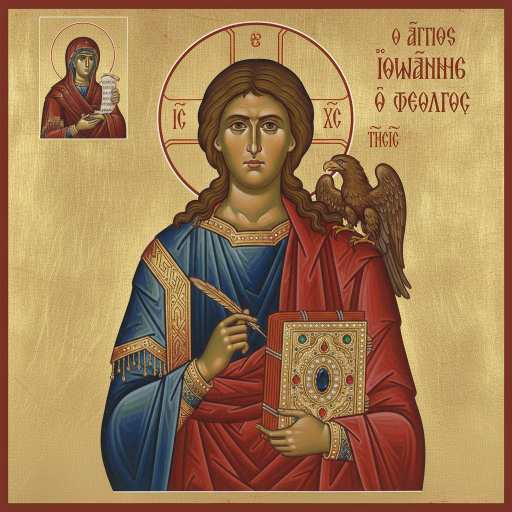
🎣From Fisherman to Beloved Disciple
Saint John the Theologian, son of Zebedee and Salome, and brother of the Holy Apostle James the
Greater, was among the first called by our Lord Jesus Christ. Born in Bethsaida of Galilee, he and
his brother were fishermen working with their father when Christ summoned them with the divine
words, "Follow Me, and I will make you fishers of men." Without hesitation, they left their nets and
followed Him, marking the beginning of John's extraordinary journey as the "Beloved Disciple."
John held a unique and intimate place in the circle of the Twelve Apostles. He, along with Peter and
his brother James, formed the inner circle who witnessed the most profound mysteries of Christ's
ministry: the Transfiguration on Mount Tabor, where they beheld the Lord's divine glory; the raising
of Jairus's daughter; and the agony in the Garden of Gethsemane. This privileged position was not
due to worldly merit, but to the special love Christ bore for this pure-hearted disciple.
❤️The Disciple Whom Jesus Loved
At the Last Supper, in that sacred upper room, John reclined upon the breast of our Lord, a gesture
of profound intimacy and trust. It was there that he received the sacred mysteries of the Kingdom
and heard the beating of the Sacred Heart that would redeem the world. This closeness was not merely
physical but spiritual—a union of hearts between Master and disciple that would endure beyond time
and death itself.
When all others fled during the Passion, John alone among the male disciples stood faithfully at the
foot of the Cross alongside the Theotokos and the holy myrrh-bearing women. In that moment of
supreme sacrifice, our Lord entrusted His Most Holy Mother to John's care, saying "Behold your
mother," and to the Virgin, "Behold your son." From that hour, John took her into his home, caring
for her with filial devotion until her Dormition and glorious Assumption into heaven.
"In the beginning was the Word, and the Word was with God, and the Word was God... And the Word
became flesh and dwelt among us." — Gospel of John 1:1, 14
✍️The Theologian and Evangelist
Saint John is honored with the supreme title "Theologian" (Mlafoyo in Syriac)—a title shared only
with Saint Gregory of Nazianzus and Saint Symeon the New Theologian. This rare distinction
acknowledges his unparalleled insight into the divine nature of Christ. His Gospel, the last to be
written, soars to theological heights beyond the other Evangelists, beginning with the majestic
hymn: "In the beginning was the Word, and the Word was with God, and the Word was God."
Written from Ephesus in his old age, John's Gospel was composed to combat the heresies that denied
Christ's divinity. While the Synoptic Gospels present Christ's humanity and earthly ministry, John
reveals the Eternal Word, the Light of the World, the Bread of Life, the Good Shepherd—proclaiming
with unwavering clarity that Jesus Christ is true God and true Man. His Gospel is the spiritual
Gospel, penetrating to the very essence of the Mystery of the Incarnation.
📜The Three Holy Epistles and the Apocalypse
Beyond his Gospel, Saint John blessed the Church with three canonical epistles that resound with his
central teaching: "God is Love." In these letters, written to combat early Gnostic heresies, he
emphasizes that true knowledge of God is inseparable from love—love for God and love for one
another. "Beloved, let us love one another, for love is from God," he proclaims, "and everyone who
loves is born of God and knows God."
The Apocalypse, or Book of Revelation, stands as John's final prophetic witness. Written during his
exile on the island of Patmos under the persecution of Emperor Domitian, this mystical revelation
unveils the cosmic battle between good and evil, the ultimate triumph of Christ, and the glorious
coming of the New Jerusalem. Through vivid imagery and symbolic language rooted in both Old
Testament prophecy and Christian mystery, John offers the Church a vision of hope, assuring
believers that despite tribulation, Christ the Lamb who was slain is victorious forever.
⛪Ministry in Asia Minor and Dormition
After Pentecost, Saint John initially remained in Jerusalem, supporting the nascent Church.
Following the Dormition of the Theotokos, he traveled throughout Asia Minor, establishing churches
and ordaining bishops and priests. He made Ephesus his primary see, from where he shepherded the
seven churches mentioned in Revelation: Ephesus, Smyrna, Pergamum, Thyatira, Sardis, Philadelphia,
and Laodicea.
During the reign of Emperor Domitian, John was arrested and brought to Rome, where according to
tradition, he was cast into a cauldron of boiling oil before the Latin Gate. By divine miracle, he
emerged unharmed, after which he was exiled to Patmos. After Domitian's death, John returned to
Ephesus, where he continued to preach, teach, and guide the faithful.
In his final years, when he was so elderly he could no longer walk, his disciples would carry him
into the assembly. His message never changed: "Little children, love one another." When asked why he
always repeated the same words, he replied, "Because it is the Lord's command, and if this alone is
done, it is enough." Saint John departed this life peacefully in Ephesus around the year 100 AD, the
last of the Apostles, having lived nearly a century witnessing to the Truth that is Christ.
Prayer for Intercession
O Holy Apostle and Evangelist John, beloved disciple of Christ, you who reclined upon the breast of
our Lord and beheld His divine mysteries, who stood faithfully at the Cross and received the Mother
of God into your care, who proclaimed the divinity of the Word made flesh—intercede for us before
the throne of grace. Grant us the gift of divine love, that we may know God as you knew Him, love as
you loved, and remain faithful unto death. Through your prayers, may we attain to the Heavenly
Kingdom and behold the glory you witnessed on Mount Tabor. Amen.