📖The Birth of the Diaconate
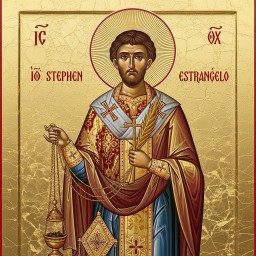
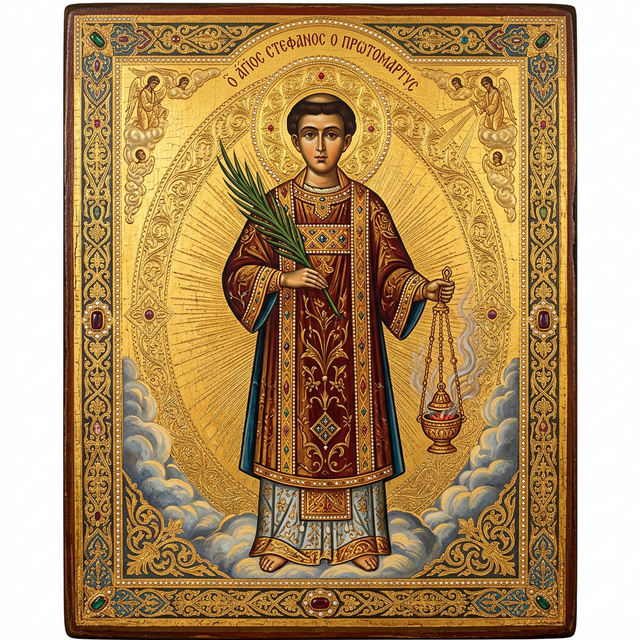
Saint Stephen the Protomartyr holds a unique and exalted place in the history of the Church as the
first person to shed his blood for Christ after the Ascension of our Lord. His name, which means
"crown" in Greek, proved prophetic, for he received the crown of martyrdom and became the model and
inspiration for all who would follow him in witnessing unto death for the faith. The Syriac Orthodox
Church venerates him with profound reverence, recognizing in his life and death the perfect
expression of Christian discipleship and the beginning of that glorious army of martyrs who have
sanctified the Church with their blood.
The story of St. Stephen unfolds in the Book of Acts, that sacred history of the early Church penned
by St. Luke the Evangelist under the inspiration of the Holy Spirit. In the days immediately
following Pentecost, when the Holy Spirit descended upon the Apostles and the Church was born in
Jerusalem, the community of believers grew rapidly. Thousands were being baptized and added to the
Church daily, and the Apostles devoted themselves to prayer, to preaching the Word of God, and to
celebrating the Holy Mysteries.
However, as the community grew, practical challenges arose. The Scriptures tell us that "in those
days, when the number of disciples was multiplying, there arose a complaint against the Hebrews by
the Hellenists, because their widows were neglected in the daily distribution" (Acts 6:1). The
community included both Hebrew-speaking Jews from Judea and Greek-speaking Jews from the Diaspora
(the Hellenists), and the widows among the Greek-speaking believers felt that they were not
receiving equal care in the distribution of food and assistance that the Church provided to those in
need.
This situation presented a significant challenge. The Apostles recognized that it would not be right
for them to neglect the ministry of prayer and the Word of God in order to serve tables, yet the
practical needs of the community could not be ignored. The complaint of the Hellenist widows was
legitimate, and justice demanded that all members of the Body of Christ receive equal care. The
solution they devised under the guidance of the Holy Spirit would have profound implications for the
structure and ministry of the Church for all time.
The Twelve Apostles summoned the entire community of disciples and said: "It is not desirable that
we should leave the word of God and serve tables. Therefore, brethren, seek out from among you seven
men of good reputation, full of the Holy Spirit and wisdom, whom we may appoint over this business;
but we will give ourselves continually to prayer and to the ministry of the word" (Acts 6:2-4). Thus
was established the order of deacons—the first ordained ministry after the apostolate itself—whose
role is to serve the practical and charitable needs of the Church, allowing the bishops and priests
to focus on teaching, prayer, and the sacraments.
The qualifications required for these seven men were remarkably high. They were not merely to be
administrators or organizers, though those skills would be needed. They had to be "of good
reputation"—known in the community for their integrity and trustworthiness. They had to be "full of
the Holy Spirit"—men of evident spiritual depth and maturity, whose lives manifested the fruits of
the Spirit. And they had to be full of "wisdom"—possessing the discernment and prudence necessary to
handle the practical affairs of the community justly and effectively.
✝️The Election and Ordination of Stephen
The proposal of the Apostles pleased the whole multitude of believers, and they set about selecting
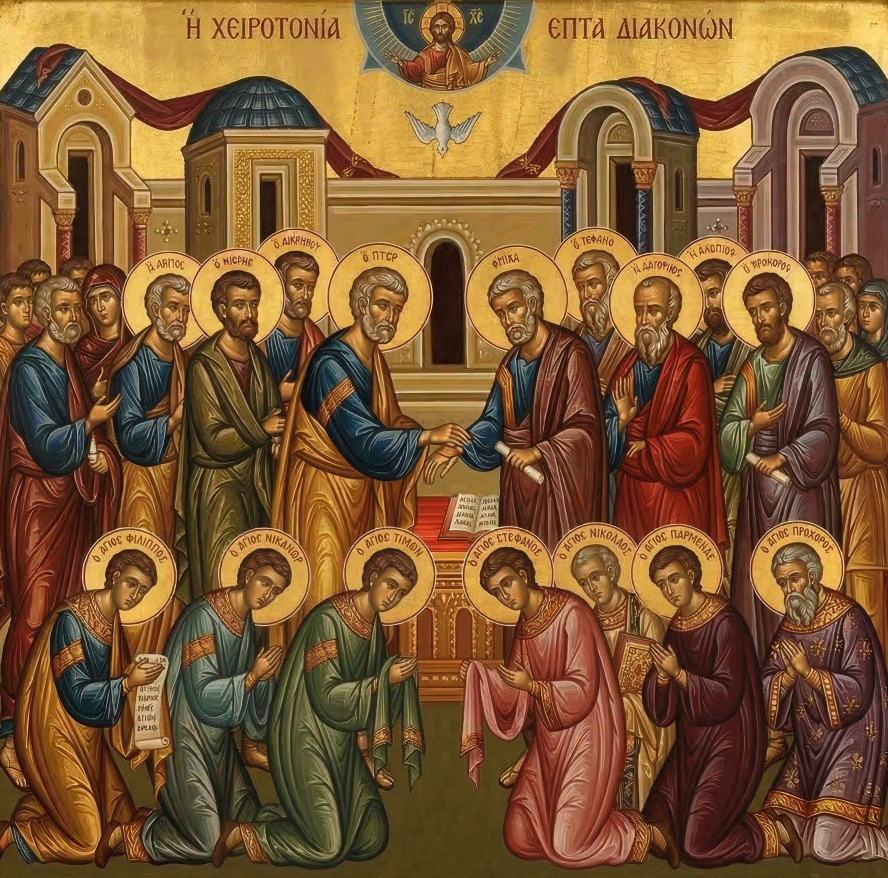
seven men who met these demanding criteria. The Scripture records: "And they chose Stephen, a man
full of faith and the Holy Spirit, and Philip, Prochorus, Nicanor, Timon, Parmenas, and Nicolas, a
proselyte from Antioch, whom they set before the apostles; and when they had prayed, they laid hands
on them" (Acts 6:5-6).
It is deeply significant that Stephen's name appears first in this list of seven. This indicates
that he held a position of particular prominence among the deacons, whether due to his age, his
spiritual maturity, or the recognition by the community of his exceptional gifts. Some Church
Fathers refer to Stephen as the "Archdeacon"—the first among the deacons—establishing a precedent
that continues in the Church to this day, where the senior deacon in a diocese often bears this
title in honor of St. Stephen.
The Scripture specifically describes Stephen as "a man full of faith and the Holy Spirit." This
remarkable description, given before the narrative of his ministry and martyrdom, indicates that his
exceptional sanctity was evident even at the time of his selection. He was not merely faithful, but
"full of faith"—his entire being was permeated with trust in God, confidence in Christ, and
commitment to the Gospel. He was not merely a recipient of the Holy Spirit, but "full of the Holy
Spirit"—the divine presence dwelt in him abundantly, empowering his ministry and radiating through
his person.
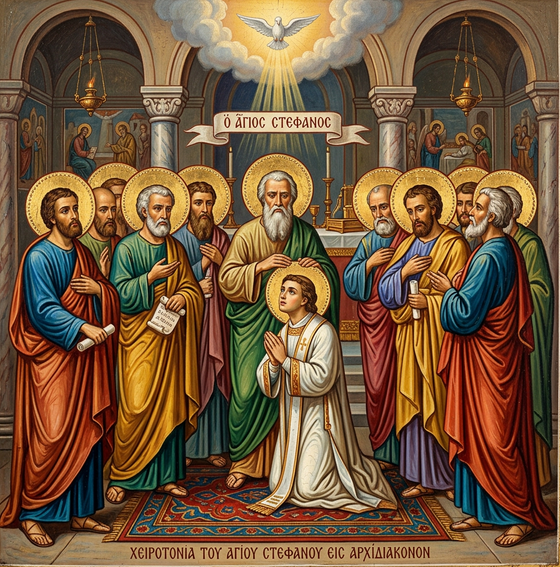
The seven chosen men were brought before the Apostles, who prayed over them and laid hands upon
them. This laying on of hands—the ancient gesture of conferring blessing, authority, and the grace
of the Holy Spirit—constituted their ordination to the sacred order of the diaconate. Through this
act, performed by the Apostles themselves, the seven received the charism necessary for their
ministry. They were not merely volunteers or committee members; they were ordained ministers of the
Church, set apart by prayer and the imposition of apostolic hands to serve in Christ's name.
The Syriac Orthodox Church recognizes this event as the institution of the diaconate, one of the
holy orders of ministry that structure the life of the Church. Every deacon ordained in our Church
stands in succession to these seven, and particularly to St. Stephen their leader. The prayers used
in the ordination of deacons in the Syriac tradition specifically invoke St. Stephen as the model of
diaconal ministry, asking that the newly ordained may serve with the same faith, wisdom, and
holiness that characterized the Protomartyr.
The immediate result of this apostolic innovation was blessed growth: "Then the word of God spread,
and the number of the disciples multiplied greatly in Jerusalem, and a great many of the priests
were obedient to the faith" (Acts 6:7). By establishing the diaconate to handle practical matters,
the Apostles freed themselves to focus on prayer and teaching, resulting in explosive growth of the
Church. Even many of the Jewish priests—men who had served in the Temple and who might have been
expected to resist the Christian message—were converted and baptized.
⚡Ministry of Power and Wisdom
Although Stephen and his fellow deacons had been ordained specifically to "serve tables"—to handle
the distribution of food and aid to widows and others in need—Stephen's ministry was not limited to
these practical matters. The Holy Spirit who filled him empowered a ministry that far exceeded the
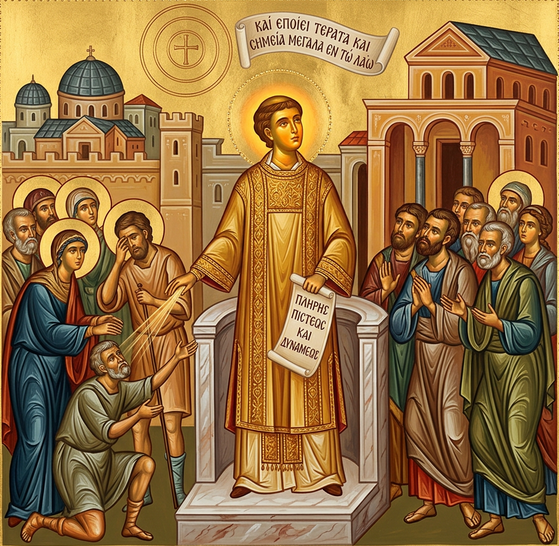
original scope of his appointment. The Scriptures tell us: "And Stephen, full of faith and power,
did great wonders and signs among the people" (Acts 6:8).
This brief statement reveals the extraordinary nature of St. Stephen's ministry. He performed "great
wonders and signs"—miracles comparable to those worked by the Apostles themselves. Though he was a
deacon, not an Apostle, the same Spirit who empowered Peter, John, and the others to heal the sick,
cast out demons, and work miracles also worked through Stephen. This demonstrates an important truth
about ministry in the Church: the ordained office one holds does not limit the gifts and power that
the Holy Spirit may manifest through that person. Holiness and the Spirit's power are not restricted
by hierarchical rank.
The tradition of the Church, preserved in the writings of the Fathers and in liturgical texts,
elaborates on the nature of these miracles. St. Stephen is said to have healed the sick, restored
sight to the blind, caused the lame to walk, and cast out demons with a word. These signs
authenticated his message and demonstrated that the power of the risen Christ was present in His
Church. The miracles performed through Stephen's hands confirmed the truth of the Gospel he
proclaimed and brought many to faith in Christ.
But St. Stephen's ministry was not limited to miraculous deeds. He was also a powerful preacher and
teacher. The Scriptures tell us that opposition arose: "Then there arose some from what is called
the Synagogue of the Freedmen (Cyrenians, Alexandrians, and those from Cilicia and Asia), disputing
with Stephen" (Acts 6:9). These were Hellenistic Jews—Greek-speaking Jews from various parts of the
Diaspora—who had their own synagogue in Jerusalem. They engaged Stephen in theological debate,
attempting to refute his teaching about Jesus as the Messiah.
The result of these debates was decisive: "And they were not able to resist the wisdom and the
Spirit by which he spoke" (Acts 6:10). Stephen's arguments, rooted in the Hebrew Scriptures and
empowered by the Holy Spirit, were irrefutable. He demonstrated from the Law and the Prophets that
Jesus of Nazareth was indeed the Messiah promised to Israel, that His death and resurrection had
been foretold, and that the salvation He offered was not a departure from the Jewish faith but its
fulfillment. His opponents could find no answer to his reasoning, no flaw in his scriptural
interpretation, no weakness in his logic.
This combination of miraculous power and intellectual brilliance, of signs and wisdom, made St.
Stephen a formidable witness to Christ. He embodied the promise Jesus had made to His disciples: "I
will give you a mouth and wisdom which all your adversaries will not be able to contradict or
resist" (Luke 21:15). In Stephen, we see this promise fulfilled. Here was a young deacon, perhaps
not many months in his ministry, who could out-debate the learned scholars of Jerusalem and perform
miracles rivaling those of the Apostles. The Church in every age needs such witnesses—people who
combine intellectual depth with spiritual power, who can both explain the faith rationally and
demonstrate its truth through holiness and the manifestation of God's power.
⚖️Arrest and Trial
The very effectiveness of St. Stephen's ministry ensured that he would face opposition. When his
adversaries in debate could not refute his arguments, they resorted to the tactics that the enemies
of truth have always employed—deception, false accusation, and violence. Unable to defeat him
through reason, they determined to destroy him through force.
The Scripture records: "Then they secretly induced men to say, 'We have heard him speak blasphemous
words against Moses and God.' And they stirred up the people, the elders, and the scribes; and they
came upon him, seized him, and brought him to the council" (Acts 6:11-12). This was a carefully
orchestrated campaign of character assassination. The opponents hired false witnesses who would
testify that Stephen had spoken blasphemy—the most serious religious crime under Jewish law,
punishable by death.
The charges brought against Stephen were threefold, and they echo ominously the accusations leveled
against our Lord Jesus Christ Himself. The false witnesses declared: "This man does not cease to
speak blasphemous words against this holy place and the law; for we have heard him say that this
Jesus of Nazareth will destroy this place and change the customs which Moses delivered to us" (Acts
6:13-14). They accused him of speaking against the Temple, against the Mosaic Law, and of claiming
that Jesus would destroy Jewish institutions and traditions.
Like most effective lies, these accusations contained twisted fragments of truth. Stephen had indeed
proclaimed that Jesus was the fulfillment of the Law and the Prophets. He had taught that the
worship of the Temple, with its animal sacrifices, had been superseded by the once-for-all sacrifice
of Christ on the Cross. He had explained that the old covenant, given through Moses, had found its
completion in the new covenant established in Christ's blood. But to present these Christian
teachings as "blasphemy against Moses and God" was a gross distortion of his actual message.
The accusations were calculated to inflame Jewish religious sensibilities. The Temple was the center
of Jewish worship and national identity. The Law of Moses was considered the very word of God, the
foundation of Jewish life. To suggest that Jesus—a crucified criminal in the eyes of the
Sanhedrin—would overthrow these sacred institutions was to invite charges of heresy and treason. The
false witnesses knew exactly which buttons to push to turn the religious authorities and the people
against Stephen.
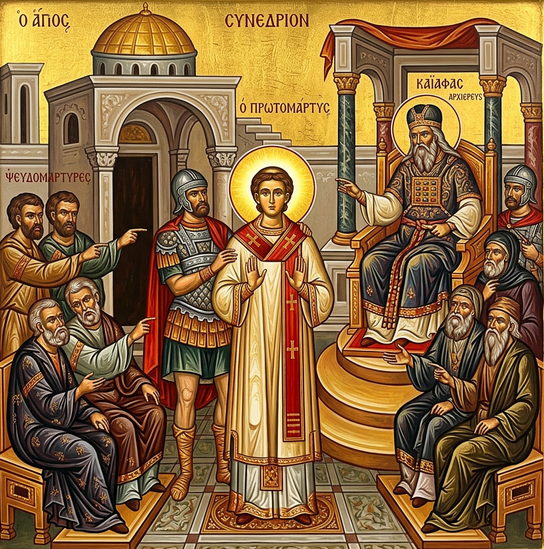
Stephen was seized and brought before the Sanhedrin, the same council that had condemned Jesus to
death. He stood in the same hall, before some of the same judges, facing similar accusations,
knowing that these men had the power to condemn him to death just as they had condemned his Master.
It was a moment of supreme testing. Would Stephen recant, compromise, or moderate his message to
save his life? Would fear overcome faith?
The Scripture gives us a remarkable detail about Stephen's appearance before the council: "And all
who sat in the council, looking steadfastly at him, saw his face as the face of an angel" (Acts
6:15). Despite the grave danger he faced, despite the hostile crowd and the false accusations,
Stephen's face shone with supernatural peace and radiance. Like Moses descending from Mount Sinai
with his face shining from having been in God's presence, Stephen's countenance reflected the glory
of the Holy Spirit dwelling within him. Even his enemies could see that this was no ordinary man
standing trial—this was someone who had been in the presence of God.
📜The Great Discourse
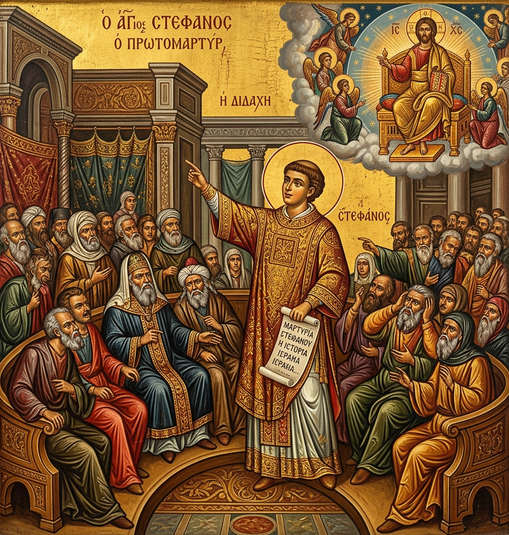
When the High Priest asked Stephen, "Are these things so?" (Acts 7:1), the young deacon did not
offer a brief defense or a simple denial of the charges. Instead, he launched into a comprehensive
recounting of salvation history—a sermon that takes up the entire seventh chapter of the Book of
Acts and stands as one of the longest speeches recorded in the New Testament. This discourse is a
masterpiece of biblical theology, demonstrating Stephen's profound knowledge of Scripture and his
ability to show how all of Israel's history pointed toward Christ.
Stephen began with Abraham, the father of the Jewish nation: "Brethren and fathers, listen: The God
of glory appeared to our father Abraham when he was in Mesopotamia, before he dwelt in Haran..."
(Acts 7:2). He recounted God's call to Abraham, the promises made to him, and the covenant
established with him. His point was subtle but crucial: God's relationship with Abraham began before
Abraham entered the Promised Land and before the Law was given—demonstrating that God's grace and
promises preceded the institutions that the Jews held sacred.
He continued with Joseph, betrayed by his brothers yet raised up by God to save his family and
become ruler in Egypt. He spoke of Moses, rescued from death as an infant, raised in Pharaoh's
court, called by God at the burning bush, and used as the instrument to deliver Israel from slavery.
He recounted the Exodus, the giving of the Law at Sinai, the building of the Tabernacle, and the
rebellion of Israel in the wilderness.
Throughout this long historical recitation, Stephen was making several crucial theological points.
First, he showed that God's presence was not limited to the Temple in Jerusalem. God appeared to
Abraham in Mesopotamia, to Joseph in Egypt, to Moses in the wilderness of Sinai. The "holy place"
that Stephen was accused of blaspheming was not, in fact, the exclusive location of God's presence.
Second, he demonstrated a pattern in Israel's history: God's prophets and deliverers were
consistently rejected by the very people they were sent to save. Joseph was betrayed by his
brothers. Moses was rejected by the Israelites, who said "Who made you a ruler and a judge over us?"
The prophets were persecuted and killed. This pattern, Stephen implied, had reached its culmination
in the rejection and crucifixion of Jesus, the ultimate Prophet and Deliverer.
Third, he showed that the Tabernacle—the movable tent of worship in the wilderness—had been ordained
by God Himself, yet it was eventually replaced by Solomon's Temple. And even that Temple,
magnificent as it was, could not truly contain God. Stephen quoted the prophet Isaiah: "Heaven is My
throne, and earth is My footstool. What house will you build for Me? says the Lord, or what is the
place of My rest? Has My hand not made all these things?" (Acts 7:49-50, quoting Isaiah 66:1-2).
His conclusion was devastating: "You stiff-necked and uncircumcised in heart and ears! You always
resist the Holy Spirit; as your fathers did, so do you. Which of the prophets did your fathers not
persecute? And they killed those who foretold the coming of the Just One, of whom you now have
become the betrayers and murderers, who have received the law by the direction of angels and have
not kept it" (Acts 7:51-53).
This was not merely a defense against the charges; it was a prophetic indictment of his accusers.
Stephen turned the tables completely. They had accused him of speaking against Moses and the Law; he
accused them of not keeping the Law. They had accused him of dishonoring the Temple; he showed that
they had turned it into an idol, imagining that God was limited to a building made with hands. They
had accused him of following Jesus the blasphemer; he declared that they were the murderers of the
Messiah whom the prophets had foretold.
The theological depth and scriptural mastery displayed in this speech are remarkable. This was not
the product of formal rabbinical training or years of study—Stephen had been a Christian for at most
a few years, and he was a Hellenistic Jew who may not have had access to the elite schools of
Jerusalem. This was the Holy Spirit teaching through him, fulfilling Jesus's promise that when His
disciples were brought before councils and rulers, the Spirit would give them the words to speak.
👁️The Vision of Glory
The reaction of the Sanhedrin to Stephen's speech was one of murderous rage: "When they heard these
things they were cut to the heart, and they gnashed at him with their teeth" (Acts 7:54). These
religious leaders, confronted with the truth of their own guilt in rejecting and murdering the
Messiah, did not repent but instead became even more hardened in their opposition. The truth they
could not refute they determined to silence.
But at this climactic moment, as the council seethed with hatred and Stephen stood alone facing
death, God granted His servant a vision of glory that has been treasured by the Church through all
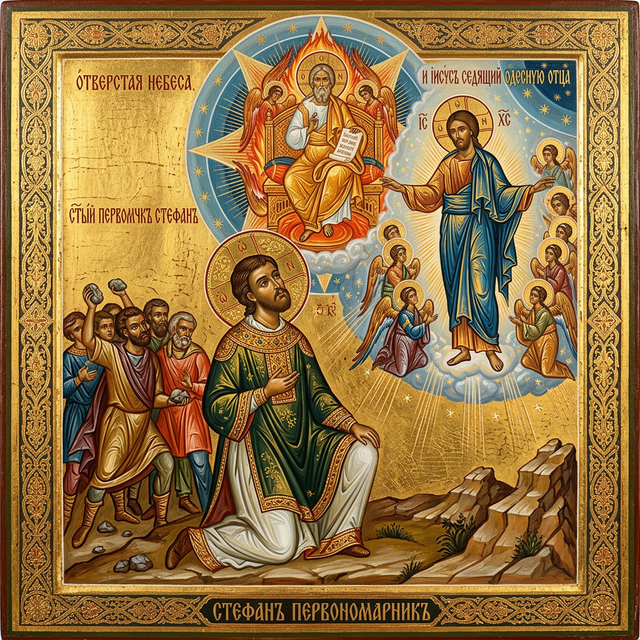
the centuries since. The Scripture records: "But he, being full of the Holy Spirit, gazed into
heaven and saw the glory of God, and Jesus standing at the right hand of God, and said, 'Look! I see
the heavens opened and the Son of Man standing at the right hand of God!'" (Acts 7:55-56).
This vision is one of the most significant Christological revelations in the New Testament. Stephen
saw Jesus Christ, whom these very men had condemned as a blasphemer and had crucified as a criminal,
now standing in the place of highest honor—at the right hand of God the Father. This confirmed
everything Stephen had been teaching: Jesus was not a failed messiah or a deceiver, but the true Son
of God, vindicated by His resurrection and exalted to the throne of heaven.
Several aspects of this vision deserve careful attention. First, Stephen saw "the glory of God"—the
same divine glory (the Shekinah) that had filled the Tabernacle and the Temple, that had appeared to
Moses on Sinai, and that the prophets had seen in their visions. This was no mere subjective
experience but an objective vision of the divine reality.
Second, Jesus was "standing" at the right hand of God. Most other New Testament passages describe
Christ as "seated" at God's right hand (Psalm 110:1, Mark 16:19, Hebrews 1:3, etc.), indicating His
completed work and His rest after victory. Why was He standing here? The Fathers of the Church offer
several beautiful interpretations: Perhaps Christ stood to receive His first martyr into heaven,
like a king standing to honor a victorious warrior. Perhaps He stood as an advocate, defending
Stephen before the Father. Perhaps He stood ready to strengthen His servant in the final ordeal. All
of these interpretations reflect the truth that Christ is not distant from those who suffer for His
name but is present with them, honoring their witness.
Third, Stephen called Jesus "the Son of Man"—the title from Daniel 7:13-14 that Jesus frequently
used for Himself. This title combines humanity and divinity, referring to the one who would receive
"dominion and glory and a kingdom" from the Ancient of Days. By using this title while describing
his vision of Jesus in glory, Stephen was identifying Jesus as the fulfillment of Daniel's prophecy,
the one to whom all authority in heaven and earth had been given.
Fourth, the fact that Stephen saw this vision at all is significant. Ordinary humans do not see into
the heavenly realm—the veil between heaven and earth is not typically lifted. But for martyrs, for
those about to give their lives for Christ, God often grants such visions. They die with their eyes
fixed not on the instruments of death but on the glory that awaits them. They pass from this world
while gazing into the next. This is one of the great privileges of martyrdom—to see, even if
briefly, the reality that we normally apprehend only by faith.
Stephen's announcement of his vision—"Look! I see the heavens opened and the Son of Man standing at
the right hand of God!"—was the final provocation for his murderers. What he meant as a testimony to
Christ's glory they interpreted as the ultimate blasphemy—claiming to see God and identifying the
crucified Jesus with the divine "Son of Man" of Daniel's vision. Their response was immediate and
violent: "Then they cried out with a loud voice, stopped their ears, and ran at him with one accord"
(Acts 7:57).
☦️The Crown of Martyrdom
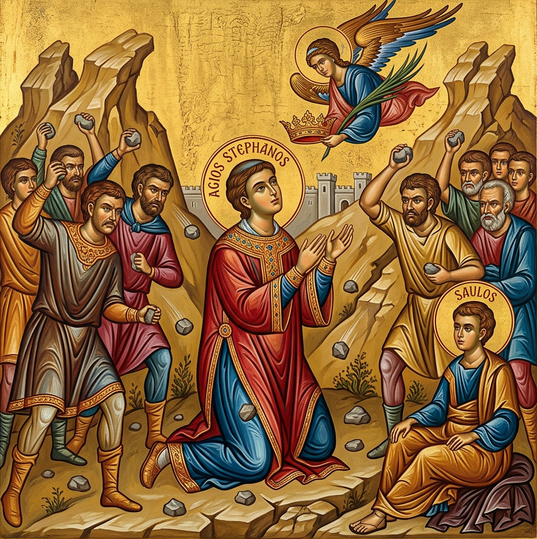
What followed was not a legal execution but a lynching, a mob killing driven by religious fury. "And
they cast him out of the city and stoned him" (Acts 7:58). The Law of Moses prescribed stoning as
the punishment for blasphemy, but this was not a carefully regulated judicial execution. This was a
rage-filled mob, driven by hatred of the truth, determined to silence the voice that had exposed
their guilt and proclaimed their Messiah.
The detail that they "cast him out of the city" before stoning him reflects the legal requirement
that executions for blasphemy take place outside the city limits (Leviticus 24:14). Even in their
murderous rage, they maintained a semblance of legal propriety. But the greater significance is
theological: just as Jesus had been crucified outside the city gates, suffering "outside the camp"
(Hebrews 13:12), so His first martyr would shed his blood outside Jerusalem's walls. The rejection
was complete—both Master and disciple were cast out of the holy city, their witness considered too
dangerous to be tolerated within its sacred precincts.
The manner of execution—stoning—was particularly brutal. The condemned person was typically thrown
from a height, often into a pit or off a wall, to break bones and stun the victim. Then large stones
were thrown down or upon the person until death occurred. It was a communal form of execution, with
multiple people participating in throwing stones, distributing the responsibility (and the guilt)
among many hands rather than concentrating it in a single executioner.
A significant detail is recorded: "And the witnesses laid down their clothes at the feet of a young
man named Saul" (Acts 7:58). The "witnesses"—those who had testified against Stephen—were required
by law to cast the first stones, and they apparently removed their outer garments so they could
throw more effectively. A young man named Saul (who would later be known as Paul, the Apostle to the
Gentiles) was holding their clothing. This same Saul "was consenting to his death" (Acts 8:1),
approving of this execution and believing it to be righteous judgment against a blasphemer.
The irony and the providence of God are evident here. The greatest persecutor of the Church was
present at the martyrdom of its first martyr. Saul witnessed Stephen's death, heard his final words,
saw his peaceful face shining like an angel, and observed how a true believer dies for Christ. Years
later, when the risen Christ appeared to Saul on the Damascus road and converted him, he must have
remembered this scene. The witness of Stephen's martyrdom was undoubtedly one of the factors that
prepared Saul's heart for conversion. The blood of the martyr became the seed that would eventually
bear fruit in the conversion of Christianity's greatest missionary.
As the stones rained down upon him, breaking his bones and crushing his flesh, Stephen displayed the
same spirit that had characterized his entire ministry—faith, courage, and love. The Scripture
records his final words with the careful attention they deserve, for they are among the most
beautiful and significant in all of Christian history.
First, "they stoned Stephen as he was calling on God and saying, 'Lord Jesus, receive my spirit'"
(Acts 7:59). In his dying moments, Stephen prayed to Jesus, calling upon Him as "Lord" and
entrusting his soul to Him. This simple prayer demonstrates Stephen's faith in Christ's divinity and
His power over life and death. It echoes Jesus's own words from the Cross: "Father, into Your hands
I commit My spirit" (Luke 23:46). Master and disciple both died entrusting their spirits to God.
Second, "Then he knelt down and cried out with a loud voice, 'Lord, do not charge them with this
sin.' And when he had said this, he fell asleep" (Acts 7:60). Even as he was being murdered,
Stephen's final concern was not for himself but for his murderers. He prayed that God would forgive
them, that this sin would not be held against them. This too echoes Jesus's words from the Cross:
"Father, forgive them, for they do not know what they do" (Luke 23:34).
These two prayers—"Lord Jesus, receive my spirit" and "Lord, do not charge them with this
sin"—perfectly parallel Jesus's last words from the Cross. The first expresses trust and surrender
to God; the second expresses love and forgiveness toward enemies. In dying, Stephen imitated Christ
completely. He demonstrated that Christian discipleship means conforming oneself to Christ not only
in life but also in death, not only in ministry but also in suffering, not only in preaching but
also in martyrdom.
The Scripture's final statement—"he fell asleep"—is the beautiful euphemism that the Church has
always used for the death of the righteous. Stephen did not merely die; he fell asleep in Christ,
entering that peaceful rest from which he would awaken to eternal life at the resurrection. The term
emphasizes the Christian understanding of death not as final annihilation but as a temporary sleep
from which believers will be awakened by Christ's voice on the last day.
✨Immediate Aftermath and the Spread of the
Gospel
The martyrdom of St. Stephen marked a turning point in the history of the early Church. What his
enemies intended as a crushing blow to the Christian movement became instead the catalyst for its
expansion beyond Jerusalem and into the wider world. As Tertullian would later write, "The blood of
the martyrs is the seed of the Church."
The Scripture records: "Now Saul was consenting to his death. At that time a great persecution arose
against the church which was at Jerusalem; and they were all scattered throughout the regions of
Judea and Samaria, except the apostles... Therefore those who were scattered went everywhere
preaching the word" (Acts 8:1-4). Stephen's death emboldened the enemies of the Church to launch a
systematic persecution. Many believers were arrested, beaten, and imprisoned. Homes were invaded,
property confiscated, and families torn apart.
Yet this persecution, which seemed to threaten the Church's very existence, actually fulfilled
Jesus's commission to His disciples: "You shall be witnesses to Me in Jerusalem, and in all Judea
and Samaria, and to the end of the earth" (Acts 1:8). The Christians had remained largely
concentrated in Jerusalem, perhaps comfortable in the familiar environment of the holy city. The
persecution forced them to scatter, and wherever they went, they preached the Gospel. What began as
flight from persecution became a missionary movement. Believers who fled to Judea and Samaria
established churches in those regions. Some traveled as far as Phoenicia, Cyprus, and Antioch (Acts
11:19), planting the seeds of Christianity throughout the eastern Mediterranean.
One immediate result of this dispersion was the evangelization of Samaria by Philip, one of the
seven deacons who had been ordained alongside Stephen. Philip preached Christ in Samaria, performed
miracles, and many believed and were baptized (Acts 8:4-13). The ancient hostility between Jews and
Samaritans was broken down as the Gospel crossed ethnic and religious boundaries. This would never
have happened if the persecution following Stephen's death had not driven Philip out of Jerusalem.
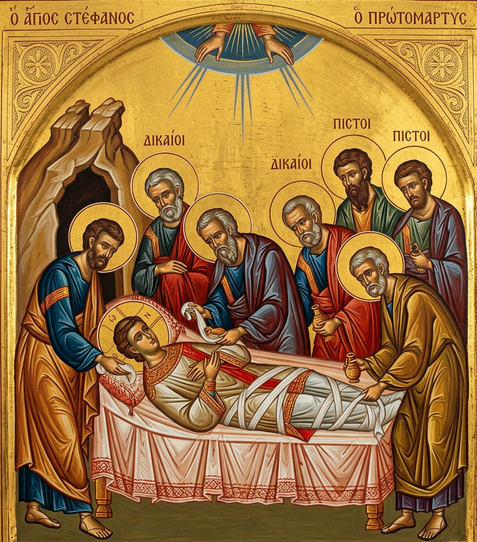
The Scripture also records: "And devout men carried Stephen to his burial, and made great
lamentation over him" (Acts 8:2). Despite the danger—the persecution was in full swing, and to be
identified as a Christian invited arrest—there were brave believers who claimed Stephen's body, gave
him proper burial, and mourned him openly. The tradition of the Church tells us that these devout
men included Gamaliel, the respected Pharisee who had earlier counseled tolerance toward the
Christians (Acts 5:34-39), and his son Abibas, who were secret believers. They buried Stephen with
honor, and great was the lamentation of the faithful over the loss of this brilliant young deacon
whose ministry had been cut short just as it was beginning to flourish.
Yet even in death, Stephen's influence continued to grow. His example inspired countless others to
face persecution with courage. His prayers from the midst of his martyrdom—praying for the salvation
of his enemies—became the model for all Christian martyrs. His vision of Christ standing at God's
right hand gave courage to believers facing death, assuring them that Christ was present with them
and would receive them into glory. And perhaps most significantly, his martyrdom planted a seed in
the heart of Saul of Tarsus that would eventually bear fruit in one of the most dramatic conversions
in history.
🏛️Discovery of the Holy Relics
For nearly four centuries, the location of St. Stephen's tomb was known only through oral tradition,
passed down among the Christian community. But in December of the year 415 AD, during the reign of
Emperor Theodosius II, a miraculous discovery occurred that would renew devotion to the Protomartyr
throughout the Christian world.
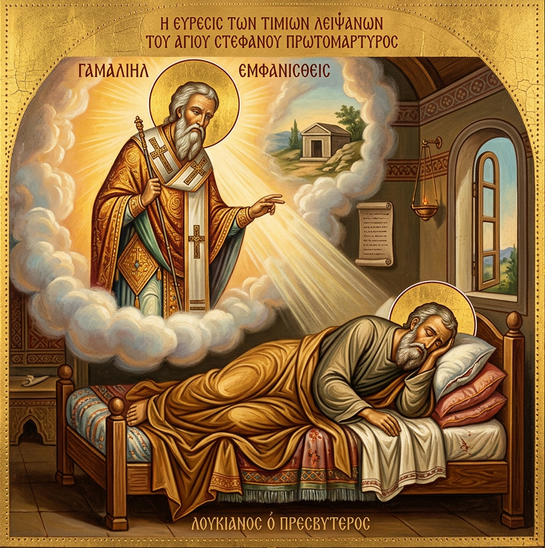
A priest named Lucian, who served at a church in Kfar Gamla (about 20 miles north of Jerusalem),
received a vision. In this vision, an elderly man of venerable appearance, clothed in white garments
and holding a golden rod, appeared to him three times. The figure identified himself as Gamaliel,
the Jewish teacher and member of the Sanhedrin who had protected the Apostles (Acts 5:34-39) and
who, according to tradition, had become a secret Christian and had buried St. Stephen.
In the vision, Gamaliel told Lucian where to find the relics of St. Stephen, as well as his own
remains and those of his son Abibas and St. Nicodemus (the Pharisee who had come to Jesus by night
and had helped Joseph of Arimathea bury Jesus's body). He explained that he had buried Stephen in
his own property, and that the location had been forgotten over the centuries of persecution and
upheaval.
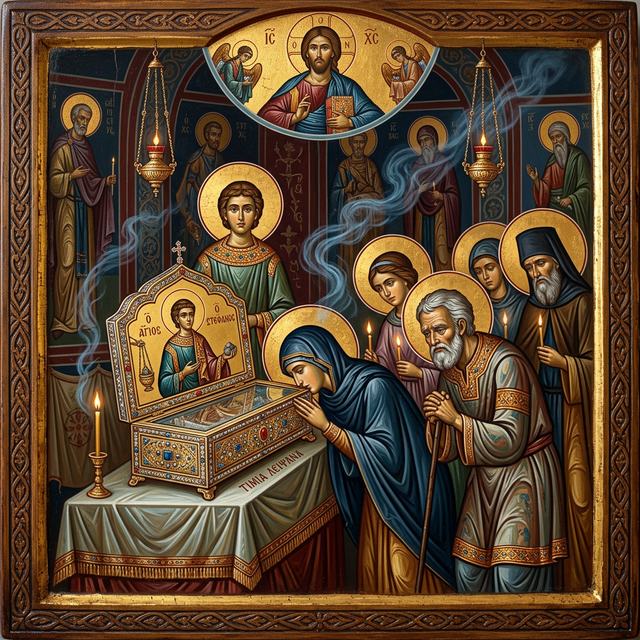
Lucian reported the vision to John, the Bishop of Jerusalem, who authorized an investigation. In
August 415 AD, they excavated at the location indicated in the vision and discovered a tomb
containing four chests or ossuaries. As they opened the first chest, which contained Stephen's
relics, a powerful and sweet fragrance filled the air, and many sick people who were present were
healed instantaneously. The earth trembled slightly, and people reported seeing a light over the
tomb. These miraculous signs confirmed that these were indeed the holy relics of the Protomartyr.
The discovery caused tremendous excitement throughout the Christian world. St. Augustine of Hippo,
writing from North Africa, recorded numerous miracles that occurred through the intercession of St.
Stephen following the discovery and distribution of his relics. Churches were built in his honor
across the Christian world. Portions of his relics were distributed to major cities, and wherever
they went, they became centers of pilgrimage and devotion.
In the Syriac Orthodox tradition, the discovery of St. Stephen's relics is commemorated
liturgically, and the saint's intercession has been sought continuously from that time to the
present. Many Syriac Orthodox churches throughout the Middle East, India, and the diaspora are
dedicated to St. Stephen, testifying to the enduring devotion to the Protomartyr.
📿Veneration in Syriac Orthodox Tradition
The Syriac Orthodox Church has maintained unbroken veneration of St. Stephen the Protomartyr from
apostolic times to the present day. His commemoration appears in the most ancient Syriac liturgical
texts, and his name is invoked in the prayers of the Church alongside the Apostles and other great
saints of the early Christian centuries.
The feast of St. Stephen is celebrated with great solemnity on December 26 (or December 27 in some
Eastern traditions, depending on the calendar used). This placement immediately following the Feast
of the Nativity is deeply significant. As we celebrate the birth of our Savior on December 25, we
immediately celebrate on the following day the first one to die for that Savior. The liturgical
juxtaposition reminds us that the Incarnation was ordered toward the Cross, that Christ came to die
for our salvation, and that His followers are called to take up their crosses and follow Him.
The Syriac liturgical tradition has produced beautiful hymns (madrashe) and prayers in honor of St.
Stephen. These compositions, many of which date from the early centuries of the Church, praise his
courage, celebrate his vision of Christ in glory, meditate on the meaning of his martyrdom, and seek
his intercession. The hymns often draw parallels between Stephen's death and Christ's Passion,
noting how the disciple imitated the Master in his suffering, his prayers for his enemies, and his
peaceful surrender of his spirit to God.
In the Divine Liturgy of St. James, which is one of the ancient liturgies used in the Syriac
Orthodox Church, St. Stephen is commemorated in the diptychs—the lists of saints whose names are
read during the Eucharistic Prayer. His name appears immediately after the Apostles, reflecting his
unique status as the first martyr and the first of the deacons. This liturgical commemoration
ensures that every time the Holy Qurbono is celebrated according to this ancient rite, the memory of
St. Stephen is perpetuated.
The Syriac Orthodox Church also preserves the tradition of invoking St. Stephen's intercession
particularly for deacons. When a man is ordained to the diaconate in our Church, the prayers of
ordination specifically invoke St. Stephen as the model and patron of all deacons. The newly
ordained deacon is exhorted to imitate Stephen's service, his wisdom, his holiness, and his courage.
The presence of St. Stephen as the prototype and heavenly patron gives dignity and meaning to the
diaconal ministry, reminding all deacons that they stand in a direct line of succession from the
seven chosen by the Apostles in Jerusalem.
Many Syriac Orthodox families name their sons "Stephen" (or its Syriac/Arabic forms such as "Istfan"
or "Istaphan") in honor of the Protomartyr, seeking his protection and patronage for their children.
The name, meaning "crown," is considered particularly auspicious, as it reminds us of the crown of
martyrdom that St. Stephen received and of the crown of life promised to all who are faithful unto
death.
The theological reflection on St. Stephen's martyrdom in Syriac tradition emphasizes several key
themes. First, his witness demonstrates the power of the Holy Spirit to sustain believers even in
the midst of the most extreme suffering. Second, his vision of Christ standing at God's right hand
confirms the resurrection and exaltation of our Lord and assures believers that Christ is present
with His suffering Church. Third, his prayers for his persecutors exemplify the Christian command to
love enemies and to pray for those who persecute us. Fourth, his death "outside the city" connects
him typologically with Christ, who also suffered outside Jerusalem's walls, and reminds us that
faithful discipleship may require us to be rejected by the world.
👑Model for All Martyrs
St. Stephen's title as "Protomartyr"—first martyr—carries profound significance beyond mere
chronological priority. He is not simply the first Christian to die for the faith; he is the
pattern, the model, the prototype after which all subsequent Christian martyrdom is understood.
Every martyr who came after Stephen in some sense reenacts his witness, follows his example, and
shares in his crown.
The Syriac Orthodox Church has been, from its earliest days, a Church of martyrs. From the
persecution under Shapur II of Persia in the fourth century, through the various persecutions under
Islamic rulers in the medieval period, to the horrific genocides of the twentieth century, our
Church has produced countless martyrs—men, women, and children who chose death rather than denial of
Christ. All of these martyrs looked to St. Stephen as their model and drew courage from his example.
What specific elements of Stephen's martyrdom have served as the pattern for all martyrs? First, his
boldness in witness—he did not compromise or moderate his message even when threatened with death.
He spoke the truth clearly and fearlessly, knowing that it might cost him his life. This same
boldness has characterized every authentic Christian martyr. They have refused to practice taqiyya
(religious dissimulation), refused to deny Christ to save their lives, refused to compromise
essential doctrines for the sake of peace or safety.
Second, his forgiveness of his persecutors—his prayer "Lord, do not charge them with this sin" has
been echoed by countless martyrs who faced death with love rather than hatred in their hearts. There
are numerous accounts from the Syriac tradition of martyrs who, even as they were being tortured or
killed, prayed for their tormentors and expressed forgiveness toward them. This supernatural love,
which can only come from the Holy Spirit, is one of the most powerful testimonies to the reality of
Christian faith.
Third, his vision of Christ in glory—many martyrs have reported experiencing visions of Christ, the
saints, or angels as they faced death. These visions serve multiple purposes: they confirm the
martyr in his or her resolve, they provide supernatural strength to endure suffering, they remind
the martyr that the brief suffering of this world will be followed by eternal glory, and they bear
witness to those present that the martyrs truly see a reality invisible to ordinary eyes.
Fourth, his peaceful death—the description of Stephen "falling asleep" rather than being described
as dying violently emphasizes the paradox of martyrdom: though the external circumstances are
brutal, the internal experience of the martyr who trusts in Christ is one of peace. Many accounts of
martyrdom describe how the martyrs went to their deaths singing hymns, praising God, and radiating
joy, their faces shining with supernatural peace even as their bodies were being torn apart.
The Syriac Church's rich martyrological tradition includes numerous accounts of martyrs who
explicitly invoked St. Stephen or who cited his example as they faced their own deaths. When St.
Behnam and St. Sarah were martyred in the fourth century, they prayed prayers similar to Stephen's.
When the forty martyrs of Sebaste were dying of exposure in the frozen lake, they encouraged one
another by remembering Stephen's vision of Christ. When St. Shmuni watched her seven sons martyred
before her eyes, she exemplified Stephen's forgiveness and courage. The Protomartyr's influence
extends through every generation of Christian witnesses.
🕊️Theological Significance
The theological significance of St. Stephen extends far beyond his personal holiness or even his
role as the first martyr. His life and death illumine several crucial dimensions of Christian faith
and practice.
First, Stephen's ministry demonstrates the importance of service (diakonia) in the Church. He was
ordained specifically to serve tables, to handle the practical matters of food distribution to
widows. This might seem like a merely administrative role, but the Church recognized it as sacred
ministry requiring ordination and the laying on of apostolic hands. Stephen's example teaches us
that there is no hierarchy of sacred and secular in Christian life—serving the poor is as much a
spiritual ministry as preaching or celebrating the sacraments. The diaconate, instituted for
practical service, becomes a conduit for divine grace and power.
Second, Stephen's combination of service and evangelism shows that these are not separate or
competing vocations but complementary aspects of Christian witness. He served tables and he preached
Christ. He cared for widows and he debated with scholars. He performed miracles of healing and he
explained Scripture. The holistic nature of his ministry reminds us that authentic Christianity
engages both body and soul, both material and spiritual needs, both practical service and
theological reflection.
Third, Stephen's vision of Christ standing at God's right hand provides crucial Christological
insight. It confirms Jesus's claim to divine authority and His fulfillment of Psalm 110:1 ("The LORD
said to my Lord, 'Sit at My right hand'"). It demonstrates that the crucified Jesus is indeed the
exalted Lord of heaven. It shows that Christ, though seated in glory, is not distant from His
suffering Church but stands in active concern and support for His witnesses. The standing posture
suggests Christ's readiness to receive martyrs, to vindicate their witness, to honor their
sacrifice.
Fourth, Stephen's death outside the city connects him typologically with Jesus and with the Old
Testament sacrifices. The sin offering under the Mosaic Law was taken "outside the camp" to be
burned (Leviticus 16:27). Jesus suffered "outside the gate" (Hebrews 13:12). Stephen was cast out of
the city to be stoned. This pattern teaches us that faithful witness to Christ often results in
rejection and exclusion from "respectable" society, from religious institutions, from the centers of
power and prestige. To follow Christ is to be willing to suffer "outside the camp," bearing His
reproach.
Fifth, Stephen's martyrdom demonstrates the mysterious providence of God in using evil for good. The
murder of Stephen was a wicked act, motivated by hatred and religious bigotry. Yet God used it to
scatter the believers and thereby spread the Gospel. He used it to plant a seed in Saul's heart that
would bear fruit in his conversion. He used it to strengthen the faith of believers who saw
Stephen's courageous witness. He used it to establish the pattern of martyrdom that would nourish
the Church for centuries. This does not excuse or justify the sin of Stephen's murderers, but it
does reveal that God's sovereignty extends even over human evil, bringing good out of what humans
intend for harm.
Sixth, Stephen's forgiveness of his persecutors embodies the radical ethic of Jesus's Sermon on the
Mount. "Love your enemies, bless those who curse you, do good to those who hate you, and pray for
those who spitefully use you and persecute you" (Matthew 5:44). It is easy to assent to this
teaching in theory; Stephen put it into practice in the most extreme circumstances imaginable. His
example challenges every Christian to examine whether we truly love our enemies or merely tolerate
those who are mildly annoying to us.
⛪Patronage and Intercession
St. Stephen is invoked as heavenly patron and intercessor for numerous causes and groups within the
Church. First and foremost, he is the patron of all deacons. Every deacon in the Syriac Orthodox
Church, from the moment of his ordination, is placed under the special protection and patronage of
St. Stephen. Deacons seek his prayers for wisdom in service, for holiness of life, for courage in
witness, and for grace to fulfill their ministry faithfully.
He is also the patron of martyrs and of all who suffer persecution for their faith. Christians
facing hostility, discrimination, violence, or death because of their faith turn to St. Stephen with
special confidence, knowing that he understands their situation and can intercede powerfully for
them. In regions where Christians face ongoing persecution—and the Syriac Orthodox Church has always
been located in such regions—devotion to St. Stephen remains particularly vibrant.
Stonemasons, bricklayers, and those who work with stone have traditionally claimed St. Stephen as
their patron, due to his death by stoning. Though this connection might seem morbid, it reflects the
medieval understanding that every trade should have a heavenly patron and that the circumstances of
a saint's death (the instruments of martyrdom) could become occasions for remembering and invoking
that saint.
Those who face false accusations, unjust trials, or persecution from religious authorities seek St.
Stephen's intercession. He who stood falsely accused before the Sanhedrin, who faced false
witnesses, and who was condemned by religious leaders who should have been shepherds of God's people
understands the pain of such injustice and can pray effectively for those in similar circumstances.
People engaged in apologetics—defending the faith through reasoned arguments—invoke St. Stephen's
help, remembering how he could not be refuted in debate and how the Holy Spirit gave him wisdom that
his opponents could not resist. Students and scholars, particularly those studying theology or
Scripture, seek his intercession for wisdom and understanding.
Those seeking the grace of forgiveness, whether trying to forgive others or seeking forgiveness for
themselves, pray to St. Stephen who forgave even as he was being murdered. His example of radical
forgiveness serves both as an inspiration and as an intercession for those struggling with
bitterness, resentment, or the desire for revenge.
Finally, all Christians can invoke St. Stephen's intercession for courage to witness to Christ in
whatever circumstances we find ourselves. Most of us will not be called to literal martyrdom, but
all are called to be witnesses (the Greek word "martys" means both martyr and witness). We need
courage to speak the truth in the face of opposition, to maintain our faith when it is unpopular, to
live according to Christian principles when the world despises them. St. Stephen, who witnessed
boldly unto death, can pray for us to witness faithfully in life.
✨Spiritual Lessons from His Life
The life and martyrdom of St. Stephen offer profound spiritual lessons for Christians in every age.
First and most obviously, his example teaches us about the cost of discipleship. Following Christ is
not merely a matter of intellectual assent to certain doctrines or periodic attendance at church
services. It is a total commitment that may require the sacrifice of comfort, reputation, family
ties, worldly success, and even life itself. Stephen was willing to pay that ultimate price, and his
example challenges us to examine whether we are truly willing to follow Christ regardless of the
cost.
Second, Stephen demonstrates that youth and recent conversion are no barriers to holiness or
effective ministry. He appears to have been a relatively young man (tradition suggests he was in his
thirties at his death) who had been a Christian for at most a few years. Yet he accomplished more in
his brief ministry than many who labor for decades. This teaches us that what matters is not length
of service but intensity of commitment, not seniority but sanctity, not age but faithfulness.
Third, Stephen's ministry shows the importance of being "full of the Holy Spirit." This phrase is
used repeatedly in describing him. He was not merely inspired or motivated by the Spirit on occasion
but was filled with the Spirit as a permanent condition of his life. This fullness manifested in
wisdom, in power, in courage, in love—in every dimension of his being. The implication for us is
clear: we need to seek constantly to be filled with the Spirit, to surrender ourselves completely to
His guidance, to make room in our hearts for His presence by emptying ourselves of sin and
selfishness.
Fourth, his combination of theological depth and practical service reminds us that authentic
Christianity is never merely theoretical. Stephen could debate the finest points of scriptural
interpretation with the scholars of Jerusalem, yet he was also willing to organize food distribution
for widows. He exemplified the truth that orthodoxy (right belief) and orthopraxis (right practice)
are inseparable. We cannot claim to love God if we do not love our neighbor in practical ways.
Fifth, Stephen's vision of Christ in glory teaches us about the importance of keeping our eyes fixed
on eternal realities even while living in this temporal world. He saw heaven opened and Christ
standing at God's right hand. This vision sustained him through his martyrdom. While we may not
experience literal visions, we are called to live with spiritual vision—to see by faith what is
invisible to physical eyes, to orient our lives toward heaven rather than earth, to value eternal
things more than temporary pleasures or pains.
Sixth, his forgiveness of his murderers challenges us to examine our own capacity for forgiveness.
If Stephen could pray for those who were actively stoning him to death, how can we justify nursing
grudges against those who have merely insulted us or inconvenienced us? His example exposes the
pettiness of most of our grievances and calls us to a radical forgiveness that reflects God's mercy
toward us.
Finally, Stephen's peaceful death reminds us that those who trust in Christ need not fear death.
Though his death was violent and brutal from an external perspective, he "fell asleep"—passing
peacefully from this life into the arms of the Christ he had seen standing ready to receive him. For
believers, death is not the end but the beginning, not annihilation but transformation, not defeat
but victory. Stephen's example assures us that the same Christ who stood ready to receive the first
martyr stands ready to receive each of us when our time comes.
Prayer for Intercession
O Holy Protomartyr Stephen, crowned with glory as the first to shed his blood for Christ, we honor
your memory with love and veneration. You who were full of faith and the Holy Spirit, who performed
great wonders and signs, who could not be refuted in wisdom, intercede for us before the throne of
God.
You who saw the heavens opened and beheld Christ standing at the right hand of the Father, help
us to keep our eyes fixed on heavenly realities even while living in this world. You who forgave
your murderers even as the stones rained down upon you, teach us to love our enemies and to pray for
those who persecute us. You who served the widows with compassion and defended the faith with
courage, help us to combine practical service with bold witness. You who were cast out of the city
but welcomed into Paradise, comfort all who suffer rejection for Christ's sake.
Pray for all deacons, that they may serve with your holiness and wisdom. Pray for all who face
persecution, that they may have your courage and peace. Pray for all who seek to witness to Christ,
that the Holy Spirit may give them words that cannot be refuted. Pray for all who struggle to
forgive, that they may receive grace to let go of bitterness. And pray for all of us who call upon
your name, that we may follow your example of faithfulness unto death and receive with you the crown
of life that the Lord has promised to those who love Him.
Through the prayers of our Holy Protomartyr Stephen, O Christ our God, have mercy upon us and save
us. Amen.