👥The Twin Called to Believe
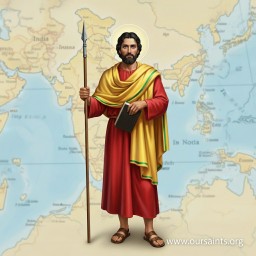
St. Thomas the Apostle, known as "Didymus" (meaning "Twin" in Greek) and "Thoma" in Syriac, stands
as one of the most profoundly human figures among the Twelve Apostles of Jesus Christ. His name in
both Greek and Aramaic identifies him as a twin, though Scripture does not reveal the identity of
his sibling. What the Gospels do reveal is a man of deep loyalty, honest questioning, and
ultimately, unshakeable faith—a transformation that would carry the Gospel of Christ to the farthest
reaches of the ancient world.
Thomas first appears in the Gospel narratives as one of the Twelve chosen by Jesus. Little is known
of his background before his calling, but like most of the apostles, he likely came from Galilee.
His personality emerges clearly in the Gospel of John, where he is shown to be devoted yet
pragmatic, willing to follow Christ unto death yet seeking concrete understanding before committing
his entire being to belief.
When Jesus announced His intention to return to Judea to visit Lazarus, knowing the danger that
awaited Him there, it was Thomas who said to his fellow disciples: "Let us also go, that we may die
with Him" (John 11:16). This declaration reveals Thomas's character—courageous, loyal, and ready to
face death alongside his Master. He did not fully understand what Jesus was about to accomplish, but
he was willing to follow Him regardless of the cost.
❓The Question That Led to Understanding
At the Last Supper, when Jesus spoke of preparing a place for His disciples and assured them that
they knew the way to where He was going, Thomas voiced the honest confusion of all present: "Lord,
we do not know where You are going, and how can we know the way?" (John 14:5). This sincere question
elicited one of the most profound declarations in all of Scripture. Jesus responded: "I am the way,
the truth, and the life. No one comes to the Father except through Me" (John 14:6).
Thomas's willingness to ask questions, to seek clarity rather than pretend understanding, ultimately
drew forth divine truth that has illuminated the path of countless believers throughout history. His
question was not born of unbelief but of a desire for genuine comprehension. He refused to rest in
vague generalities when the eternal destiny of his soul was at stake. This intellectual honesty
would prove characteristic of his entire journey of faith.
The Path to Faith
"Thomas said to Him, 'Lord, we do not know where You are going, and how can we know the way?' Jesus
said to him, 'I am the way, the truth, and the life. No one comes to the Father except through Me.'"
— John 14:5-6
🙏From Doubt to the Greatest Confession
Thomas's most famous moment came in the days following Christ's resurrection. When the risen Lord
appeared to the disciples, Thomas was not present. When the others excitedly told him, "We have seen
the Lord!" Thomas responded with words that have echoed through two millennia: "Unless I see in His
hands the print of the nails, and put my finger into the print of the nails, and put my hand into
His side, I will not believe" (John 20:25).
This response has earned Thomas the unfortunate epithet "Doubting Thomas," yet a deeper reading
reveals not stubborn unbelief but a refusal to base his faith on secondhand testimony when the
stakes were so monumentally high. Thomas had witnessed Jesus die on the cross. He had seen the
brutal reality of crucifixion, the finality of death. To believe in resurrection required more than
human testimony—it required personal encounter with the risen Christ.
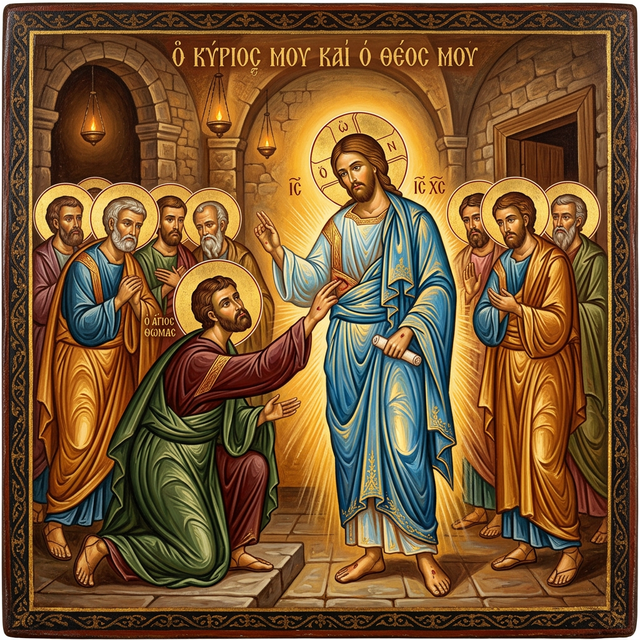
Eight days later, Jesus appeared again to the disciples, and this time Thomas was present. Christ
immediately addressed Thomas's need, showing divine compassion for honest seeking. "Reach your
finger here, and look at My hands; and reach your hand here, and put it into My side. Do not be
unbelieving, but believing" (John 20:27). The moment Thomas saw the risen Lord, before he even
touched the wounds, he made the greatest confession of faith in all the Gospels: "My Lord and my
God!" (John 20:28).
This declaration acknowledged not merely that Jesus was alive, but that He was divine—"my God!"
Thomas, who had required evidence, became the first disciple to explicitly proclaim Jesus's divinity
after the resurrection. His journey from doubt to faith becomes a pattern for all believers. Jesus's
words to him—"Thomas, because you have seen Me, you have believed. Blessed are those who have not
seen and yet have believed" (John 20:29)—were not a rebuke but an affirmation, followed by a
blessing for future generations who would believe without physical sight.
St. Thomas's confession "My Lord and my God!" represents the fullest acknowledgment of Christ's
divinity in the New Testament. The one who had doubted became the one who believed most completely,
proclaiming Jesus as both his personal Lord and his God.
🕉️The Mission to India: Foundation of the
Eastern Church
St. Thomas and the Church of India
According to ancient and venerable tradition preserved by the Saint Thomas Christians of India,
after receiving the Holy Spirit at Pentecost and preaching for a time in the regions around
Judea and Syria, St. Thomas undertook a missionary journey that would establish Christianity in
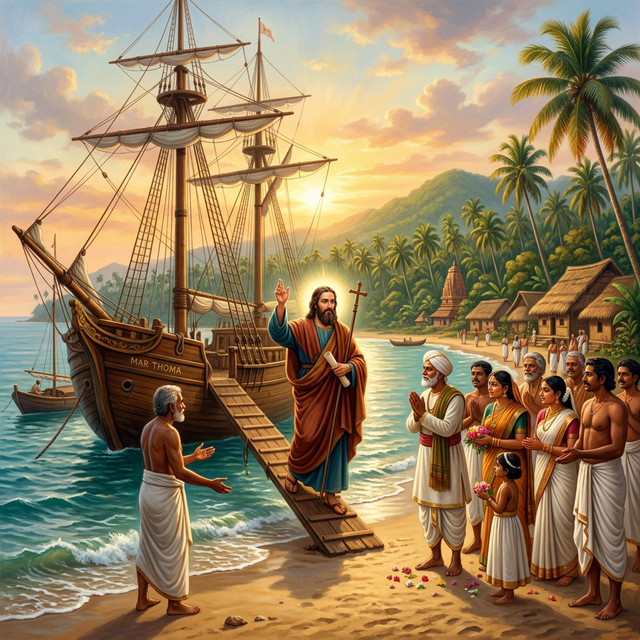
one of the most distant lands known to the apostolic age. Around 52 AD, Thomas sailed to India,
landing at Muziris (near present-day Kodungallur) on the Malabar Coast in what is now the state
of Kerala.
The journey itself was remarkable. Thomas likely traveled along established trade routes that
connected the Roman world with India. Jewish communities had long existed in Kerala, maintaining
commercial ties with the West, and Thomas, as an Aramaic-speaking Jew from Galilee, would have
found a community that could understand his language and cultural references. The Cochin Jews,
documented to have lived in Kerala during the first century, provided a cultural bridge for the
apostle's mission.
The traditional account, preserved in Malayalam songs and poems such as the "Thomma Parvam"
(Song of Thomas) and "Ramban Pattu," describes Thomas's arrival and ministry with vivid detail.
He is said to have converted Jews, native Indians of high caste, and even local royalty.
According to legend, Thomas converted 32 Brahmin families, establishing a Christian community
that would maintain its faith for nearly two thousand years. These families, whose names are
still preserved in tradition, became the foundation of what would be known as the Saint Thomas
Christians or Syrian Christians of India.
⛪The Seven Churches of St. Thomas
Central to the tradition of St. Thomas in India is his establishment of seven churches along the
Malabar Coast, known in Malayalam as "Ēḻarappaḷḷikaḷ" (Seven and a Half Churches). These foundations
represent the earliest Christian communities in India and demonstrate Thomas's systematic approach
to evangelization. Each church became a center of faith, worship, and Christian community that has
endured through the centuries.
Kodungallur
Muziris - First Landing Site
Niranam
Ancient Christian Center
Kollam
Quilon - Southern Mission
Palayur
Brahmin Conversions
Kokkamangalam
Royal Conversions
Thiruvithamcode
The "Half Church"
The last church, Thiruvithamcode, is traditionally called the "half church" because Thomas only
partially completed its construction before moving on to the eastern coast of India. These seven
churches became the nuclei of Christian communities that preserved their faith through centuries of
isolation from the rest of Christendom, maintaining Syriac liturgy and traditions that connected
them directly to the apostolic age.
The Saint Thomas Christians developed a unique identity, blending the apostolic faith brought by
Thomas with Indian cultural elements while maintaining strong connections to the Syriac-speaking
Church of the East. They used Syriac in their liturgy, preserved Thomas's teachings, and maintained
their distinct Christian identity even when cut off from Western Christianity for extended periods.
Their very existence stands as living testimony to Thomas's mission and the enduring power of the
Gospel he preached.
🌊Journey to the Eastern Coast
After establishing the churches on the Malabar Coast, Thomas crossed the Indian subcontinent to the
eastern shore, arriving at Mylapore (now part of Chennai in Tamil Nadu). Here, tradition holds that
he continued his missionary work, converting both common people and members of the royal court. The
apostle's preaching and miracles drew large crowds, and Christianity began to take root in this
region as well.
In Mylapore, Thomas is said to have converted many through his teaching about the one true God and
His Son Jesus Christ, the Savior of the world. His message of redemption, resurrection, and eternal
life challenged the prevailing Hindu and Buddhist religious systems, offering a radically different
understanding of the divine and humanity's relationship to God. Thomas's compassion for the poor and
marginalized, his miracles of healing, and his profound teaching about Christ's sacrifice all
contributed to the growth of the Christian community.
Ancient tradition speaks of Thomas's encounters with local rulers and priests. The Acts of Thomas,
an early Christian text dating to the 3rd century (though containing legendary elements), preserves
traditions about Thomas's ministry in India. While not all details can be verified historically, the
core tradition of Thomas's presence in India is strongly supported by consistent testimony from
multiple early sources and the continuous existence of the Saint Thomas Christian community itself.
✝️Martyrdom at St. Thomas Mount
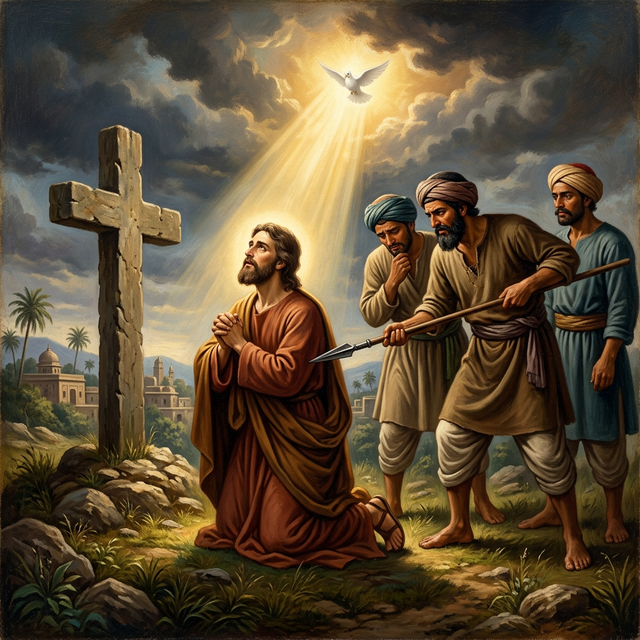
Around the year 72 AD, St. Thomas sealed his testimony with his blood. According to tradition
preserved by the Indian Christians, Thomas was praying at a small cave on what is now called St.
Thomas Mount (Parangi Malai) in Chennai when he was martyred. The circumstances of his death vary in
different accounts, but the consistent tradition holds that he was killed by those who opposed his
preaching of Christ.
One account states that Thomas was speared to death by Brahmin priests and soldiers who viewed his
conversion of high-caste Hindus as a threat to the established religious and social order. Another
tradition holds that he was martyred on the orders of a local king whose wife had converted to
Christianity. The instrument of his martyrdom is traditionally said to be a lance or spear, which
became one of his symbols in Christian iconography.
As he died, Thomas is said to have prayed for his persecutors and for the young Church he was
leaving behind, asking God to strengthen the believers and cause the faith to flourish in India. His
final words echoed his master's from the cross—forgiveness for those who killed him and confidence
in God's providential care for His Church. The place of his martyrdom became a site of pilgrimage,
and a church was later built there, where crosses carved into stone are believed to date from the
earliest Christian period.
Thomas's body was initially buried in Mylapore, where a church was built over his tomb. This site,
now occupied by the San Thome Basilica in Chennai, has been a place of pilgrimage for centuries. In
232 AD, some of his relics were translated to Edessa (modern-day Urfa in Turkey), reflecting the
connection between the Indian church and the Syriac-speaking Christianity of the Middle East.
Further portions of his relics were later moved to Ortona, Italy, where they remain enshrined today.
Archaeological excavations at San Thome Basilica in the 1950s revealed an ancient tomb and artifacts
consistent with first-century burial practices, lending credibility to the tradition that Thomas was
indeed buried at this site. The discovery included an ancient stone with a cross carved in the
Pallava script, suggesting early Christian presence.
📅Timeline of St. Thomas's Ministry
-
c. 1st Century BC - Birth
Born in Galilee, likely a fisherman before being called as an apostle
-
c. 28-30 AD - Called by Christ
Chosen as one of the Twelve Apostles of Jesus Christ
-
30-33 AD - Ministry with Christ
Witnesses Christ's miracles, teaching, death, and resurrection
-
33 AD - The Resurrection
Encounters the risen Christ, makes the confession "My Lord and my God!"
-
33 AD - Pentecost
Receives the Holy Spirit with the other apostles in Jerusalem
-
33-52 AD - Early Ministry
Preaches in Judea, Syria, and possibly Mesopotamia
-
52 AD - Arrival in India
Lands at Muziris on the Malabar Coast, begins evangelization of India
-
52-60 AD - Seven Churches
Establishes the seven churches along the Malabar Coast
-
60-72 AD - Eastern India
Travels to Mylapore, continues evangelization on the eastern coast
-
72 AD - Martyrdom
Martyred at St. Thomas Mount near Mylapore, buried at San Thome
🌍The Saint Thomas Christians: A Living Legacy
The Saint Thomas Christians of India, also known as Syrian Christians, Nasrani Christians, or
Thomasine Christians, represent one of the oldest continuous Christian communities in the world.
Their existence provides powerful testimony to the historicity of Thomas's mission. These
communities maintained their Christian identity through centuries of geographical isolation from the
rest of Christendom, preserving Syriac liturgical traditions and apostolic practices that link them
directly to the earliest days of the Church.
For nearly 1,500 years, the Saint Thomas Christians maintained communion with the Church of the East
(the Persian Church), receiving bishops, liturgical texts, and theological guidance from Mesopotamia
and Persia. This connection explains their use of Syriac language in worship and their preservation
of East Syriac theological and liturgical traditions. The Patriarch of the Church of the East held
ecclesiastical authority over these Indian Christians, sending bishops and maintaining spiritual
oversight despite the great distance.
When Portuguese colonizers arrived in India in the late 15th century, they were astonished to find
thriving Christian communities that predated their own missionary efforts by more than a millennium.
The Portuguese initially embraced these Christians but later attempted to bring them under Latin
Catholic authority, leading to conflicts that resulted in schisms within the community. Some
accepted union with Rome, while others maintained their ancient independence, eventually coming
under the authority of various Eastern Orthodox and Oriental Orthodox patriarchates.
Today, the Saint Thomas Christian community comprises several million adherents distributed across
various denominations, including the Syro-Malabar Catholic Church, the Syro-Malankara Catholic
Church, the Malankara Orthodox Syrian Church, among others. Despite these denominational divisions,
all trace their origins to St. Thomas the Apostle and maintain elements of the ancient Syriac
liturgical tradition. Notably, the Malankara Syrian Orthodox Church and the Syro-Malankara Catholic
Church adhere to the West Syriac liturgical tradition, derived from the Syriac Orthodox Church of
Antioch.
The Syriac Connection
The liturgical and theological traditions of the Saint Thomas Christians demonstrate their
connection to the Syriac-speaking Christianity of Antioch, Edessa, and Mesopotamia. They used
(and many still use) the Syriac language in worship, employed Syriac scripts for writing
Malayalam, and preserved theological formulations from the early Syriac fathers. This living
connection to the Syriac tradition makes them spiritual siblings to the Syriac Orthodox Church
and other ancient Eastern churches.
The title "Mor Thoma" (Saint Thomas) in Syriac is cherished by these communities, and many
churches and institutions bear his name. The preservation of Syriac liturgical music, prayers,
and biblical texts in India represents a remarkable cultural and religious continuity spanning
nearly two millennia. Even as Malayalam became the vernacular language of worship for many, the
Syriac heritage remained central to their identity as bearers of an apostolic tradition.
📖Thomas in Scripture and Tradition
Beyond the Gospel accounts, St. Thomas is mentioned in the Acts of the Apostles (1:13) as being
present in the Upper Room after the Ascension. Early Church fathers and historians provide testimony
to his ministry. St. Ephrem the Syrian (4th century), one of the great doctors of the Syriac Church,
wrote hymns celebrating Thomas's mission to India. St. Gregory of Nazianzus, St. Ambrose, and St.
Jerome all reference Thomas's evangelization of the East, with some specifically mentioning India or
Parthia.
The Acts of Thomas, though containing legendary elements, preserves early traditions about Thomas's
journey and ministry. Written in Syriac in the early 3rd century, it reflects the understanding of
the ancient Syriac-speaking Church regarding Thomas's apostolic work. While modern scholars debate
the historical accuracy of specific details in this text, the core tradition it preserves—that
Thomas evangelized the East and died a martyr—is corroborated by multiple independent sources.
Eusebius, the 4th-century Church historian, records that Pantaenus of Alexandria (2nd century) found
Christians in India who possessed a Gospel of Matthew in Hebrew that had been left with them by the
Apostle Bartholomew or Thomas. This testimony, though brief, indicates that by the 2nd century, it
was commonly accepted that apostolic Christianity had reached India. The consistency of this
tradition across different geographical regions and time periods strengthens its credibility.
💎Lessons from the Apostle Thomas
St. Thomas teaches us that honest doubt, when pursued with sincerity, can lead to the deepest faith.
His refusal to believe without evidence was not the mark of a skeptic who wished to disbelieve, but
of a seeker who needed certainty before committing his entire being. Christ honored this honest
seeking by providing the evidence Thomas needed. The Church has always recognized that faith and
reason are not enemies but partners in the pursuit of truth.
Thomas also demonstrates that those who struggle with belief can become the most ardent witnesses
once they encounter the truth. His confession "My Lord and my God!" surpasses all other apostolic
declarations in its explicit acknowledgment of Christ's divinity. The one who doubted became the one
who believed most fully. His journey reminds us that God meets us in our questions and transforms
our struggles into testimonies of His grace.
The scope of Thomas's missionary work—traveling from Jerusalem to the furthest reaches of the known
world—exemplifies the universal mission of the Church. He did not remain in comfortable, familiar
surroundings but ventured into foreign lands, learned new languages and customs, and proclaimed
Christ in cultures vastly different from his own. His willingness to cross geographical, linguistic,
and cultural barriers to share the Gospel challenges every generation of Christians to do likewise.
Finally, Thomas's martyrdom reminds us that authentic Christian witness may cost us everything. He
could have remained in Galilee, living quietly as a disciple who had known Jesus. Instead, he chose
to carry the Gospel to distant lands, knowing the risks involved. When faced with death, he did not
recant but sealed his testimony with his blood, joining the great cloud of martyrs who considered
Christ worth dying for.
Christ's Blessing Through Thomas
"Jesus said to him, 'Thomas, because you have seen Me, you have believed. Blessed are those who have
not seen and yet have believed.'" — John 20:29
🙏The Patron Saint of
India
The Syrian Orthodox Church honors Saint Thomas as one of the great Apostles and the Patron Saint of
India, celebrating his feast (Dukrono) on July 3rd. Liturgical commemorations specifically honor his
confession of Christ’s divinity, his missionary journeys to the Indian subcontinent, and his
glorious martyrdom on Indian soil. Having brought the light of Christ to India in 52 AD and
establishing churches from Muziris to Mylapore, liturgical hymns praise him as "Mor Thoma"—the
apostolic forefather of Indian Christianity who has remained its spiritual pillar through the
centuries. As the Patron of India, Saint Thomas sanctified this land with his apostolic presence and
shed his precious blood in Mylapore, forever transforming India into a holy land blessed by a direct
apostolic foundation.
Believing that honest inquiry leads to an encounter with Divine Truth, his example encourages the
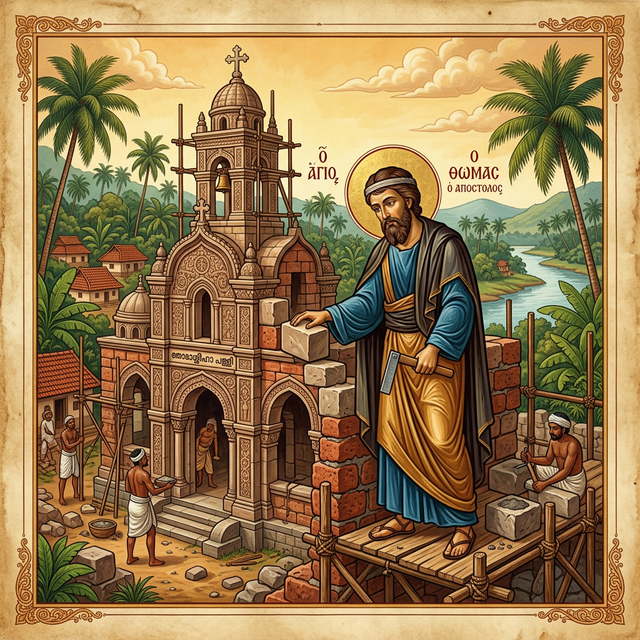
faithful to bring their questions before God rather than suppressing them. Reflecting the tradition
that he worked as a builder during his ministry in India, he is also the patron of architects and
builders. Most importantly, he stands as the eternal guardian and protector-father of India and all
Saint Thomas Christian communities, preserving the Orthodox faith in this land through times of
persecution, trial, and the challenges of modernity.
Pilgrimage sites associated with Saint Thomas, the Patron Saint of India, continue to attract
Christians from around the world. The San Thome Basilica in Chennai stands over the tomb of the
Apostle who became a martyr for Christ, while St. Thomas Mount marks the site of his martyrdom where
his blood sanctified the Indian soil. In Kerala, the seven-and-a-half churches he
established—Kodungallur, Palayur, Kottakkavu, Kokkamangalam, Niranam, Nilackal, Kollam, and
Thiruvithamcode—remain active places of worship and living testimonies to his apostolic mission. In
Ortona, Italy, pilgrims venerate his relics at the St. Thomas Cathedral.
Each of these sites serves as a tangible link to the Apostle who walked with Christ and carried His
message to the ends of the
earth, establishing India as a beloved portion of Christ’s inheritance.
Prayer to St. Thomas the Apostle
O glorious Saint Thomas, beloved apostle of Jesus Christ, you who walked with the Lord and
touched His sacred wounds, who declared with full conviction "My Lord and my God": grant us the
grace to encounter Christ in our own doubts and questions, that our seeking may lead us to
deeper faith. You who traveled to distant India, crossing seas and mountains to proclaim the
Gospel, who established churches that endure to this day: inspire in us the same missionary zeal
and courage to share Christ with all nations. You who sealed your witness with martyrdom, giving
your life rather than deny the truth: strengthen us to remain faithful in times of persecution
and trial. O Holy Apostle Thomas, Mor Thoma, patron of India and friend of all who seek
understanding: intercede for us before the throne of grace, that we may grow in faith, hope, and
love, and one day join you in the glory of God's kingdom. Through Christ our Lord. Amen.