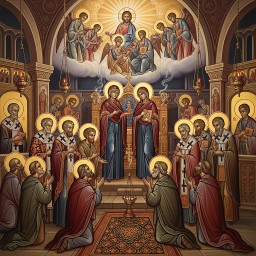
⛪The Communion of Saints: A Living Reality
The doctrine of the communion of saints stands as one of the most beautiful and profound teachings
of the Syriac Orthodox Church, expressing our firm belief that the Church is not divided by death
but remains one body united in Christ across the boundaries of time and eternity. When we confess in
the Nicene Creed "one holy, catholic, and apostolic Church" and profess belief in "the communion of
saints," we are affirming that the Church consists not only of those living on earth but also of the
saints who have departed this life and now stand before the throne of God. This understanding
transforms our experience of worship, prayer, and Christian life, for we recognize that we are never
alone but are surrounded by "a great cloud of witnesses" (Hebrews 12:1) who accompany us on our
pilgrimage toward the kingdom.
The communion of saints is not a sentimental notion or pious metaphor but a theological reality
rooted in the mystery of the Incarnation and the nature of the Church as the Body of Christ. Because
Christ assumed human nature and united it to His divine Person, and because through baptism we are
incorporated into His Body, all who belong to Christ share in one organic life. Death does not sever
this union; rather, those who die in Christ pass from the Church Militant (struggling on earth) to
the Church Triumphant (reigning with Christ in heaven), but both remain parts of the one Body. As
St. Paul writes, "If one member suffers, all suffer together; if one member is honored, all rejoice
together" (1 Corinthians 12:26). This solidarity extends beyond earthly life into eternity.
The Syriac theological tradition has always emphasized the corporate nature of salvation and the
interconnectedness of all believers. St. Ephrem the Syrian frequently employs the imagery of the
Church as a garden in which many flowers bloom, each contributing its unique beauty to the whole.
The saints are the most radiant flowers in this garden, those who have brought forth fruit in
abundance—some thirtyfold, some sixtyfold, some a hundredfold. Their holiness does not isolate them
from us but rather draws them closer, for perfect love casts out all selfishness, and the saints,
perfected in love, desire nothing more than the salvation of their brethren still struggling in this
world.
The distinction between worship (latria) given to God alone and veneration (dulia) given to saints is
crucial in Orthodox theology. We do not worship saints as if they were divine; rather, we honor them
as friends of God who have achieved the purpose of human existence—union with God—and who continue
to assist us through their prayers and example. The honor we show to saints ultimately glorifies
God, the source of all holiness.
👑The Theotokos: First Among the Saints
In the hierarchy of veneration, the Blessed Virgin Mary, the Theotokos (God-bearer), holds a unique
and exalted position. She is honored above all angels and saints as the one whom God chose to be the
Mother of the Incarnate Word. The title Theotokos, defined at the Council of Ephesus in 431 AD, is
not merely an honorific but a profound Christological affirmation: if Mary is truly the Mother of
God, then her son is truly God incarnate, not merely a human being to whom divinity was later
attached. The defense of this title by St. Cyril of Alexandria and the Syriac Orthodox fathers was
ultimately a defense of the Incarnation itself.
In Syriac tradition, Mary is addressed with numerous beautiful titles that express various aspects
of her dignity and role in salvation history: Yoldath Aloho (Mother of God), Bethulto Qadishto (Holy
Virgin), Malkath Shmayo wa'Ar'o (Queen of Heaven and Earth), and Sittena (Our Lady). The liturgical
texts of the Church overflow with praise for her purity, her obedience, her humility, and her
motherly intercession. St. Ephrem composed entire cycles of hymns celebrating her virtues, calling
her "the beautiful dove," "the pure lamp," "the spiritual vineyard," and "the dwelling place of the
Most High."
The veneration of the Theotokos in Syriac Orthodox practice includes special liturgies, feast days
throughout the year, and the custom of seeking her intercession in all circumstances. Her major
feasts include the Nativity of the Theotokos (September 8), the Presentation in the Temple (November
21), the Annunciation (March 25), and the Dormition or "Falling Asleep" (August 15). Each of these
feasts celebrates a moment in her participation in the mystery of redemption. The Church teaches
that Mary, having been preserved from sin through her cooperation with divine grace, was assumed
body and soul into heaven at the end of her earthly life, becoming the first-fruits of the
resurrection and a sign of hope for all humanity.
Mary's intercession is considered especially powerful because of her unique relationship with
Christ. As His mother, she possesses a particular boldness before His throne, and the Syriac
liturgical texts frequently invoke her maternal mediation: "O Virgin Mary, who bore the Word of God
in your womb, intercede for us before your Son that He may grant us forgiveness of our sins." This
invocation reflects the biblical scene at the wedding of Cana, where Mary's intercession prompted
Christ's first miracle. If Christ heeded His mother's request then, how much more will He hear her
prayers now, when she stands glorified before His throne in heaven?
✝️The Apostles: Foundations of the Church
The holy apostles hold a foundational place in the Church's structure and spirituality, for they
were chosen directly by Christ, witnessed His earthly ministry, received the Holy Spirit at
Pentecost, and carried the Gospel to the ends of the known world. The Syriac Orthodox Church traces
its origins to the apostolic preaching, particularly that of St. Peter who established the See of
Antioch, and St. Thomas who evangelized the East and brought the faith to India. The commemoration
of the apostles is therefore not merely historical remembrance but recognition of the living
foundation upon which the Church continues to stand.
Each apostle is honored on his individual feast day, and collectively they are commemorated on the
Friday after Pentecost and throughout the apostolic season. The liturgical texts celebrate their
abandonment of worldly pursuits to follow Christ, their witness to His resurrection, their suffering
and martyrdom for the faith, and their continuing presence in the Church through apostolic
succession and the sacraments they instituted. St. Jacob of Sarug composed magnificent homilies on
the apostles, portraying them as spiritual athletes who ran the race and won the crown, as wise
fishermen who caught the world in the net of the Gospel, and as luminous stars illuminating the
darkness of paganism.
Special veneration is accorded to St. Peter and St. Paul, the "chief apostles," whose combined feast
is celebrated on June 29. St. Peter, the Rock on whom Christ built His Church, is honored as the
first Patriarch of Antioch and the model of repentance and pastoral care. St. Paul, the Apostle to
the Gentiles, is celebrated for his theological profundity, his tireless missionary journeys, and
his epistles that continue to instruct the Church. Together, they represent the union of Jewish and
Gentile Christianity and the universality of the Gospel message.
The Syriac tradition also honors St. Thomas the Apostle with particular affection, especially in the
Indian branch of our Church. According to ancient tradition, St. Thomas arrived in India in 52 AD
and established Christian communities along the Malabar Coast, communities that maintain the Syriac
liturgical and theological heritage to this day. His feast is celebrated with special solemnity in
Malankara, where numerous ancient churches bear his name and preserve the memory of his missionary
labors and martyrdom.
🔥The Martyrs: Witnesses in Blood
The veneration of martyrs constitutes one of the oldest and most fundamental forms of Christian
devotion, dating back to the age of persecutions when Christians gathered at the tombs of those who
had sealed their faith with blood. The very word "martyr" means "witness," and the martyrs are
supremely witnesses to Christ, having loved Him more than their own lives. Their testimony is
considered especially credible because it was confirmed not merely by words but by the ultimate
sacrifice. As Tertullian famously declared, "The blood of martyrs is the seed of the Church."
The Syriac Orthodox Church has been blessed—or perhaps we should say "baptized"—with countless
martyrs throughout its history. From the earliest persecutions under Roman emperors through the
medieval Islamic conquests, the Mongol invasions, the Ottoman oppression, and the modern genocides
of the twentieth century, Syriac Christians have repeatedly been called to witness to their faith
unto death. The Sayfo (Assyrian Genocide) of 1915, which occurred simultaneously with the Armenian
Genocide, claimed hundreds of thousands of Syriac Orthodox lives. These modern martyrs join the
ancient witnesses—St. Ignatius of Antioch torn by lions in the Colosseum, St. Romanos who had his
tongue cut out yet miraculously continued to praise God, St. Barbara tortured by her own father for
refusing to renounce Christ, and countless others known and unknown.
The veneration of martyrs includes several practices deeply rooted in Syriac tradition. Their feast
days are celebrated with special liturgies that recount their struggles and victories. Their
relics—physical remains or objects associated with them—are treasured and often enshrined beneath
church altars, symbolizing that the Eucharistic sacrifice is offered in unity with their
self-sacrifice. Pilgrims visit their tombs seeking healing and blessing, confident that the martyrs'
prayers are powerful before God. The faithful give their names to children, hoping that the child
will emulate the martyr's faith and courage.
The theological significance of martyrdom extends beyond individual salvation. The martyrs, through
their willing acceptance of death, participated in Christ's own passion and became living icons of
His crucifixion and resurrection. Their suffering was not meaningless but redemptive, contributing
to the building up of the Church and the defeat of evil. In the Syriac liturgical texts, martyrs are
called "athletes of Christ," "brave warriors," "radiant lamps," and "victorious champions." Their
deaths are not occasions for mourning but for celebration, for they died to sin and the world and
now live eternally with Christ.
The commemoration of martyrs in the Holy Qurbono through the reading of the "Tubden" (Diptychs) in
the Fifth Prayer demonstrates their integral place in our liturgical life. When we recite the names
of martyrs during the Divine Liturgy, we affirm our communion with them and invoke their
intercession. This practice dates to the earliest centuries when the names of local martyrs were
read aloud during the Eucharistic celebration.
📖The Confessors and Holy Fathers
While martyrs witnessed to Christ through their blood, confessors witnessed through their
lives—through years of faithful service, theological defense of the faith, ascetic struggle, or
pastoral care. The term "confessor" in early Christian usage referred to those who endured
persecution and torture but survived, later coming to include all who confessed Christ courageously
whether in word or deed. The Syriac Orthodox Church honors numerous confessors who suffered exile,
imprisonment, and hardship for refusing to compromise the orthodox faith, particularly during the
Christological controversies of the fifth and sixth centuries.
Among the confessors, the holy fathers—the great theologians, bishops, and teachers of the
Church—occupy a place of special honor. These are the men who articulated the faith in precise
theological language, refuted heresies, established liturgical norms, and guided the Church through
crises. The Syriac tradition particularly venerates St. Ephrem the Syrian, "the Harp of the Holy
Spirit," whose hymns and biblical commentaries shaped Syrian Christian spirituality; St. Jacob of
Sarug, "the Flute of the Holy Spirit," whose metrical homilies provided theological instruction in
poetic form; St. Severus of Antioch, the brilliant defender of Cyrillian Christology who suffered
exile for his convictions; St. Philoxenos of Mabbug, theologian and martyr; and St. Jacob Baradaeus,
who preserved the non-Chalcedonian Church during the darkest period of persecution.
The contributions of these fathers extend far beyond their own lifetimes. Their theological writings
continue to be studied, their liturgical compositions continue to be chanted, their spiritual wisdom
continues to guide the faithful. When we celebrate their feast days and invoke their intercession,
we acknowledge our debt to them and our continuity with the tradition they transmitted. The
commemoration of the fathers in the Tubden during the Holy Qurbono—reciting names like "Mor Severus,
Mor Philoxenos, Mor Jacob"—is not a mere historical exercise but an affirmation that these holy men
remain living members of the Church, actively participating in its prayer and mission.
The monastic fathers, who withdrew to deserts and mountains to pursue lives of prayer and
asceticism, form another category of confessors. Figures like St. Symeon the Stylite, who spent
decades atop a pillar in prayer; St. Abraham Qidunaya, the hermit of Qidun; St. Maro, founder of the
Maronite tradition; and countless desert fathers and mothers who populated the wildernesses of Syria
and Egypt—all these demonstrated through their extraordinary ascetic feats that the kingdom of God
is worth any sacrifice, that the world is not worthy to be compared to union with Christ. Their
radical commitment challenges the comfortable Christianity of every age and calls believers to take
up their cross and follow Christ without reservation.
🖼️Icons: Windows to Heaven
The veneration of saints finds visible expression in the sacred art of icons, which adorn Syriac
Orthodox churches, homes, and prayer corners. Icons are not mere decorations or didactic
illustrations but sacramental presences—"windows to heaven" through which the faithful encounter the
spiritual realities they depict. The theology of icons is grounded in the Incarnation: because God
became visible in Christ, the invisible can now be depicted. The icon of Christ testifies that God
truly assumed material flesh and sanctified matter as a vehicle of grace.
Syriac iconography developed its own distinctive style, influenced by both Byzantine and indigenous
Syrian artistic traditions. While sharing the basic theological principles of Eastern Christian
iconography—the use of reverse perspective, gold backgrounds symbolizing divine light, stylized
rather than realistic features emphasizing the spiritual rather than material aspect—Syriac icons
often display unique characteristics such as larger eyes (symbolizing spiritual vision), more
frontal poses (emphasizing direct encounter), and incorporation of Syriac inscriptions identifying
the saint depicted.
The production of icons is itself a spiritual discipline. Iconographers traditionally prepare
through prayer and fasting, approaching their work as a form of worship rather than mere artistic
endeavor. The writing of an icon (Orthodox tradition speaks of "writing" rather than "painting"
icons, emphasizing their status as sacred texts) follows established patterns and symbolism,
ensuring theological accuracy and continuity with tradition. The completed icon is blessed by the
priest before being placed for veneration, a ritual that acknowledges the icon as a sacred object
through which God's grace operates.
The veneration of icons includes several practices: bowing or prostrating before them, kissing them,
lighting candles or lamps before them, censing them with incense, and praying before them. These
acts are not directed to the material object itself but through it to the person depicted. As St.
John of Damascus explained in his defense of icons against the Iconoclasts, "I do not worship
matter, I worship the Creator of matter who became matter for my sake." The icon serves as a point
of contact between heaven and earth, a means through which the saint's intercession is accessed and
God's grace is mediated.
📅Feast Days: Sanctifying Time
The liturgical calendar of the Syriac Orthodox Church is organized around the commemoration of
saints, their feast days sanctifying time and providing a rhythm for spiritual life. Every day of
the year has its assigned saints, ensuring that the faithful are constantly reminded of the cloud of
witnesses surrounding them. The calendar includes major feasts (like those of the Theotokos and
chief apostles), memorial days of significant fathers and martyrs, and daily commemorations of
lesser-known saints.
The celebration of a saint's feast day typically includes special prayers, hymns, and readings
during the Divine Liturgy and the daily offices. The liturgical texts for the feast recount the
saint's life, virtues, and miracles, providing both instruction and inspiration. In parishes named
after particular saints, the patronal feast is celebrated with special solemnity, often including an
all-night vigil, festive Qurbono, processions, and community gatherings. These celebrations
strengthen parish identity and foster devotion to the patron saint.
The faithful observe feast days through various practices: attending liturgical services, fasting
beforehand (many major feasts are preceded by fasting periods), preparing special foods, giving
charity in the saint's name, and gathering with family to share stories of the saint's life.
Children are taught about the saints whose names they bear, learning their feast days and life
stories. This integration of saints' commemorations into family and community life ensures that the
communion of saints remains not an abstract doctrine but a lived reality shaping daily existence.
🙏Intercession: The Power of Saintly Prayer
The belief in the intercessory power of saints' prayers forms a cornerstone of Syriac Orthodox
spirituality. This belief rests on several scriptural and theological foundations. First, Scripture
testifies that the prayers of the righteous are powerful and effective (James 5:16). If this is true
during earthly life, how much more is it true of the righteous who now stand perfected before God's
throne? Second, the Book of Revelation depicts the saints in heaven offering the prayers of the
faithful before God (Revelation 5:8, 8:3-4), indicating their active role in the Church's prayer
life. Third, the principle of mutual intercession within the Body of Christ, which operates among
living Christians, logically extends to those who have died in Christ, for death does not sever the
bonds of the Body.
The practice of seeking saints' intercession does not imply that we cannot approach God directly
through Christ. Rather, it recognizes the scriptural pattern of asking others to pray for us and the
value of approaching God in the company of His friends. When we ask the Theotokos or a saint to pray
for us, we are not bypassing Christ but rather approaching Him with the saint, bringing the saint's
prayers alongside our own. This practice reflects both humility (recognizing our own unworthiness)
and wisdom (seeking the assistance of those who have already attained the goal we pursue).
The Syriac liturgical tradition includes numerous prayers invoking saints' intercession. The Hoosoyo
prayers concluding each office typically ask for the prayers of "the God-bearer Mary, the apostles,
martyrs, confessors, and all saints." The anaphoras of the Holy Qurbono include the commemoration of
saints by name, asking that through their prayers and intercessions, God would accept our offerings.
Hymns frequently address saints directly: "O St. George, victorious martyr, intercede for us"; "O
St. Ephrem, harp of the Spirit, pray for the Church you served." This constant invocation creates an
atmosphere of communion, reminding worshippers that they pray not alone but in solidarity with the
entire Church, visible and invisible.
⭐Toward Theosis: Saints as Models and Guides
The ultimate purpose of venerating saints is not merely to honor their memory or benefit from their
prayers but to follow their example in the pursuit of theosis—union with God, the goal of Christian
existence. The saints are not spiritual aristocrats whose holiness was uniquely gifted to them;
rather, they are ordinary humans who, through cooperation with divine grace, ascetic struggle, and
faithful perseverance, achieved the purpose for which all humans were created: to become by grace
what God is by nature.
As St. Athanasius proclaimed, "God became man so that man might become god." This striking formula,
echoed throughout patristic literature, expresses the conviction that the Incarnation opened the way
for humanity to participate in divine life. The saints are those who walked this path to its
completion. Their lives demonstrate that holiness is possible, that transformation is real, that the
Christian claim to offer eternal life is not mere rhetoric but attainable reality. When we venerate
saints, we are acknowledging their success in the spiritual life and seeking to learn from their
example and benefit from their guidance.
Each saint offers a particular model of holiness adapted to different temperaments and vocations.
The martyrs teach courage and radical commitment. The ascetics teach detachment and self-mastery.
The bishops and fathers teach faithful teaching and pastoral care. The monastics teach the primacy
of prayer and contemplation. The righteous lay people teach how to sanctify ordinary life. By
studying their lives, reading their writings, celebrating their feasts, and seeking their
intercession, we allow ourselves to be shaped by their sanctity, gradually conforming our lives to
their pattern, which is ultimately the pattern of Christ Himself.
The communion of saints thus becomes not a static reality but a dynamic force propelling believers
toward holiness. We do not venerate saints as distant figures from a remote past but as living
companions on our journey, older brothers and sisters in the faith who have completed the race and
now cheer us on from the heavenly grandstands. Their prayers support us in our weakness, their
examples inspire us in our mediocrity, and their intercession draws down God's grace to enable our
transformation. In this way, the veneration of saints is inseparably linked to our own
sanctification, for by honoring them, we commit ourselves to following the path they trod—the narrow
way that leads to life, the way of the Cross that leads to resurrection, the way of theosis that
leads to eternal union with the Triune God.
Prayer Invoking the Saints' Intercession
O Lord Jesus Christ, who has surrounded us with a great cloud of witnesses, the holy Theotokos, the
apostles, prophets, martyrs, confessors, holy fathers, and all the righteous perfected in faith, we
glorify You for the grace You have given them and the example they have left us. Through their holy
prayers and intercessions, have mercy upon us sinners. May we follow in their footsteps, imitate
their virtues, and share in their blessedness. Grant us grace to run with perseverance the race set
before us, looking to You, the author and perfecter of our faith, that we may attain with them the
incorruptible crown of glory. For You are our sanctification, and to You we ascribe glory, together
with Your eternal Father and Your all-holy, good, and life-giving Spirit, now and always and
forever. Amen.