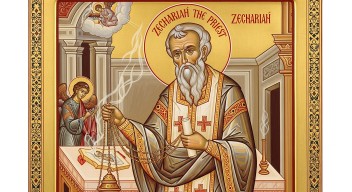
👑Life and Witness of St. Zechariah the Priest
In the sacred heritage of the Syriac Orthodox Church, St. Zechariah (Zakariya in Syriac, ܙܟܰܪܝܳܐ) is
honored as one of the last and most noble priests of the Old Covenant who directly witnessed the
dawn of the New Testament revelation. My life forms a bridge between the Law and the Gospel, between
the Temple of Jerusalem with its sacrificial worship and the Church of Christ with its eternal
priesthood. The canonical Scriptures present him not merely as a historical figure, but as a
righteous and devout priest whose faith, obedience, and ultimately his martyrdom prepared the way
for the coming of the Messiah through his remarkable son, St. John the Baptist, the Forerunner and
Herald.
The Syriac Orthodox Church venerates St. Zechariah with deep reverence—not only as the earthly
father of John the Baptist, but also as a priest who became a martyr and prophet. His life reveals
with extraordinary clarity the transition from the silence of the Law to the voice crying in the
wilderness: "Prepare ye the way of the Lord, make His paths straight." Through his witness, we see
how the ancient priesthood gave way to the eternal High Priesthood of Christ, and how human weakness
and silence can become instruments of God's most triumphant revelation.
🏛️Priestly Lineage and Character
According to the Gospel of St. Luke (1:5), Zechariah belonged to the division of Abijah (ܦܶܠܓܳܐ
ܕܰܐܒܺܝܳܐ), one of the twenty-four priestly courses established by King David in the organization of
the Temple worship (1 Chronicles 24:10). This division was organized so that priests would serve in
rotation, ensuring that the perpetual sacrifice and sacred service of the Temple continued
uninterrupted throughout the year. Each course served for two weeks and included numerous priests
who shared the duties of the Temple.
Zechariah's wife was St. Elizabeth, as we have discussed, herself of the priestly lineage of Aaron.
Thus, Zechariah's family represented the spiritual continuity of the Aaronic priesthood—a lineage
that for over a thousand years had served God faithfully in the Temple of Jerusalem. His entire
household was devoted to the sacred ministry; his calling was not merely an inherited privilege but
a divine vocation.
The Gospel of Luke provides a powerful assessment of Zechariah's character, describing both him and
Elizabeth as "righteous before God, walking in all the commandments and ordinances of the Lord
blameless" (Luke 1:6, ܦܽܘܩܕܳܢܰܘܗ݈ܝ ܘܙܰܕܺܝܩܽܘܬ݂ܶܗ ܕܡܳܪܝܳܐ). This testimony is not a casual statement;
it underscores that Zechariah was no ordinary priest. He was a man of deep piety, careful observance
of the Law, and unwavering devotion to God. Despite living in an era when priestly corruption was
not uncommon, Zechariah maintained a spotless reputation for righteousness and purity.
The Syriac Fathers, particularly the great hymnographer and theologian Mar Jacob of Sarug (St. Jacob
of Serugh, d. 521 AD), often refer to Zechariah as "the last priest of the silent Law" (ܩܰܫܺܝܫܳܐ
ܐܰܚܪܳܝܳܐ ܕܰܥܡܽܘܬ݂ܳܐ ܘܬܶܟܒܬ݂ܳܐ). This designation carries profound theological weight. It signifies
that after Zechariah, the purpose and meaning of the Mosaic priesthood would be fulfilled and
transformed in Christ, the eternal High Priest, who needs no successor. Zechariah's faithfulness,
therefore, stands as the final, radiant echo of the ancient covenant before the fullness of grace
appeared in the Incarnation of the Son of God.
🕯️The Angelic Vision in the Temple of Jerusalem
The turning point—the moment that transformed Zechariah's life from that of a righteous but aging
priest into a herald of the New Covenant—came during his priestly service in the Temple of
Jerusalem. The circumstances were ordinary at first: as was the custom and according to the
divisions of labor, priests were chosen by lot to perform the sacred duty of offering incense before
the Holy of Holies (the inner sanctuary where only the High Priest could enter on the Day of
Atonement, and before which even the other priests made their offerings).
To be chosen to offer incense in the Temple was considered a great honor, often granted only once or
twice in a priest's lifetime. It was a solemn moment, fraught with religious significance. The
priest would ascend the steps of the altar, carry the censer containing burning coals and fragrant
incense, and offer them before the veil of the Holy of Holies, where the Shekinah glory of God
dwelt. This was the pinnacle of priestly service—a direct approach to the very presence of God,
accompanied by prayers for the people's redemption and the coming of the Messiah.
It was at this sacred and climactic moment that the Archangel Gabriel appeared to Zechariah,
standing at the right side of the altar of incense (Luke 1:11). The entire sanctuary was filled with
the presence of the angel—a theophany, a visible manifestation of divine power. Gabriel's appearance
was not hidden or subtle; it was the dramatic intervention of heaven into history, a sign that the
long silence between God and His people was about to end. For four hundred years, since the time of
Malachi the last canonical prophet, heaven had been silent. No word from the Lord had come to
Israel. But now, at the very heart of the Temple, amid the incense and prayers of the old covenant,
the messenger of God appeared to announce the fulfillment of all Israel's hopes.
Gabriel's message to Zechariah was extraordinary. The angel announced that Zechariah's prayers had
been heard—prayers, we must understand, not merely for a child (for children were ultimately a
blessing but not a necessity for salvation), but for the coming of the Messiah, prayers that had
characterized the faithful of Israel for centuries. The angel then declared: "Your wife Elizabeth
will bear you a son, and you shall call his name John" (Yohannan, ܝܽܘܚܰܢܳܢ).
But this was no ordinary birth announcement. Gabriel revealed that the child would be "great in the
sight of the Lord" and "filled with the Holy Spirit even from his mother's womb." The angel further
disclosed that this child would "turn back many of the children of Israel to the Lord their God" and
that "he will go before Him in the spirit and power of Elias [Elijah], to turn the hearts of the
fathers to the children, and the disobedient to the wisdom of the righteous—to make ready for the
Lord a people prepared" (Luke 1:15–17).
The Syriac Orthodox Church perceives this scene as a divine encounter that unites and reveals the
continuity between the Old and New Testaments. The angel's appearance in the Temple—that holiest of
places, where for centuries prayers had been offered for the coming of the Messiah—signifies that
the long-awaited promise of God was now about to be fulfilled. The silence of heaven was broken;
prophecy, which had been stilled for four hundred years since Malachi, was reawakened through the
voice of Gabriel and would soon continue through the voice of John crying in the wilderness.
🤐Doubt, Silence, and the Symbol of
Transformation
When Zechariah heard these astonishing words, his human mind struggled to comprehend them. He
responded to Gabriel with a question born of doubt and human reasoning: "How shall I know this? For
I am an old man, and my wife is well advanced in years" (Luke 1:18). The question was reasonable by
human logic. Both Zechariah and Elizabeth had lived long lives; childbearing was biologically
impossible. Zechariah's doubt was understandable—and yet, it revealed a failure of faith at a
crucial moment. He did not trust fully in the angel's word, in God's power to accomplish what He had
declared.
Gabriel's response was swift and significant: "I am Gabriel, who stand in the presence of God... and
behold, you will be mute and not able to speak until the day these things take place, because you
did not believe my words which will be fulfilled in their proper time" (Luke 1:19–20).
Immediately, Zechariah became unable to speak. He was struck dumb—his tongue bound, his voice
silenced. This judgment might seem harsh by human standards, but within the theology of the Syriac
Orthodox Church, it carries layers of mystical and spiritual meaning far beyond mere punishment for
disbelief.
In Syriac theological interpretation, Zechariah's muteness is understood as a profound mystical sign
and symbol of the times in which he lived. It represents nothing less than the silence of the old
covenant, the silence of the Law that could not fully speak the love and mercy of God. The Law,
given at Sinai through Moses with thunder and fear, was preparation—but preparation could not itself
accomplish salvation. The Law could command obedience, could expose sin, could establish
boundaries—but it could not transform the human heart or grant eternal life. Thus, in a mystical
sense, the Law itself was silent about ultimate redemption; it pointed toward something beyond
itself.
The great Syriac Father Mar Jacob of Sarug wrote with poetic profundity on this mystery:
"The priest's tongue was bound, that the child's tongue might proclaim freedom.
In silence, the Law was bound, that Grace might speak aloud in the wilderness.
The old man lost his voice, that the Forerunner's cry might shake the foundation of all things."
Zechariah's silence foreshadows the ultimate fading of the Law's voice and the emergence of the
prophetic voice of John the Baptist, who would cry aloud in the wilderness like a voice that cannot
be silenced: "Prepare ye the way of the Lord!" In Zechariah's muteness, we see the Law coming to its
silence; in the birth of John, we see prophecy awakening from its long sleep.
Yet Zechariah's muteness also served a pastoral purpose. During the nine months of his silence, he
had to live by faith alone, without the comfort of words. He witnessed his aged wife's conception,
saw the physical transformation of her pregnant body, and waited in faith for the fulfillment of the
angel's word. He became, in his silence, a living witness to the power of faith—faith that must
trust in God's word even when circumstances seem to deny it.
👶The Birth of St. John and Zechariah's Restored
Voice
When Elizabeth gave birth to their son, the neighbors and relatives gathered to rejoice with the
family, recognizing that "the Lord had shown His great mercy upon her" (Luke 1:58). The birth of a
child to an aged, barren woman was a marvel, a sign that God's hand was active. The community shared
in the joy and the wonder of this miraculous event.
On the eighth day, according to the Law of Moses, the child was brought for the rite of
circumcision—the sign of the covenant made between God and Abraham and his descendants. At this
ceremony, the relatives and neighbors gathered to participate. By custom, the child would be named
after his father or a respected ancestor. Thus, the assembled company expected the child to be named
Zechariah, preserving the family name and lineage.
But as we have already noted, Elizabeth, speaking with prophetic authority, declared: "He shall be
called John" (Luke 1:60). The people were amazed and confused. "None of your kinfolk is called by
this name," they protested. They gestured to Zechariah, seeking his opinion and consent. Despite his
muteness, Zechariah could see and hear. The Gospel tells us that they asked him, "by signs, what he
would have him named."
At that moment, Zechariah asked for a tablet (a wax writing tablet used for temporary writing) and
wrote: "His name is John" (Luke 1:63). The moment he had written these words—the moment he
confirmed, even in his silence, the prophetic word that Elizabeth had spoken—an extraordinary
transformation occurred. The Gospel records: "His mouth was opened at once and his tongue loosed,
and he spoke, blessing God" (Luke 1:64).
Zechariah's silence was ended. His voice, restored after nine months of muteness, burst forth not in
ordinary speech but in profound praise and prophecy. The Syriac Church interprets this moment with
rich theological significance: the old priest, now enlightened by faith and by the birth of his
prophetic son, became the first herald of the new age. His restored voice did not speak idle words
but proclaimed the mighty works of God and the coming of the Messiah.
This moment symbolizes the transition from the silent Law to the proclamation of Grace. The old
covenant, represented by Zechariah in his muteness, was not destroyed but perfected and transformed.
The Law had prepared the way; now, in the birth of John and the restoration of Zechariah's voice,
the fulfillment was beginning.
🎵The Benedictus: The Prophetic Song of
Zechariah
The words that flowed from Zechariah's newly restored lips are among the most beautiful and
theologically profound in all of Scripture. Known as the Benedictus (from the Latin for "Blessed,"
as the hymn begins: "Blessed be the Lord God of Israel"), this canticle is recorded in Luke 1:68–79
and stands as a masterpiece of religious poetry and prophetic insight.
"Blessed be the Lord God of Israel,
For He has visited and redeemed His people.
And has raised up a horn of salvation for us
In the house of His servant David,
As He spoke by the mouth of His holy prophets from ages past..."
In this hymn, Zechariah does far more than rejoice in his son's birth. He proclaims the fulfillment
of the covenant made to Abraham, the promises given through the prophets, and the coming of the
Messiah. He recognizes that in the child born to Mary (of whom he had not yet been explicitly told,
yet understood through the revelation of the Spirit), the "horn of salvation"—the Messiah—had come
through the house of David.
Most significantly, Zechariah prophesies over his own son John with words that define the entire
purpose of the Forerunner:
"And you, child, shall be called the prophet of the Most High;
For you will go before the face of the Lord to prepare His ways,
To give knowledge of salvation to His people
By the remission of their sins,
Through the tender mercy of our God,
By which the Dayspring from on high has visited us;
To give light to those who sit in darkness and in the shadow of death,
To guide our feet into the way of peace."
The Syriac Orthodox Church regards the Benedictus as nothing less than "the awakening of the
priesthood" (ܦܰܪܩܕܽܘܬ݂ܳܐ ܕܩܰܫܺܝܫܽܘܬ݂ܳܐ). It represents the moment when the last righteous priest of
the old order—the Temple priest Zechariah—recognized and proclaimed the coming of a new and eternal
covenant. In this hymn, sacrifices of animals, the burning of incense, the Day of Atonement
itself—all the apparatus of the old priesthood—were being superseded by the coming of the Lamb of
God, the true and eternal Priest who would make one sacrifice for all sins, once and for all.
In the Syriac Orthodox liturgy, the Benedictus holds a place of supreme importance. It is
incorporated into the daily office of the Church and is recited or sung at Morning Prayer (Sapro
d'Qodosh). Together with the Magnificat of Mary and the Nunc Dimittis of Simeon, it forms part of
the Church's cycle of praise surrounding the mystery of the Incarnation. Each hymn reveals a
different perspective on the coming of Christ: Mary's song proclaims her willing submission and joy,
Simeon's song praises the salvation of the nations, and Zechariah's song connects the incarnation to
the fulfillment of all the promises given since Abraham.
⛑️The Martyrdom of St. Zechariah
While the Gospel of Luke concludes Zechariah's narrative with the joyful events surrounding the
birth of John—leaving him alive and presumably continuing his priestly service—the Syriac Orthodox
tradition, drawing upon early Christian writings and the Synaxaria (Books of Saints), preserves
additional details about his ultimate fate. These traditions, though not part of the canonical
Gospel, carry great authority in the Church and are rooted in the testimony of early Christian
communities.
According to these authoritative Syriac sources, including the writings of Mar Michael the Great
(Mor Mikhael al-Kabir, d. 1199 AD), the great historian and Patriarch of the Syriac Orthodox Church,
and other ancient Christian documents such as The Book of the Bee, Zechariah ultimately became a
martyr—a witness sealed with his own blood to the truth of his faith.
The circumstances of his martyrdom were connected to the terrible events that occurred when King
Herod the Great, seized by paranoia and the desire to maintain his throne, determined to eliminate
any potential rival. When wise men from the East came to Jerusalem seeking the newborn "King of the
Jews," and when Herod learned that prophecies foretold the coming of the Messiah, his murderous fury
was unleashed.
Herod issued a decree commanding the slaughter of all male children in Bethlehem and the surrounding
regions who were two years old and under—a terrible massacre aimed at eliminating any potential heir
who might have been born. As part of this murderous campaign, Herod's soldiers sought also the young
John the Baptist, recognizing that the child might have messianic significance.
When Herod's soldiers came to seize the child John, they confronted Zechariah, demanding to know
where the boy was hidden. The priest, faithful to the end and knowing that his son was destined to
be the forerunner of the Messiah—not a political king but the herald of God's Savior—refused to
betray his son. Zechariah would not reveal where Elizabeth had fled with the child, would not
sacrifice his trust in God for the sake of saving his own life.
For his refusal to comply with Herod's demands and his steadfast protection of his prophetic son,
Zechariah was slain. According to the tradition, his blood was shed between the Temple and the
altar—at the very heart of the sacred sanctuary where he had once offered incense and received the
angelic announcement. His martyrdom stained the sanctuary floor with the blood of a righteous man, a
final and terrible testimony to the transition from the old priesthood to the new.
This account finds echoes in the words of Jesus recorded in Matthew 23:35, when the Lord denounced
the religious leaders of His time:
"That upon you may come all the righteous blood shed upon the earth, from the blood of righteous
Abel unto the blood of Zechariah, son of Barachiah, whom you murdered between the temple and the
altar."
In this passage, Jesus associates Zechariah's martyrdom with the very foundation of human
history—with Abel, the first righteous one to shed his blood (Genesis 4:10). Just as Cain's jealous
rage led him to murder his righteous brother Abel, so too did Herod's jealous pride lead him to
murder Zechariah, a righteous priest. In both cases, innocent blood cried out to God from the
ground. Zechariah's blood, shed in defense of truth and in protection of the forerunner, became a
testimony to the faith of the old covenant and a sign of the transition to the new.
In the Syriac Church, Zechariah is therefore revered as a priest and a martyr—a hieromartyr (ܐܣܬ̥ܗܠܘ
ܘܰܗܠܺܝܡܳܐ), one whose priesthood and whose martyrdom were inseparably united. His blood bore witness to
the faith, and in his death, he heralded the coming of the eternal High Priest—Christ Himself—who
would shed His own blood for the redemption of all humanity.
⛪Veneration and Commemoration in the Syriac
Orthodox Church
The Syriac Orthodox Church commemorates St. Zechariah the Priest together with St. Elizabeth (his
wife) and St. John the Baptist (his son) in a unified observance that celebrates the entire family
as witnesses to the incarnation and the transition from the old to the new covenant. While each
figure has his or her own distinctive feast day and commemoration, they are inseparably linked in
the liturgical and spiritual memory of the Church.
St. Zechariah's feast is observed on the Second Day of the Nativity Fast (Soumow d'Eeth - ܨܰܘܡܳܐ
ܕܥܺܕܬ݂ܳܐ), specifically on December 7 in the Syriac calendar, commemorating both his righteous
priesthood and his heroic martyrdom. His feast also falls within the period of preparation for
Christmas, reminding the faithful that the birth of Christ was preceded by and dependent upon the
faith and witness of righteous servants like Zechariah.
In the Syriac liturgy, Zechariah is invoked as the righteous priest who saw the dawn of salvation.
The beautiful hymns of the Church celebrate him in the following manner:
"The old man who entered the Temple with incense,
And came out carrying the fragrance of prophecy.
His tongue was bound by the angel's word,
Yet his heart sang the hymn of salvation.
O righteous Zechariah, priest and martyr,
Remember us in your holy intercession,
That we may live faithfully and die courageously
In the witness of Christ."
In the Qurbana (the Divine Liturgy of the Syriac Orthodox Church), Zechariah is remembered among the
righteous servants of God who throughout the ages have prepared the way for Christ's redemption. The
faithful invoke his intercession, particularly those in the priesthood, who look to Zechariah as a
model of faithful service, humility, obedience, and ultimate sacrifice.
Prayers offered to or in memory of St. Zechariah focus on his steadfast faith despite doubt, his
courage in the face of persecution, and his willingness to surrender his life rather than betray the
truth. He is remembered as an intercessor for priests, for those facing trials of faith, and for all
who seek to remain faithful to God's covenant even when the world seeks to turn them aside.
💎Theological Significance and Spiritual Meaning
In the profound theological understanding of the Syriac Orthodox Church, St. Zechariah embodies and
represents several deep spiritual truths that extend far beyond his historical life into the realm
of eternal significance and typological meaning within the economy of salvation.
First: The End of the Old Priesthood. Zechariah's muteness symbolizes the fading of
the Mosaic priesthood—the priesthood of the Law that could command but not transform, that could
purify externally but not touch the human heart. His restored voice marks the revelation of Christ,
the eternal High Priest, whose priesthood is not temporary but eternal, not based on genealogy but
on divine appointment, not requiring repeated sacrifices but accomplished through one perfect
sacrifice. In Zechariah's silence and restoration of voice, we see the entire transition from the
old covenant to the new.
Second: The Father of Prophecy. Through his son John, Zechariah becomes the father
of the final and greatest of the prophets—the one who stands at the threshold of the New Testament
as both the last prophet of the old order and the herald of the Prophet greater than all prophets,
Jesus Christ. Zechariah's own prophetic gift, evident in the Benedictus, flows into and is perfected
in the prophetic mission of John.
Third: Witness to the Light. Though old and, for a time, silenced, Zechariah was
the first priest to encounter the angel Gabriel announcing the coming of the Messiah. He was the
first to receive this supreme revelation directly from heaven. His story reminds us that age does
not disqualify anyone from witnessing God's work, that silence can be a form of listening and
waiting for God, and that the most profound experiences of God often come in unexpected moments and
circumstances.
Fourth: Martyr of the Temple. Zechariah's death signifies the ultimate witness—that
even the priesthood itself, the institution that had served God faithfully for over a thousand
years, must die and be transformed. His blood, shed in the Temple, marks the end of that era and the
beginning of a new dispensation. As he shed his blood rather than betray his son, so too is he a
prefiguration of the martyrs of the early Church who would shed their blood rather than deny Christ.
Fifth: The Bridge Between Covenants. Most profoundly, Zechariah stands as the
symbolic bridge connecting the Old and New Testaments. His entire life—his righteous service in the
Temple, his barrenness and miraculous fatherhood, his muteness and prophetic restoration, his
faithfulness unto martyrdom—all serve as a bridge by which the faithful are carried from the age of
preparation to the age of fulfillment in Christ.
The Syriac Fathers often summarize Zechariah's spiritual legacy in this profound manner:
"Zechariah offered incense of the Law,
But the Lord granted him the incense of grace.
The fire on the altar faded,
Yet his heart became the living flame of prophecy.
He stood in the Temple of stone,
But his faith built a temple eternal.
His blood was spilled on the sanctuary floor,
Yet his witness rose to the heavens."
✝️Conclusion: The Legacy of Righteous Priesthood
St. Zechariah the Priest stands as one of the most noble and spiritually rich figures in the
pre-Gospel era of salvation history. His story is not merely a historical account preserved in the
Gospel records; it is deeply and richly symbolic of the entire journey of humanity from the law to
grace, from silence to proclamation, from the Temple of stone to the Church which is the Body of
Christ.
For the Syriac Orthodox Church and for all believers, Zechariah is a profound model and teacher. He
teaches us about righteous faith—faith that perseveres in obedience to God's commandments even when
the world seems indifferent to spirituality. He teaches us about patience—enduring long years of
apparent barrenness, trusting that God's purposes will be fulfilled. He teaches us about
obedience—accepting correction when we stumble in faith, as he did when he doubted Gabriel's word.
He teaches us about the power of silence—learning to listen to God more deeply than we speak.
Most importantly, Zechariah teaches us about martyrdom in its truest sense—not merely a violent
death, but the ultimate witness to truth. He refused to deny his son to Herod, refused to betray the
forerunner, refused to save his own life at the cost of betraying God's purposes. In this refusal,
he became a witness—a martyr—to the supremacy of God's kingdom over all earthly powers, and to the
conviction that some truths are worth dying for.
His life reminds us that God fulfills His promises, often in ways that surpass human understanding.
The barren wife conceives; the doubtful priest speaks prophecy; the old man becomes the herald of
the new age; the martyr's death becomes a testimony to eternal life.
Through his faith and through his blood shed in martyrdom, Zechariah prepared the world for the
coming of the Savior. And through the memory of his righteous life and holy death, preserved in the
Church's tradition and celebrated in her liturgy, he continues to inspire priests and faithful
across all generations to live with integrity, to serve faithfully, and to witness boldly to the
truth of God's redemptive love in Christ.
O Saint Zechariah, righteous priest and glorious martyr,
intercede for us before the
throne of Christ our God,
that we may be counted worthy to inherit the kingdom
prepared
for those who love and serve the Lord in truth. Amen.