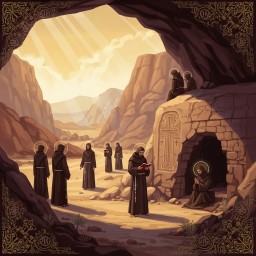
⛪The Birth of Christian Monasticism: Flight to
the Desert
The monastic tradition of the Syriac Orthodox Church represents one of Christianity's most radical
and transformative movements, emerging from the Syrian deserts in the third and fourth centuries as
a prophetic response to the increasing worldliness of the Church following the Constantinian
settlement. When Christianity became the religion of the Roman Empire, many fervent believers felt
that the faith was losing its countercultural edge, its demand for total commitment, its witness to
the kingdom that is "not of this world." In response, men and women began withdrawing to the
wilderness—the deserts, mountains, and remote valleys of Syria, Mesopotamia, and Egypt—to pursue
with undivided hearts the pearl of great price: union with God through prayer, asceticism, and
spiritual combat.
This flight to the desert was not escapism but engagement at the deepest level. The desert fathers
and mothers understood that the true battlefield of the Christian life is not the external world but
the human heart, where passions rage and demons assault the soul. By withdrawing from the
distractions and comforts of civilization, they sought to confront directly the powers of darkness
and to purify the heart until it became a temple worthy of God's indwelling. As St. Antony the
Great, often called the father of monasticism, declared: "The monk's cell is the furnace of Babylon
where the three children found the Son of God, and it is also the pillar of cloud from which God
spoke to Moses."
The Syrian wilderness proved particularly fertile soil for this new form of Christian witness. The
harsh landscape—scorched by relentless sun, swept by violent winds, inhabited by wild beasts and
demons—provided the ideal arena for spiritual warfare. Here, in caves and cells, on pillars and in
monasteries, Syrian Christians developed distinctive forms of ascetic practice that would influence
the entire Christian world. The Syriac tradition produced not only hermits and anchorites but also
cenobitic communities, stylites who lived atop pillars, encratites who practiced extreme continence,
and wandering holy men who brought the desert spirituality to towns and villages.
What drove these desert pioneers was not hatred of the world or the body but an overwhelming love
for God that made all earthly attachments seem trivial by comparison. They took literally Christ's
words: "If anyone comes to me and does not hate his father and mother, his wife and children, his
brothers and sisters—yes, even his own life—he cannot be my disciple" (Luke 14:26). This "hatred"
was not malice but the recognition that God must be loved supremely, infinitely more than any
created good. The monastic vocation was thus a love affair with the Divine, a romance that required
leaving everything else behind to pursue the Beloved with single-minded devotion.
The Syrian monastic tradition distinguished between three primary forms of ascetic life: the hermit
(ihidaya) living in complete solitude, the semi-hermit (dayraya) living in a laura or loose
community while maintaining individual cells, and the cenobite (dayraya d-kawno) living in organized
monasteries under a rule and abbot. Each form offered a legitimate path to theosis, suited to
different temperaments and stages of spiritual development.
🏜️The Desert Fathers: Spiritual Athletes of
Syria
The Syrian desert produced a remarkable array of ascetic heroes whose feats of self-denial, prayer,
and spiritual power astonished the ancient world and continue to challenge believers today. Among
the earliest and most influential was St. Antony the Great (251-356), though Egyptian by birth,
whose life written by St. Athanasius became the template for Christian hagiography and inspired
countless Syrians to embrace the monastic life. Antony's battles with demons, his wisdom sayings,
and his attainment of apatheia (freedom from passions) established the paradigm of the desert father
as spiritual athlete, warfare expert, and charismatic elder.
Syria's own contribution to desert spirituality began with figures like St. Julian Sabas, the hermit
of Osrhoene, who lived in a cave near Edessa and was renowned for his gift of healing and prophecy.
St. Ephrem the Syrian (306-373), though primarily known as theologian and hymnographer, spent his
later years in Edessa leading an ascetic community and composing hymns that celebrate the monastic
ideal. His "Hymns on Paradise" envision the monk's cell as a return to Eden, a place where humanity
recovers its original communion with God through contemplation and purity of heart.
Perhaps the most distinctive Syrian contribution to monasticism was the phenomenon of the
stylites—pillar-dwellers who lived atop columns as a form of extreme asceticism. St. Symeon the
Elder (390-459), known as Symeon Stylites, pioneered this practice on a mountain near Aleppo,
spending the last thirty-seven years of his life on a pillar that eventually reached eighteen meters
in height. Far from being a bizarre eccentricity, Symeon's practice had profound theological
significance: elevated between heaven and earth, he mediated between God and humanity, interceding
for the world while embodying radical detachment from it. Thousands of pilgrims—including emperors,
barbarian chiefs, and common folk—came to seek his counsel and blessing, and his example inspired
numerous imitators throughout Syria.
St. Symeon the Younger (521-592), who established his pillar near Antioch on the Wondrous Mountain,
continued this tradition for over forty years, becoming a spiritual authority whose advice was
sought on ecclesiastical, political, and personal matters. Other notable Syrian stylites included
St. Daniel (409-493), who lived on a pillar near Constantinople after training in Syria, and St.
Alypius, who spent fifty-three years standing on a column without sitting or lying down. These
pillar saints were not mere exhibitionists seeking attention but men consumed by the desire to "pray
without ceasing" and to stand as perpetual witnesses to the primacy of the spiritual over the
material.
The Syrian desert also produced countless anonymous ascetics whose names are known only to God but
whose collective witness sustained the Church. The Sayings of the Desert Fathers preserves hundreds
of wisdom teachings from these elders—brief, penetrating insights into spiritual warfare, humility,
discernment, prayer, and the art of living. These sayings, collected and transmitted orally before
being written down, became a foundational text of Christian spirituality, studied in monasteries
throughout the Christian world and continuing to nourish contemplatives today.
👑The Desert Mothers: Women Pioneers of
Asceticism
While historical records more frequently preserve the names and deeds of male monastics, the Syrian
ascetic movement included from its inception remarkable women who pursued holiness with equal fervor
and attained equal sanctity. These desert mothers challenged the gender conventions of their time,
demonstrating that the call to radical discipleship transcends social categories and that women
possess the same spiritual capacity as men for theosis. In the harsh democracy of the desert, where
only genuine holiness mattered, women proved themselves spiritual equals and sometimes superiors to
their male counterparts.
The tradition of female asceticism in Syria traces back to the earliest centuries. The "Daughters of
the Covenant" (bnath qyama) represented an institutionalized form of consecrated virginity unique to
the Syriac Church, emerging as early as the second century. These women took vows of celibacy and
dedicated themselves to prayer, fasting, and service to the Church while often remaining in their
family homes or living in small communities. St. Ephrem composed numerous hymns addressing and
praising the Daughters of the Covenant, calling them "brides of Christ," "luminous lamps," and
"gardens enclosed" for God alone.
Some Syrian women pursued even more radical forms of asceticism. St. Febronia of Nisibis (fourth
century) lived in a monastery under her aunt's guidance, dedicating herself to prayer, fasting, and
the study of Scripture. When persecutors came during Diocletian's persecution, she endured horrific
tortures rather than renounce her monastic vows and faith, becoming both martyr and monastic
exemplar. Her passio, preserved in Syriac, was widely read in monasteries as an inspiration to
steadfastness.
The remarkable phenomenon of female "transvestite saints"—women who disguised themselves as men to
enter male monasteries—appears in several Syrian hagiographies. St. Pelagia of Antioch, after her
conversion from a life of vanity and sin, dressed as a man and lived as a hermit on the Mount of
Olives, known only as "the beardless monk Pelagius." Similarly, St. Euphrosyne of Alexandria and St.
Apollinaria entered monasteries disguised as men, their true identity revealed only after death.
While modern sensibilities may find this practice strange, it testifies to women's determination to
pursue the most rigorous forms of asceticism despite social barriers, and to the desert fathers'
recognition that true monasticism transcends bodily form.
St. Mary of Egypt (344-421), though not Syrian by birth, became deeply connected to the Syriac
tradition through her decades of penance in the Syrian desert east of Jordan. After living as a
prostitute in Alexandria, she experienced a miraculous conversion at the Church of the Holy
Sepulchre in Jerusalem and immediately fled to the desert, where she spent forty-seven years in
complete solitude, sustained by divine grace. Her story, preserved in Syriac and other languages,
became one of the most beloved monastic tales, illustrating the power of repentance and
demonstrating that no sinner is beyond redemption.
The desert mothers bequeathed to the Church the same spiritual wisdom as their male counterparts.
Amma Syncletica, whose sayings are preserved in the Apophthegmata, taught: "In the beginning, there
is struggle and a lot of work for those who come near to God. But after that, there is indescribable
joy. It is just like building a fire: at first it's smoky and your eyes water, but later you get the
desired result. Thus we ought to light the divine fire in ourselves with tears and effort." This
practical wisdom, born of experience rather than theory, characterizes the teaching of both desert
fathers and mothers.
The Syriac Orthodox Church has always honored women monastics alongside men, recognizing that
holiness knows no gender. Convents of nuns existed throughout the Syriac-speaking world, and female
elders (ammas) exercised spiritual authority and offered guidance to both women and men. This
tradition continues today in Syriac Orthodox convents where nuns dedicate their lives to prayer,
contemplation, and service.
📿The Monastic Way: Prayer, Fasting, and
Spiritual Combat
The daily life of Syrian monastics, whether hermits or cenobites, revolved around three primary
disciplines: prayer, fasting, and spiritual warfare. These were not arbitrary practices but
carefully calibrated tools for the transformation of the human person from the image of Adam
enslaved to sin into the likeness of Christ radiant with divine glory. The monastic way represented
applied theology, the practical outworking of the Church's understanding of human nature, sin,
grace, and deification.
Prayer formed the very heartbeat of monastic existence. The Syrian monks developed elaborate prayer
rules involving the recitation of psalms, the repetition of short ejaculatory prayers, and extended
periods of silent contemplation. The goal was to fulfill St. Paul's command to "pray without
ceasing" (1 Thessalonians 5:17), transforming the entire life into an uninterrupted dialogue with
God. The Jesus Prayer—"Lord Jesus Christ, Son of God, have mercy on me, a sinner"—though often
associated with later Byzantine hesychasm, has roots in the Syrian desert where monks sought to
synchronize prayer with breathing, making every breath a prayer.
The Syriac monastic office, based on the cathedral liturgy of Antioch, divided the day and night
into hours of prayer. Hermits prayed the offices privately in their cells, while cenobites gathered
in the monastery church for corporate worship. The night vigil held particular importance, for the
deep stillness of night was considered especially conducive to communion with God. St. Isaac the
Syrian, the great seventh-century mystic, wrote extensively on nocturnal prayer, calling it "the
mother of prayer" and teaching that the night hours open the soul to divine revelation in ways
impossible during the busy day.
Fasting complemented prayer as a means of subduing the body's tyranny over the spirit and creating
inner spaciousness for God. Syrian monastics practiced varying degrees of fasting, from complete
abstinence from food except bread and water to eating only once daily after sunset. Some desert
fathers ate only once a week; others, like St. Symeon Stylites, abstained from food entirely during
Lent. This extreme asceticism was not self-hatred but recognition that the fallen body, enslaved to
appetites, requires discipline before it can become a willing servant of the spirit. Fasting
weakened the power of the passions—lust, anger, greed, gluttony—creating the psychological
conditions for spiritual progress.
The practice of vigil (keeping the body awake beyond its natural desire for sleep) served similar
purposes. By limiting sleep to only a few hours, monastics demonstrated that humans need not be
slaves to bodily demands and created additional time for prayer and meditation. The struggle against
sleep, especially during night prayer, was itself a form of spiritual combat, training the will in
self-mastery. Yet the desert fathers also warned against excessive asceticism that weakened the body
beyond its ability to function, teaching that discretion—the ability to discern the right measure of
ascetic practice for each individual—was the highest spiritual gift.
Spiritual warfare constituted the third pillar of monastic practice. The desert fathers understood
Christian life as combat against an invisible but very real enemy: Satan and his demonic hosts. By
withdrawing to the wilderness, the monks entered the demons' own territory, deliberately provoking
spiritual warfare in order to learn the tactics of the enemy and develop the skills needed to defeat
him. The demons assaulted the monks through thoughts (logismoi)—suggestions, fantasies, memories,
and temptations that arose in the mind. The art of spiritual warfare consisted in recognizing these
thoughts at their first appearance and rejecting them before they could take root in the heart.
The desert fathers identified eight principal logismoi that formed the basis of all sin: gluttony,
lust, avarice, sadness, anger, acedia (spiritual listlessness), vainglory, and pride. These "eight
thoughts," later systematized as the "seven deadly sins" in Western Christianity, provided a
psychological map of temptation. Each thought had its characteristic pattern, its typical
progression, and its antidote. Monks learned to observe their own thought processes with ruthless
honesty, bringing dark motives into the light, confessing temptations to their spiritual father, and
cultivating the opposing virtues.
🏛️Cenobitic Monasticism: The Rise of Organized
Communities
While eremitic (hermit) monasticism captured the popular imagination through its dramatic
austerities and charismatic saints, cenobitic (communal) monasticism ultimately proved more
sustainable and influential for the Church's long-term development. The organization of monks into
communities living under a common rule, sharing possessions, and submitting to an abbot's authority
created stable institutions that could preserve learning, maintain liturgical life, and train
successive generations of monastics. Syria witnessed both forms of monastic life, with many monks
beginning in communities before advancing to eremitic solitude.
The development of cenobitic monasticism in Syria was influenced by St. Pachomius of Egypt
(292-348), who established the first organized monastic communities with written rules. Syrian
monasticism, however, developed its own distinctive character under figures like St. Maro (d. 410),
whose disciples founded numerous monasteries in northern Syria that eventually gave rise to the
Maronite Church, and St. Awgin (d. 363), the "Father of Syrian Monasticism," who established a great
monastery on Mount Izla in Mesopotamia that became a center of learning and spiritual formation.
The monastery of Mor Gabriel, founded in 397 AD in the Tur Abdin region of southeastern Turkey,
stands as one of the oldest continuously functioning Christian monasteries in the world and serves
as the spiritual heart of Syriac Orthodox monasticism. Through seventeen centuries of Islamic rule,
Mongol invasions, persecution, and genocide, Mor Gabriel has maintained the monastic tradition,
serving as a beacon of Christian presence in Mesopotamia. Its survival testifies to the resilience
of the Syriac monastic spirit and the power of consecrated communities to preserve faith through the
darkest times.
The monastic rule governing cenobitic life addressed every aspect of communal existence: the daily
schedule of prayer and work, the distribution of duties, procedures for admitting new members,
discipline for those who violated the rule, and the spiritual formation of monks. The rule's purpose
was not legalistic control but the creation of conditions favorable to spiritual growth. By
surrendering personal will to the abbot's direction, sharing all possessions in common, and
submitting to a regular routine, monks learned the fundamental Christian virtues of obedience,
poverty, and stability.
Syrian monasteries became centers of learning, preserving classical knowledge through the
translation of Greek philosophical and scientific texts into Syriac, copying manuscripts, and
developing schools where monks studied Scripture, theology, and the spiritual classics. The
scriptoria of monasteries like Mor Gabriel, Qartmin, and Za'faran produced the manuscript tradition
that preserves Syriac literature today. Monks were often the most educated members of society,
serving as teachers, physicians, and advisors to secular rulers while maintaining their primary
vocation of prayer.
The monastery church stood at the physical and spiritual center of the community. Here the monks
gathered seven times daily for the divine office, celebrating the Holy Qurbono on Sundays and feast
days. The monastic liturgy, more elaborate than that of parish churches, included ancient hymns and
prayers composed by saints like Ephrem and Jacob of Sarug. This liturgical life formed monks in
Orthodox theology and spirituality, creating a lived theology expressed in worship rather than
merely abstract doctrines.
📚The Spiritual Literature of Syrian Monasticism
The Syrian monastic tradition generated a vast spiritual literature that ranks among the treasures
of Christian mysticism. Written in Syriac, the liturgical and literary language of the Syriac
Orthodox Church, these texts distilled centuries of ascetic experience and contemplative wisdom into
teachings that continue to guide spiritual seekers today. Unlike systematic theology, monastic
literature emphasized practical instruction, psychological insight, and the experiential knowledge
of God gained through prayer and purification.
St. Isaac the Syrian (Isaac of Nineveh, seventh century) stands as perhaps the greatest mystical
theologian in the Syriac tradition. Though a bishop for only a few months before returning to
eremitic life, Isaac composed ascetical homilies of such profundity that they were translated into
Greek, Arabic, Latin, and Slavonic, influencing both Eastern and Western Christian spirituality. His
writings explore the nature of prayer, the transformation of consciousness through ascetic practice,
divine mercy, the nature of gehenna (hell), and the ultimate restoration of all creation. Isaac's
theology of love—asserting that God's essence is mercy and that even divine judgment serves
redemptive purposes—offered a hopeful vision that balanced the severe asceticism of desert practice
with confidence in divine compassion.
The Book of Steps (Liber Graduum), a fourth-century Syriac text possibly from Edessa, presents
Christian life as a progressive ascent through various levels of spiritual perfection. It
distinguishes between "the righteous" who keep the commandments while remaining in the world, and
"the perfect" who embrace voluntary poverty, celibacy, and contemplative prayer, ascending through
stages of spiritual development toward complete union with God. This text influenced subsequent
understandings of the spiritual life as a journey with distinct stages requiring different practices
and virtues.
St. John of Dalyatha (John Saba, eighth century), another East Syrian mystic, wrote extensively on
contemplative prayer and the mystical experience of divine light. His mystical theology described
the soul's ascent to God through stages of purification, illumination, and union, drawing on
Evagrian and Dionysian sources while adding distinctively Syriac emphases. John's writings on the
"prayer of silence" and the ineffable encounter with divine mystery influenced later hesychast
spirituality.
The anonymous author of the Pseudo-Macarian homilies (probably written in Syria or Mesopotamia in
the fourth century) produced fifty spiritual homilies that emphasize the experiential dimension of
Christian life. These texts speak powerfully of the indwelling Holy Spirit, the spiritual senses
through which the soul perceives divine realities, the struggle against demonic powers, and the
transformation of the human person through grace. The Macarian homilies profoundly influenced
Byzantine spirituality and continue to be read in Orthodox monasteries.
Beyond these major figures, countless monks composed prayers, hymns, rules, hagiographies, and
spiritual instructions that collectively constitute the Syriac ascetical corpus. Monastery libraries
preserved these texts, copying them for new generations and ensuring the continuity of spiritual
tradition. Even today, Syriac monastics draw on this literature, finding in the wisdom of the desert
fathers and mothers guidance for contemporary struggles.
The reading of spiritual literature formed an essential part of monastic formation. Novices studied
the lives of saints, the sayings of elders, and mystical texts under their spiritual father's
guidance. This "rumination" on sacred texts, combined with the experience of ascetic practice,
gradually transformed the monk's consciousness, creating what the fathers called "nepsis"—spiritual
sobriety and wakeful attention to God.
⚔️Spiritual Warfare: The Invisible Battle
The monastic understanding of spiritual warfare represents one of the desert tradition's most
significant contributions to Christian spirituality. Far from the naive optimism that views the
Christian life as merely moral improvement or the following of Jesus' ethical teachings, the desert
fathers recognized that believers engaged in cosmic combat against intelligent, malevolent spiritual
powers intent on humanity's destruction. This realistic assessment of the spiritual battlefield
equipped Christians to understand their inner struggles not as psychological quirks but as attacks
from a real enemy requiring specific counter-tactics.
The Syrian monks understood that demons—fallen angels who followed Satan in rebellion against
God—retained formidable powers despite their defeat by Christ's Cross and Resurrection. These beings
could not force humans to sin (free will remained inviolate), but they could suggest sins through
thoughts, stir passions through memories and fantasies, and create external circumstances designed
to lead to temptation. The monk's task was to recognize demonic influence, resist it through prayer
and invocation of Christ's name, and gradually weaken the demons' power through consistent
resistance.
The Life of St. Antony, written by St. Athanasius, provided the classic account of demonic warfare.
Antony faced demons appearing as wild beasts, as seductive women, as fellow monks offering bad
advice, and even as angels of light. Through each assault, he learned that demons are fundamentally
cowards who flee before genuine faith, that they can do nothing without God's permission, and that
their apparent power is largely illusory. This realization demystified the demons, stripping away
the terror they sought to inspire and replacing it with holy boldness.
The desert fathers developed sophisticated psychological analyses of how demonic thoughts (logismoi)
operate. Evagrius Ponticus, though technically not Syrian (he died in Egypt), spent time in Syrian
monasteries and his thought deeply influenced Syriac spirituality, systematized the teaching on the
eight principal thoughts. He taught that demonic warfare follows predictable patterns: a thought
arises (suggestion), engages the mind (dialogue), generates emotion (passion), becomes established
(captivity), and finally controls behavior (sin). The key to victory lies in rejecting thoughts at
their first appearance, before they gain foothold in the heart.
Syrian monastics employed specific weapons in spiritual combat. The name of Jesus, invoked with
faith, possessed power to scatter demons like smoke before fire. The sign of the Cross, made
reverently with faith, created a spiritual barrier demons could not penetrate. The constant
remembrance of death (memento mori) undermined the demons' promises of worldly pleasure by reminding
the monk that all earthly things are transient. The confession of thoughts to a spiritual father
brought hidden sins into light where demons cannot operate. Humility, recognizing one's absolute
dependence on divine grace, prevented the pride that opens the door to demonic delusion.
The ultimate goal of spiritual warfare was not merely victory over particular temptations but the
attainment of apatheia—a controversial term often mistranslated as "apathy" but actually meaning
freedom from enslaving passions. Apatheia did not mean emotional numbness but the proper ordering of
emotions under reason and grace, so that anger is directed only toward sin, desire only toward God,
and fear only toward losing God's presence. A monk who achieved apatheia had conquered the passions
and thereby stripped demons of their primary weapons. Such a person attained hesychia (inner
stillness), the tranquility of soul in which contemplative prayer becomes possible.
🕯️The Role of Monasteries in Church and Society
While monastics withdrew from society geographically, they never ceased to exercise profound
influence on both Church and world. Monasteries served multiple functions beyond the spiritual
formation of their inhabitants: they were centers of learning and manuscript production, hospitals
offering medical care, hospices providing shelter to travelers and pilgrims, agricultural centers
developing farming techniques, courts of arbitration settling disputes, and sources of spiritual
counsel to all classes from peasants to emperors. The monastery stood as a city on a hill, a visible
sign of the kingdom of God that both judged the world's values and offered an alternative way of
living.
In the Christological controversies that divided the Church in the fifth and sixth centuries, Syrian
monasteries became bastions of anti-Chalcedonian resistance. When the imperial government attempted
to impose the Council of Chalcedon's formula, many monks fled to the mountains and deserts, refusing
to compromise the Cyrillian Christology they believed essential to authentic faith. Monasteries
provided sanctuary for persecuted bishops, meeting places for clandestine ordinations, and bases for
missionary work that kept the non-Chalcedonian Church alive. St. Jacob Baradaeus, the tireless
organizer who preserved the Syriac Orthodox hierarchy during the darkest period of persecution,
operated from a network of monasteries that sheltered him during his decades of itinerant ministry.
Monasteries produced the Church's intellectual and spiritual leaders. Most Syriac Orthodox
patriarchs, bishops, and theologians received their formation in monastic schools before assuming
ecclesiastical office. The rigor of monastic discipline, the depth of liturgical immersion, and the
intimate knowledge of Scripture acquired through years of lectio divina created churchmen who
combined pastoral sensitivity with theological precision. Even those who left the monastery for
episcopal service maintained monastic spirituality, viewing their pastoral role as an extension of
their monastic vocation.
The social welfare functions of monasteries proved particularly important in pre-modern societies
lacking organized social services. Monasteries maintained hospices for pilgrims traveling to holy
sites, offered medical care through infirmaries staffed by monk-physicians, distributed food during
famines, ransomed captives taken by raiders, and provided education for children from poor families.
This charitable work flowed naturally from the monastic commitment to love of neighbor,
demonstrating that authentic contemplation always issues in compassionate action.
Monastics also served as spiritual directors to lay Christians seeking guidance in prayer and the
spiritual life. The institution of the spiritual father (abba or rabban), a relationship of complete
transparency between disciple and elder, extended beyond monastery walls to include lay people who
sought out renowned monks for confession, counsel, and prayer. The spiritual father discerned
spirits, identified the root causes of spiritual struggles, prescribed remedies tailored to each
person's situation, and bore his disciples' burdens through intercessory prayer. This practice of
spiritual eldership remains central to Orthodox spirituality today.
In regions under Islamic rule, monasteries often served as the only visible Christian presence,
maintaining schools where Syriac language and Christian culture could be transmitted to new
generations despite the pressure to assimilate. The survival of Syriac Christianity through fourteen
centuries of Islamic domination owes much to monasteries that preserved liturgical books,
theological texts, and historical records that would otherwise have been lost. Monasteries became
living museums of Christian civilization, repositories of memory that connected present communities
to their apostolic origins.
🌄Historic Monasteries: Pillars of Faith Through
the Ages
The Syriac Orthodox Church's monastic heritage is embodied in numerous historic monasteries that
have served as spiritual centers for over a millennium. These sacred sites, built in remote
locations that facilitated contemplation, have witnessed empires rise and fall, survived
persecutions and invasions, and maintained unbroken traditions of prayer and worship that connect
contemporary believers to the Church's apostolic roots.
The Monastery of Mor Gabriel (Dayro d-Mor Gabriel), founded in 397 AD by monks Samuel and Simeon on
the instructions of an angel, stands as the oldest surviving Syriac Orthodox monastery. Located in
the Tur Abdin ("Mountain of the Servants of God") region, Mor Gabriel has functioned continuously
for over sixteen centuries, maintaining monastic life through Byzantine, Persian, Arab, Ottoman, and
modern Turkish rule. The monastery complex includes multiple churches, the most ancient of which
contains mosaics and architectural elements from the fourth century. The tomb of St. Gabriel, a
seventh-century bishop, lies in the monastery church, making it a pilgrimage site for Syriac
Christians worldwide.
Throughout its history, Mor Gabriel served as a center of learning where monks studied theology,
philosophy, and medicine, producing manuscripts that preserved Syriac literature. During the Sayfo
genocide of 1915, the monastery provided refuge to thousands of fleeing Christians, with its walls
literally sheltering survivors from massacre. Today, Mor Gabriel remains the spiritual heart of the
Syriac Orthodox Church, home to monks and nuns who maintain the ancient liturgical tradition and
welcome pilgrims seeking spiritual renewal.
The Monastery of Mor Hananyo (Deyrulzafaran), founded in 493 AD on the site of a former temple of
the sun god, served as the patriarchal seat of the Syriac Orthodox Church from 1160 to 1932. Located
near Mardin in southeastern Turkey, its name "Saffron Monastery" derives from the yellow stone used
in its construction. The monastery contains a magnificent church with intricate carvings, ancient
manuscripts in its library, and patriarchal tombs spanning centuries. Mor Hananyo exemplifies the
Syriac architectural style with its domed ceilings, massive walls, and integration into the mountain
landscape.
The monastery served not only as an administrative center but as a theological school where future
patriarchs, bishops, and scholars received their formation. The presence of the patriarchal throne
made Mor Hananyo a pilgrimage destination and a symbol of Syriac Orthodox identity. Though the
patriarchal seat moved to Homs, Syria in 1932 and later to Damascus, Mor Hananyo remains a
functioning monastery and museum attracting visitors interested in Syriac Christian heritage.
The Monastery of St. Matthew (Dayro d-Mor Mattai), perched on Mount Alfaf near Mosul, Iraq, claims
foundation by the hermit St. Matthew in the fourth century. The current structures date primarily to
the sixth century, with continuous additions and restorations through subsequent centuries. Mor
Mattai's dramatic location—built into a mountainside at an elevation of over 1,200 meters—provided
both security from raiders and an environment conducive to contemplation. The monastery's isolation
helped preserve it through centuries of tumult in Mesopotamia.
Mor Mattai housed one of the most important Syriac libraries in Iraq, containing manuscripts dating
to the sixth century. The monastery's scriptorium produced numerous biblical and liturgical
manuscripts that were distributed to parishes throughout the region. Though the monastery suffered
damage and abandonment during various persecutions, it was repeatedly restored by devoted monks
determined to maintain this ancient center of faith. In recent years, the monastery faced new
threats from extremist violence, but efforts continue to preserve this irreplaceable heritage site.
The Monastery of St. Mark in Jerusalem, located in the Old City, holds special significance as the
traditional site of the Upper Room where the Last Supper occurred and where the Apostles gathered
after the Resurrection. According to tradition, this was the house of Mary, mother of John Mark,
making it one of the earliest Christian meeting places. The Syriac Orthodox community has maintained
continuous presence at this site since the early centuries, and the monastery contains a church
built over the ancient room.
St. Mark's Monastery preserves numerous holy relics and ancient manuscripts, including fragments of
Syriac biblical texts. The monastery served as residence for Syriac Orthodox bishops of Jerusalem
and continues to function as a place of worship and pilgrimage. Its location in the Holy City
connects Syriac Christians to the geographic origins of their faith and maintains their historic
presence in the land where Christianity was born.
In India, the Malankara Syriac Orthodox Church maintains its own monastic tradition at ancient
centers like the Monastery of St. Mary at Piramadam, Kerala. Founded centuries ago by Syriac monks
who came from the Middle East, Indian Syriac monasteries adapted the desert tradition to the
tropical environment while preserving essential elements of Syriac monastic spirituality. These
monasteries serve as centers of theological education and spiritual formation for the Indian Syriac
Orthodox community.
The preservation of historic monasteries represents not merely cultural conservation but the
maintenance of living spiritual centers. When ancient monasteries continue to function with resident
monastic communities, they provide continuity with the Church's origins and demonstrate that the
monastic vocation remains relevant in every age. The prayers offered in these holy places link
contemporary believers to the cloud of witnesses who prayed there through the centuries.
🙏Contemporary Monastic Life: Tradition Alive
Today
The monastic tradition of the Syriac Orthodox Church, far from being a relic of the past, continues
to thrive in the contemporary world. Modern Syriac Orthodox monasteries maintain the essential
elements of desert spirituality—prayer, fasting, solitude, and spiritual warfare—while adapting to
changed historical circumstances. In the Middle East, Europe, North America, India, and Australia,
men and women continue to embrace the monastic vocation, withdrawing from the world to seek union
with God through the time-tested practices of ascetic spirituality.
Contemporary Syriac Orthodox monks and nuns follow daily routines structured around the liturgical
offices. Rising in the early hours before dawn, they begin with the midnight office (Lilyo),
followed by morning prayers (Sapro), and continuing through the day with offices at the third,
sixth, and ninth hours, evening prayer (Ramsho), and compline (Sootoro). Between these fixed times
of prayer, monastics engage in manual labor, study of Scripture and patristic texts, spiritual
reading, and private contemplation. The rhythm of prayer and work (ora et labora) sanctifies time
and creates an environment where continuous awareness of God becomes possible.
The monastic tonsure ceremony, in which a person is formally received into monastic life, marks the
death to the world and rebirth to a new existence centered on Christ. The candidate receives a new
name (often that of a saint), dons the monastic habit, and makes vows of celibacy, poverty,
obedience, and stability. These vows are not viewed as oppressive restrictions but as liberating
commitments that free the monk from the tyranny of bodily passions, material attachments, self-will,
and the restless searching for fulfillment that characterizes worldly life.
Modern monasteries continue the ancient practice of offering spiritual direction to lay Christians.
Many laypeople maintain ongoing relationships with monastic spiritual fathers or mothers, seeking
guidance on prayer, confession of sins and struggles, and discernment of God's will for major life
decisions. The monastery thus functions as a spiritual hospital where wounded souls find healing
through the sacraments, prayer, and wise counsel. Retreats and pilgrimages bring lay Christians into
temporary contact with monastic life, offering them a taste of the contemplative dimension often
missing from busy secular existence.
The challenges facing contemporary Syriac Orthodox monasticism are considerable. In the Middle East,
political instability, persecution, and emigration have reduced Christian populations, making
recruitment of new monastics difficult. Ancient monasteries struggle with maintenance costs for
historic buildings, and some have been damaged or destroyed by warfare. In the diaspora, the
attraction of secular lifestyles and career opportunities makes the monastic vocation seem
countercultural and unappealing to many young people. Yet despite these challenges, new vocations
continue to emerge, demonstrating that the monastic call remains alive in human hearts.
Some contemporary monasteries have embraced new technologies to extend their ministry. Websites
share teachings from monastic elders, podcasts make spiritual conferences available globally, and
social media connects monasteries with supporters worldwide. While maintaining their essential
separation from worldly concerns, monastics recognize that technology can serve evangelical and
catechetical purposes. The key is using these tools without allowing them to disrupt the silence and
recollection essential to contemplative life.
The revival of monasticism in the diaspora represents an encouraging development. New monasteries
and monastic communities have been established in Europe and North America, providing centers of
spiritual life for immigrant Syriac Orthodox communities and attracting converts drawn to the depth
of Orthodox spirituality. These new foundations adapt the monastic tradition to Western contexts
while preserving essential elements of Syriac spiritual heritage. They demonstrate that the monastic
vocation transcends cultural boundaries and speaks to universal human longings for meaning,
transcendence, and communion with the Divine.
✨The Mystical Goal: Union with God Through
Theosis
All monastic practices—the prayers, fasts, vigils, and spiritual combat—serve a single ultimate
purpose: theosis, the divinization or deification of the human person through participation in
divine nature. This audacious claim, rooted in Scripture ("that you may become partakers of the
divine nature," 2 Peter 1:4) and articulated by the Church Fathers ("God became man so that man
might become god," St. Athanasius), represents the summit of Christian anthropology and soteriology.
The monk pursues not merely moral improvement or even sinlessness but actual transformation into the
likeness of God, restoration of the divine image obscured by sin, and entrance into the very life of
the Trinity.
The Syrian monastic tradition understood theosis not as absorption into divine essence (which would
destroy human personhood) but as communion with divine energies—God's activities and presence that
can be experienced and shared without compromising the divine transcendence. In this mystical union,
the human person remains fully human while becoming "by grace what God is by nature." The saints are
not annihilated but perfected, their humanity brought to its fullest potential through saturation
with divine grace. As gold placed in fire becomes fiery while remaining gold, so the human person
immersed in God becomes divine while remaining human.
St. Isaac the Syrian described the stages of this mystical ascent with extraordinary psychological
and theological precision. The journey begins with repentance (tiyabutho), the turning away from sin
and toward God that characterizes conversion. Through ascetic practice, the monk progresses to
purity (dakhyutho), the cleansing of the heart from passions. This purification enables the stage of
apatheia (shaynutho), freedom from enslaving passions, which opens the way to hesychia (shelyutho),
inner stillness and recollection. From hesychia emerges contemplation (teoryuto), direct spiritual
knowledge of divine realities, which culminates in union (khudaya), mystical participation in divine
life.
This mystical union brings tangible effects. The saints radiate uncreated light, the same divine
glory that shone from Christ on Mount Tabor. Their bodies become incorrupt after death, witnessing
to the defeat of corruption and anticipating the general resurrection. They acquire gifts of
clairvoyance, healing, and prophecy, not through natural abilities but through the divine energies
working through them. Most importantly, they become bearers of perfect love—agape that loves
enemies, prays for persecutors, and seeks the salvation of all without exception.
The Syriac mystical tradition particularly emphasized the role of divine love in the process of
theosis. While some Eastern Christian writers stressed the intellect's role in contemplation, Syrian
fathers like Isaac and John of Dalyatha emphasized love as the ultimate faculty that unites the soul
to God. Love transcends knowledge, enabling communion beyond concepts and images. The monk learns
not merely to think about God but to rest in God's presence, beyond thoughts, in what Isaac called
"pure prayer"—wordless, imageless, conceptless awareness of divine reality.
Yet Syrian monastics never viewed theosis as individual achievement but always as corporate reality
within the Body of Christ. The monk's sanctification benefits the entire Church through the
mysterious solidarity of the communion of saints. One person's spiritual progress elevates the whole
body; one person's prayers draw down grace upon the world. The monastery functions as a powerhouse
of intercession, the monks standing before God on behalf of humanity, their pure prayers rising like
incense to the divine throne. This understanding prevents monastic life from becoming selfish
escapism and grounds it in service to the Church and world.
🌟The Continuing Relevance of Monastic
Spirituality
In an age characterized by frenetic activity, information overload, consumer materialism, and the
fragmentation of attention through digital technologies, the monastic tradition's emphasis on
silence, simplicity, stability, and sustained contemplation offers a prophetic counter-witness. The
monastery stands as a sign of contradiction to modern culture's values, demonstrating that human
fulfillment comes not from accumulation and stimulation but from renunciation and recollection, not
from dispersing oneself among countless pursuits but from the single-minded pursuit of the "one
thing needful" (Luke 10:42).
The wisdom of the desert fathers speaks with surprising relevance to contemporary struggles. Their
insights into the psychological dynamics of temptation illuminate the spiritual dimensions of
addiction, compulsion, and behavioral patterns that secular psychology addresses only
symptomatically. Their teaching on controlling thoughts applies directly to managing the flood of
mental stimuli that modern life produces. Their emphasis on the body's role in spiritual
life—neither denigrating it as evil nor indulging it as ultimate—offers a middle path between
body-hatred and body-worship. Their commitment to community under obedience counters the radical
individualism that isolates modern persons.
Even for lay Christians who cannot embrace monastic life fully, monasticism provides resources for
deepening spiritual practice. The prayer rule, adapted to lay circumstances, structures daily life
around communion with God. The practice of fasting, maintained according to the Church's calendar,
disciplines appetites and creates solidarity with those who hunger involuntarily. The examination of
thoughts, practiced during evening prayer, brings consciousness to habitual patterns. The seeking of
spiritual direction provides accountability and guidance. Regular retreats to monasteries offer
refreshment and perspective impossible to gain in ordinary routines.
The monastic vocation itself, though embraced by the few, benefits the many. Monasteries offer
living proof that the Gospel's radical demands are not hyperbole but achievable reality. They
demonstrate that humans can indeed live by prayer, that celibacy is not merely repression but
liberation for undistracted love of God, that poverty frees rather than impoverishes, that obedience
develops rather than stunts personality. By their existence, monastics witness to transcendent
realities easily forgotten in materialistic cultures, reminding all Christians of their ultimate
citizenship in the kingdom of heaven rather than earthly kingdoms.
The preservation and revival of Syriac Orthodox monasticism in the contemporary world thus serves
essential purposes for the Church's health and mission. It maintains continuity with apostolic and
patristic tradition, ensuring that the faith transmitted is not merely doctrinal propositions but a
lived spirituality. It produces spiritual elders capable of guiding others in prayer and spiritual
warfare. It generates intercessory prayer for the Church and world. It provides centers of
liturgical excellence and theological learning. Most fundamentally, it keeps alive the possibility
and reality of theosis, reminding believers that Christianity aims not at making people moral or
happy but at making them gods by grace.
Prayer for Monastics and Those Called to Contemplative Life
O Lord Jesus Christ, who called Your disciples to leave all and follow You, and who in the
wilderness overcame the tempter through fasting and prayer, bless all who have embraced the monastic
vocation in Your Syriac Orthodox Church. Strengthen monks and nuns in their commitment to celibacy,
poverty, obedience, and stability. Grant them perseverance in prayer, victory in spiritual warfare,
and progress toward union with You. Remember the ancient monasteries of our tradition—Mor Gabriel,
Mor Hananyo, Mor Mattai, and all holy places where prayer has ascended for centuries. Preserve these
spiritual treasures for future generations. Raise up new vocations to the monastic life, that the
lamp of contemplation may never be extinguished. May the prayers of the desert fathers and mothers
surround and protect all who walk the narrow way that leads to life. For You are the Light of the
world and the Guide of those who seek You, and to You we ascribe glory, together with Your eternal
Father and Your all-holy, good, and life-giving Spirit, now and always and forever. Amen.