🌊Introduction
Baptism is the first of the Holy Sacraments in the Syriac Orthodox Church—the sacred gateway through
which a person enters the life of the Church and becomes a member of the Body of Christ. It is
called in Syriac "Ma'moditho" (ܡܰܥܡܽܘܕܺܝܬܳܐ), meaning "immersion" or "washing."
Through Holy Baptism, the believer is cleansed from original sin, reborn through water and the
Spirit, and receives a new identity as a child of God. It marks the beginning of one's journey of
salvation in Christ, and is a spiritual participation in the death and resurrection of our Lord
Jesus Christ.
Baptism stands as the foundation upon which all other sacraments and spiritual practices are built.
Without baptism, one cannot receive the other mysteries of the Church. It is the indispensable
beginning of the Christian life, the necessary initiation into the communion of saints, and the
entry point into the Kingdom of God through the grace of Christ.
✝️Biblical Foundation
The mystery of Baptism has its roots in the words and actions of our Lord Himself. Christ did not
merely teach about baptism; He established it as a sacred ordinance through which all believers
would enter His Church and participate in His redemptive work.
Jesus was baptized by St. John the Baptist in the River Jordan, sanctifying the
waters for all generations (Matthew 3:13–17). This event marked the beginning of our Lord's public
ministry and demonstrated the importance of baptism even for the sinless God made manifest. When
Jesus emerged from the water, the heavens were opened, the Holy Spirit descended upon Him like a
dove, and the voice of the Father was heard proclaiming, "This is my beloved Son, in whom I am well
pleased." In this theophany, we see the revelation of the Holy Trinity and the sanctification of the
waters for all who would follow.
He commanded His disciples: "Go therefore and make disciples of all nations,
baptizing them in the name of the Father, and of the Son, and of the Holy Spirit" (Matthew 28:19).
This Great Commission, given by the Risen Christ to His apostles, is the mandate for the Church's
baptismal ministry until the end of the age. The apostles faithfully obeyed this command, preaching
the Gospel and baptizing believers in every land where they traveled.
He declared: "Unless one is born of water and the Spirit, he cannot enter the
kingdom of God" (John 3:5). These words of our Lord emphasize the absolute necessity of baptism for
salvation and the role of both water and the Spirit in effecting spiritual rebirth. The double
motion—through water and the Spirit—indicates that baptism is not merely a human act but a
sacramental encounter with the living God.
Thus, Baptism is not a mere symbol or custom—it is a divine command and a sacramental act that
imparts true spiritual regeneration. The apostles understood this deeply and made baptism central to
their preaching. On Pentecost, when St. Peter proclaimed the Gospel, his listeners asked, "What
shall we do?" and he replied, "Repent and be baptized every one of you in the name of Jesus Christ
for the forgiveness of your sins, and you will receive the gift of the Holy Spirit" (Acts 2:37–38).
🕊️Theological Meaning
In the Syriac Orthodox understanding, Baptism is far more than mere forgiveness of sins or a
symbolic ritual. It is the profound spiritual rebirth of the entire person—a transformation that
encompasses body and soul, a complete renewal of the human being through the grace of the Holy
Spirit. When one is baptized, the fundamental orientation of one's life is redirected from death to
life, from darkness to light, from separation from God to union with God.
The baptized person experiences a fourfold transformation:
- Cleansed from all sins (original and personal) — In baptism, the stain of
original sin inherited from Adam is washed away, and any personal sins committed before baptism
are forgiven. The person emerges from the waters as spotless as a newborn child.
- Reborn as a new creation in Christ (2 Corinthians 5:17) — The baptized person
becomes part of the new creation that Christ inaugurated through His resurrection. Old things
have passed away; all things have become new. One's former identity, bound by sin and death, is
replaced by a new identity rooted in Christ and eternal life.
- United with Christ's death and resurrection (Romans 6:3–5) — Through baptism,
the believer mystically dies with Christ and rises with Him. Paul writes, "Do you not know that
all of us who have been baptized into Christ Jesus were baptized into his death? We were buried
therefore with him by baptism into death, in order that, just as Christ was raised from the dead
by the glory of the Father, we too might walk in newness of life."
- Clothed with the garment of light, symbolizing purity and holiness — The white
baptismal vestment represents the person's new status as clothed in the righteousness of Christ,
adorned with virtue, and made radiant with the light of the Holy Spirit.
St. Jacob of Serugh, one of the greatest Syriac poets and theologians, beautifully wrote:
"The waters of Baptism become a womb, and the baptized emerges as a new creation—a child of
God, radiant with light."
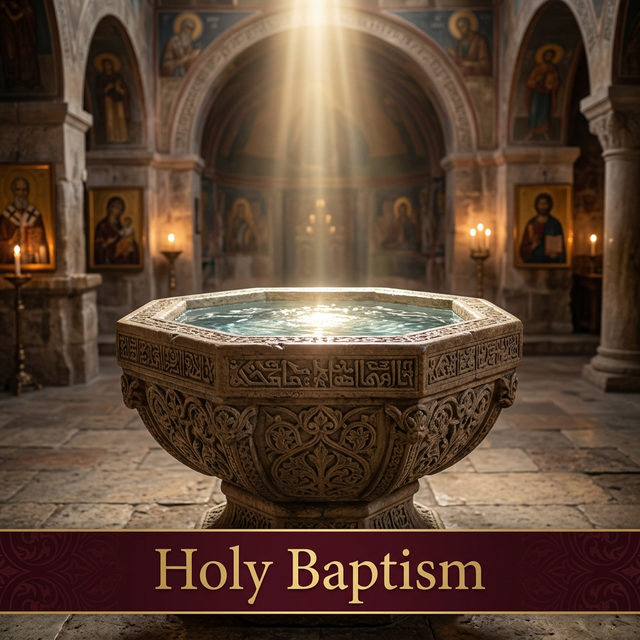
This image captures the profound mystery: the baptismal font becomes for the Christian what the womb
is for the unborn—the place of formation and birth into a new mode of existence. Just as a child
emerges from the womb into physical life, the baptized emerges from the waters into spiritual life,
born not of flesh and blood but of water and the Spirit.
💧The Rite of Baptism
The sacrament is performed by a priest or bishop, and the candidate (often an infant) is brought by
parents and godparents, who pledge to raise the child in the Orthodox faith. The ceremony is not
merely an external ritual but a profound mystery in which the invisible work of the Holy Spirit is
made manifest through visible signs and actions.
a. Preparation and Renunciation of Satan
At the entrance of the church, the priest asks the godparents to renounce Satan on behalf of the
child and to profess faith in Christ. This renunciation is a decisive break with the powers of
darkness and a turning toward the light of Christ. The godparents, representing the Church
community, make solemn vows that the child will be raised in the Orthodox faith and protected from
the snares of evil.
The priest then breathes thrice upon the child in the form of the Cross, symbolizing the driving out
of evil and the descent of the Holy Spirit. This threefold breathing echoes the creation narrative
where God breathed the breath of life into Adam, and the Pentecostal outpouring when the Risen
Christ breathed upon the apostles saying, "Receive the Holy Spirit."
b. Blessing of the Water
The priest blesses the water in the Baptismal Font, invoking the Holy Spirit to descend and sanctify
it. This blessing is not a magical incantation but a powerful prayer that transforms ordinary water
into a sacramental vehicle of grace. He prays that the water may become for the candidate a fountain
of life, cleansing, and renewal—that it may wash away sin, grant forgiveness, and impart the gift of
the Holy Spirit.
The waters are blessed with specific prayers drawn from the ancient Syriac liturgical tradition. The
priest invokes the Holy Spirit to come down upon the water, just as the Spirit moved over the waters
at creation and descended upon Christ at the Jordan. The baptismal water becomes "the womb of the
Church," the instrument through which new life is granted.
c. Anointing with Oil of Gladness
Before immersion, the candidate is anointed with the Oil of Gladness (olive oil blessed by the
bishop), signifying healing and preparation for spiritual birth. Oil has deep symbolism in Scripture
and Tradition: it represents the Holy Spirit, healing, strength, and joy. The anointing before
baptism prepares the person spiritually for the immersion to follow, marking them as one who has
been chosen by God and who is about to be sealed with the Holy Spirit.
d. Triple Immersion
The priest immerses the candidate three times in the name of the Father, Son, and Holy Spirit,
proclaiming:
"(Name), is baptized in the name of the Father, and of the Son, and of the Holy Spirit, one
true God. Amen."
This triple immersion is the essential matter of the sacrament. The complete immersion of the body
in water and the threefold nature of the action carry multiple layers of meaning. The three
immersions correspond to the three persons of the Holy Trinity and symbolize faith in the complete
Godhead. They also recall the three days of Christ's burial in the tomb and His glorious
resurrection on the third day. By being immersed three times, the candidate dies with Christ three
times and rises with Him three times.
e. Wearing the White Garment
After Baptism, the newly baptized is clothed in a white garment, representing purity and new life in
Christ. This white vestment is a reminder that they are now a child of light, clothed in the
righteousness of Christ, and destined for eternal life. In the early Church, those newly baptized
wore white garments for an entire week following their baptism, and the Sunday following baptism
came to be known as "White Sunday" or the Sunday of the Neophytes.
f. Receiving Holy Chrismation and Holy Eucharist
Immediately after Baptism, the priest administers Chrismation (Anointing with Holy Muron—sacred
chrism prepared by the bishop). This anointing seals the person with the gift of the Holy Spirit and
marks them as a member of the royal priesthood of Christ. In the Syriac Orthodox tradition,
chrismation is closely connected to confirmation and cannot be separated from baptism.
If possible, the newly baptized is given the Holy Eucharist, the Body and Blood of Christ,
completing the initiation into the full life of the Church. In this way, the three sacraments of
Christian initiation—Baptism, Chrismation, and Eucharist—are united as one continuous process of
incorporation into the life of the Church. Even infants receive the Eucharist, recognizing that all
are called to the fullness of Christian life from the very beginning.
🔥Symbolism in Baptism
Every act and element in Baptism carries deep meaning. The Syriac Orthodox Church, inheriting the
rich theological tradition of the early Church, understands baptism not as a bare memorial but as a
mystery laden with symbolism that speaks to every dimension of human existence and transformation.
|
Symbol |
Meaning |
| Water |
Cleansing, death to sin, rebirth in
Christ, life-giving source |
| Oil |
Healing, strength, anointing by the Holy
Spirit, joy |
| White Garment |
New purity, righteousness of Christ,
child of light |
| Lighted Candle |
The light of Christ shining in the heart,
witness to faith |
| Triple Immersion |
Faith in the Holy Trinity, union with
Christ's death and resurrection |
The Syriac Fathers often spoke of Baptism as the "womb of the Church"—the place where believers are
born anew through the Holy Spirit. Just as a mother carries and nourishes the child in her womb
until the time of birth, so the Church, through the baptismal waters and the work of the Spirit,
brings forth new children of God. The baptismal font is thus the life-giving center of the Church's
communion, the place where death gives way to life and the old creation is transformed into the new.
👶Infant Baptism
The Syriac Orthodox Church baptizes infants as well as adults, affirming that salvation is
fundamentally a gift of grace, not merely a result of human understanding or personal choice. This
practice, known as paedobaptism, is grounded in the apostolic tradition and reflects a profound
theological conviction about the nature of God's saving work.
The practice of infant baptism dates back to the Apostolic Age, as whole families were baptized
together (Acts 16:33; 1 Corinthians 1:16). When the Philippian jailer asked, "What must I do to be
saved?" Paul replied, "Believe in the Lord Jesus, and you will be saved, you and your household."
The jailer was baptized, together with all his family. This suggests that the early Church
understood salvation as encompassing the whole household unit, not just individuals who could
explicitly profess faith.
Furthermore, Jesus said, "Let the children come to me, and do not hinder them; for to such belongs
the kingdom of heaven" (Matthew 19:14). The Church understands that children are not excluded from
the kingdom but rather included in it through the grace of God. Baptism is the means by which even
infants enter into this kingdom and receive the protection and blessing of the Church.
The godparents take on the sacred duty to nurture the child in Orthodox faith and prayer until the
child matures and personally affirms his or her faith. The godparents (sponsors) represent the
Church community and become spiritual mentors to the child, ensuring that the child is educated in
the doctrines of the Church, participates in its sacraments, and grows in the grace of our Lord
Jesus Christ. As the child grows, he or she is expected to appropriate personally what was given
through the sacrament, confirming the commitment made on their behalf at baptism.
⛪Historical and Apostolic Continuity
Baptism in the Syriac Orthodox Church has been handed down in unbroken apostolic succession from the
early Church of Antioch—where the disciples were first called Christians (Acts 11:26). The same
faith, prayers, and symbolism that characterized the baptismal practice of the apostles and early
Church have been meticulously preserved and transmitted through the centuries to the present day.
When St. Peter preached at Pentecost and three thousand souls were baptized in a single day, they
were baptized into the same faith that the Syriac Orthodox Church confesses today. When Philip
baptized the Ethiopian eunuch on the road from Jerusalem, when Peter and John were sent to lay hands
upon the Samaritans and confer the Holy Spirit, when Ananias baptized Saul of Tarsus—all of these
events reflect the same sacramental understanding that has shaped the Church's practice throughout
the ages.
The Church teaches that through Baptism, the believer becomes part of the One, Holy, Catholic, and
Apostolic Church, and shares in the Covenant of Christ, the true Israel of God. When a person is
baptized in the Syriac Orthodox Church, they are not merely joining a modern religious institution;
they are entering into the fellowship of all saints—all who have believed from the beginning of time
until the end of the age. They are united with the apostles, the martyrs, the Church Fathers, and
all the righteous who have gone before them.
This continuity is not merely historical; it is living and dynamic. The same Holy Spirit who
descended upon the waters at Pentecost continues to work in the baptismal mysteries of the Church.
The grace that was operative in the early Church remains operative in baptisms celebrated today.
This gives the believer confidence that what was begun in baptism will be perfected in Christ and
carried through to eternal life.
🕊️The Spiritual Life After Baptism
Baptism is not the end, but the beginning of spiritual life. It is the foundation upon which the
entire edifice of Christian existence is built, but it is only the foundation. The believer is
called to grow in holiness, faith, and love, nourished by the other sacraments—especially the Holy
Eucharist—and by a life of prayer, repentance, and service to God and neighbor.
After baptism, the believer participates in the mystery of Chrismation, which seals them with the
Holy Spirit and confers upon them the gifts necessary for spiritual combat and growth. They receive
the Holy Eucharist regularly, which unites them intimately with Christ and sustains them in their
journey toward salvation. They participate in the sacrament of Repentance (Confession), which
maintains their relationship with God by providing forgiveness when they stumble in their walk.
The baptized person is called to live a life of increasing holiness, transforming their will to
align with God's will, mortifying the passions and desires that lead to sin, and cultivating virtue
and love. They are part of the Church's sacred liturgy, joining their voice with the angels and
saints in praising God. They are called to bear witness to Christ in their families, their
workplaces, and their communities.
St. Ephrem the Syrian poetically described Baptism and its implications for the spiritual life:
"A robe of glory, woven by the Spirit; a crown that does not fade; a birth from above that
makes earth-born men children of heaven."
The baptized person possesses these treasures—the robe of glory, the incorruptible crown, the status
of a child of heaven. But possessing these treasures is not enough; one must live in accordance with
them, allowing them to transform and shape one's entire existence. The grace given in baptism must
be nourished and preserved through faithful participation in the life of the Church and a genuine
commitment to Christ.
📋Summary of the Sacrament
|
Aspect |
Syriac Orthodox Understanding |
| Name |
Ma'moditho (Baptism/Immersion) |
| Minister |
Priest or Bishop |
| Matter |
Water (complete triple immersion) |
| Form |
"(Name), is baptized in the name of the
Father, and of the Son, and of the Holy Spirit, one true God. Amen." |
| Effect |
Forgiveness of sins, new birth in Christ,
union with Christ's death and resurrection, membership in the Church, receipt of the
Holy Spirit |
| Frequency |
Once in a lifetime (administered once,
unrepeatable) |
| Connection |
Immediately followed by Chrismation and
Holy Communion |
✨Conclusion
In the Holy Syriac Orthodox Church, Baptism is the doorway to eternal life, the beginning of
communion with the Triune God, and the rebirth of the human soul in the grace of the Holy Spirit. It
is not only a ritual washing but a divine mystery—a profound transformation of the believer from the
old life of sin to the radiant life of Christ.
The baptized person is marked, sealed, and claimed by God, becoming a member of the royal
priesthood, a holy nation, a people belonging to God. Through the waters of baptism, the grace of
God works a transformation so profound that the believer becomes a new creation, fully incorporated
into the life of the Church and destined for eternal communion with God.
This is why the Syriac Orthodox tradition celebrates baptism with such solemnity and joy,
understanding it as the fundamental sacrament through which all else in the Christian life becomes
possible. Whether baptized as an infant or as an adult, each person who emerges from the baptismal
waters carries the seal of the Spirit and is called to a life of holiness and love in Christ.
"Through the waters of Ma'moditho,
we pass from death to life,
from darkness to light,
from bondage to freedom,
and from the old Adam to the new in Christ."