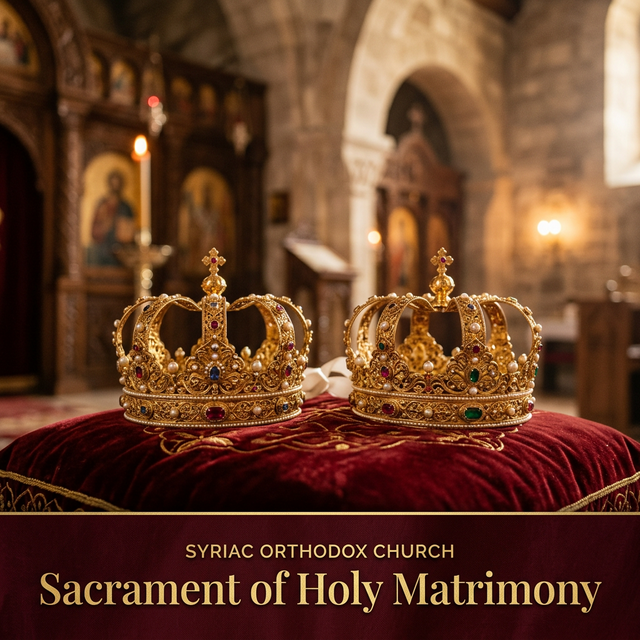
The Sacrament of Holy Matrimony is one of the seven Holy Sacraments of the Syriac Orthodox Church. It is a sacred and divine covenant between a man and a woman, instituted by God Himself for love, companionship, and the continuation of life through family. Marriage, in the Syriac Orthodox faith, is not merely a social contract or human arrangement, but a holy mystery (Rāzo Qaddišo) through which two persons become one body and one spirit in Christ.
Introduction to Holy Matrimony
Biblical Foundation
Marriage was established by God in the Garden of Eden when He created man and woman. As recorded in the book of Genesis, the Lord declared:
"It is not good that man should be alone; I will make him a helper comparable to him." (Genesis 2:18)
When God brought Eve to Adam, Adam's first words expressed profound recognition of this divine gift:
"This is now bone of my bones and flesh of my flesh." (Genesis 2:23)
Our Lord Jesus Christ confirmed the sanctity and indissolubility of marriage with these authoritative words:
"Therefore what God has joined together, let no man separate." (Matthew 19:6)
Through these scriptural foundations, the Church understands marriage as a divinely ordained union, blessed and sanctified by God Himself. The institution of marriage is not human in origin, but divine in character and purpose.
Marriage as a Holy Sacrament
In the Syriac Orthodox tradition, marriage is not simply a civil or social ceremony; it is a sacramental union, where the grace of the Holy Spirit binds husband and wife into one spiritual and physical life. The institution transcends the realm of human law and enters the realm of divine grace and mystery.
The Apostle Paul, inspired by the Holy Spirit, describes this profound reality with these words:
"This is a great mystery, but I speak concerning Christ and the Church." (Ephesians 5:32)
Thus, the relationship between husband and wife reflects the mystical union between Christ (the Bridegroom) and His Church (the Bride). Marriage becomes a living icon and tangible manifestation of Christ's eternal love for His Church. In this sacred mystery, two souls are united not only in flesh but in spirit, becoming witnesses to divine love in their daily life and family.
The Purpose of Marriage
The Holy Syriac Orthodox Church teaches that marriage serves three sacred purposes, each reflecting divine wisdom and the sanctification of human life:
1. Companionship and Love
Marriage unites two souls in love, trust, and mutual respect. It is a lifelong companionship where both husband and wife help each other in faith and virtue. This companionship is not merely emotional, but spiritual—a shared journey toward holiness and salvation. In their love for one another, spouses become instruments of God's grace, supporting each other through trials, celebrating joys, and growing together in the knowledge and fear of God.
2. Procreation and Raising of Children
The family becomes the first church—a holy environment where children are raised in the fear and love of God. Parents are entrusted with the sacred responsibility of nurturing the next generation of believers, transmitting the faith, and establishing a household rooted in Christian virtues. The home itself becomes a sanctuary of prayer, devotion, and godly instruction, where the seeds of faith are first planted in young hearts.
3. Sanctification of Life
Through marriage, the couple sanctifies their human desires and daily life, living in holiness and mutual sacrifice. What might otherwise remain in the realm of nature and instinct is transformed by grace into an expression of divine love. The struggles, joys, sorrows, and celebrations of married life all become opportunities for spiritual growth, self-surrender, and deepening union with Christ.
The Rite of Holy Matrimony
The marriage service in the Syriac Orthodox Church is deeply symbolic, beautiful, and solemn. It is celebrated in the presence of a priest (or bishop), before the altar of God, and within the context of prayer and blessing. The sacred nature of the ceremony reflects the solemnity and holiness of the covenant being made.
The Betrothal (Kthobo d'Sharubo)
The first part of the marriage rite is the Betrothal, wherein the priest blesses the rings and presents them to the couple. These rings symbolize the unbroken circle of love and commitment—a constant reminder of their mutual promise and eternal bond. The exchange of rings is not merely ornamental; it is a visible sign of an invisible sacramental reality.
The Crowning (Kthobo d'Takshe)
The most sacred part of the rite is the Crowning, where the priest blesses and crowns the bridegroom and bride with crowns of glory and honor. These crowns are laden with rich spiritual symbolism. They signify the victory of love, purity, and unity—marking the couple as victors in the spiritual battle. The crowns also remind the couple of the crown of martyrdom, for marriage involves sacrifice and self-giving love, a death to self that leads to eternal life.
Blessing and Joining of Hands
The priest joins the right hands of the couple, symbolizing their eternal bond and union before God. Through this gesture, the Church publicly witnesses and confirms their sacred commitment. The priest then invokes the Holy Trinity, praying that God may bless, sanctify, and preserve their union according to His divine will and mercy.
Reading from Scripture
Passages from the Holy Bible, especially from St. Paul's letters and the Gospels, are read during the service to remind the couple of their spiritual duties and the nature of Christian marriage. These readings provide scriptural grounding for the sacred mystery about to be enacted and guidance for the couple's life together.
Final Blessing
The priest concludes the service with a solemn blessing, praying for peace, love, and faithfulness in the couple's home. He asks God to grant them wisdom, patience, and grace to fulfill their vocations as husband and wife. The service ends with the blessing of the congregation, wherein the entire Church community affirms its support and prayers for the newly married couple.
The Spiritual Meaning of Marriage
Marriage is a path of holiness and mutual sanctification. It is not based merely on emotion or physical attraction but on divine love (ahobo d'Alaho)—a love that is patient, kind, sacrificial, and eternal. The couple is called to live a life of faith, patience, forgiveness, and prayer, sharing each other's burdens as they journey together toward eternal life.
The husband is called to love his wife as Christ loved the Church—with sacrificial, self-emptying, and redemptive love. The Apostle Paul exhorts husbands to lay down their lives for their wives, even as Christ gave Himself for the Church. The wife is called to honor and support her husband in humility and grace, recognizing his headship in the family while contributing her own unique gifts and wisdom to their shared life (Ephesians 5:22–25).
In this way, their home becomes a "little church" (Etho d'Beyto), filled with prayer, faith, and love. The daily rhythms of married life—the mundane tasks, the moments of tenderness, the resolution of conflicts, the celebration of milestones—all become opportunities for grace to work and transform the couple into the image of Christ. Marriage is thus not an escape from the spiritual life, but a particular and intimate path of spiritual growth and sanctification.
Indissolubility and Sanctity
The Syriac Orthodox Church teaches that marriage is indissoluble. What God has joined together cannot be broken by human authority or the passing whims of human sentiment. This teaching flows directly from the words of Christ Himself and reflects the Church's understanding that marriage is a divine institution, not a human contract subject to human modification or dissolution.
Divorce is permitted only in very grave circumstances, such as adultery, and even then, it is considered a tragedy and a last resort rather than a remedy. The Church deeply grieves when a marriage ends in separation and does not view divorce as a solution but as a failure to live out the fullness of the marital covenant. The Church encourages reconciliation and forgiveness whenever possible, reflecting Christ's command to forgive seventy times seven and to seek peace with one's neighbor.
The indissolubility of marriage affirms the sanctity and binding nature of the sacrament. It reminds couples that they are making a lifetime commitment before God and the Church—a commitment that requires ongoing faith, effort, grace, and prayer to maintain and deepen.
Marriage and the Holy Eucharist
A Christian marriage finds its true foundation and sustenance in the Holy Eucharist (the Divine Liturgy and Holy Communion). Couples are encouraged to participate regularly in the Divine Liturgy and receive Holy Communion together, thereby nourishing their marriage with the very life and grace of Christ. The Eucharist is the sacrament of unity, wherein all believers are united with Christ and with one another in His mystical body.
When husband and wife receive Holy Communion together, they are spiritually nourished by the same source and are called to embody in their marriage the unity they experience in the sacrament. Through regular participation in the Eucharist, couples are graced to live their marital vocation with greater fidelity, love, and holiness.
The home becomes an extension of the altar—a place of prayer, love, and charity where the grace received at the Eucharist is lived out in concrete acts of service, forgiveness, and sacrifice. In this way, the marriage participates in and reflects the redemptive work of Christ.
Celibacy and Monastic Life
While marriage is a blessed and holy path to sanctification, the Church also honors celibacy and monasticism as a higher calling for those who dedicate their lives entirely to the service of God. Both marriage and celibacy are considered sacred vocations—two different but equally valid paths leading to holiness and salvation. Both require prayer, faith, sacrifice, and grace.
The Church recognizes that God calls different people to different states of life. Some are called to the married state; others are called to celibacy for the sake of the Kingdom of Heaven. Both callings are divine and sacred. The married person and the celibate person each have their own spiritual gifts and responsibilities. The important thing is that each person faithfully answers the call that God has placed upon their life and lives it out with devotion, prayer, and love.
The Role of the Family
In the Syriac Orthodox vision, the family is the domestic church (Itho d'Beyto). It is where faith is first nurtured, where prayers are first learned, and where Christian virtues are first practiced. The family is the foundational unit of the Church and of society. It is within the family that children first encounter Christ through the faith and example of their parents.
The parents, especially, are seen as the first teachers of faith. They are responsible for raising their children in godliness and obedience to the Church. They must model faith in their daily lives, pray with their children, teach them the scriptures, and bring them to Church. The family that prays together, worships together, and serves others together becomes a powerful witness to the transforming power of the Gospel.
The domestic church is not separate from the universal Church but rather an essential part of it. When families are strong in faith and love, the entire Church community is strengthened. Conversely, when families falter in their faith, the whole community suffers. Thus, the health and holiness of individual families directly impacts the health and holiness of the Church.
Conclusion
Holy Matrimony in the Syriac Orthodox Church is a divine mystery of love, unity, and grace. It is a covenant before God, where two souls are joined by the Holy Spirit to live as one in faith and holiness. Through this sacrament, the couple becomes a living icon of Christ and His Church—witnessing God's eternal love in their life, family, and community.
Marriage is not a destination but a journey—a journey of mutual sanctification, forgiveness, and growth toward the likeness of Christ. It is a challenging but deeply rewarding vocation that brings with it both cross and resurrection, suffering and joy, death and life. Those who undertake this journey with faith, prayer, and grace will discover that marriage, at its deepest level, is a profound expression of God's love for His people.
Prayer for Couples in Holy Matrimony
O Almighty God, Creator of all and Source of all love, who in Your infinite wisdom joined man and woman in the sacred bond of marriage, we humbly ask Your blessings upon all couples united in Holy Matrimony. Grant them strength in trials, wisdom in decision-making, and deepening love through the years. Help them to bear one another's burdens with patience and forgiveness, to grow together in faith and virtue, and to raise their children in the knowledge and fear of You. Bless their home with peace, their hearts with devotion, and their lives with the fullness of Your grace. May they forever reflect in their marriage the sacrificial love of Christ for His Church, and may they, together with their children, inherit the Kingdom of Heaven. Through the mercies of our Lord Jesus Christ, to Whom, together with You and the Holy Spirit, be glory, honor, and dominion, now and forever. Amen.
"Blessed is the husband and wife who love each other truly. Their hearts are temples where Christ dwells, and their love becomes a fragrance before the throne of God." — St. Ephrem the Syrian