🕊️Introduction
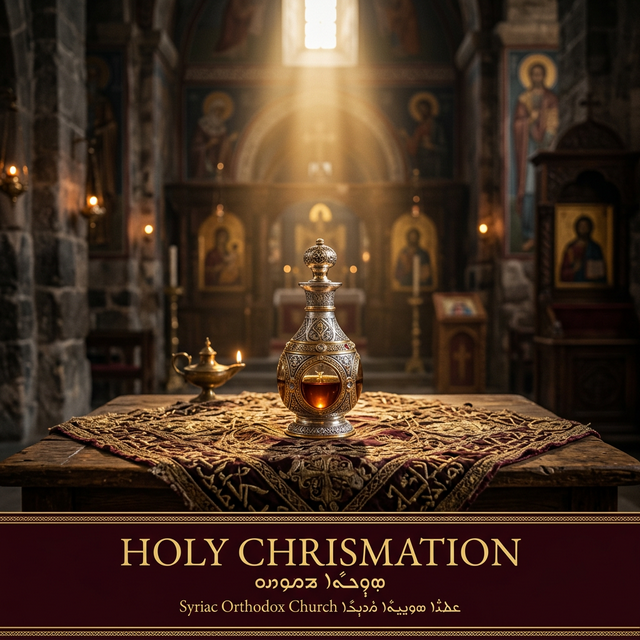
In the Syriac Orthodox Church, Holy Muron (Confirmation)—more properly called Holy Chrismation
(Sleebo M'shicho)—is one of the Holy Sacraments of profound spiritual significance. It is the
sacrament through which a baptized Christian receives the gifts of the Holy Spirit, becoming a fully
initiated member of the Body of Christ, the Holy Church. This sacred mystery cannot be separated
from Baptism; it is the immediate and necessary continuation of the baptismal grace, completing the
believer's initiation into the full life of the Church.
Through Chrismation, the grace that begins in Baptism reaches its fullness. While Baptism brings the
believer into the Church as a new member, Chrismation seals them with the Holy Spirit and empowers
them for a life of active witness and spiritual combat. The two sacraments together form an
inseparable unity in the apostolic tradition of the Church of Antioch.
✝️The Meaning of Chrismation
The word Chrismation comes from the Greek chrisma (χρίσμα), meaning "anointing." In Syriac, the
sacrament is called "Muron" (ܡܽܘܪܽܘܢܳܐ), referring to the Holy Chrism—the consecrated oil—which is
the
matter of this divine mystery. Through this anointing, the believer receives the seal of the Holy
Spirit, just as was done by the Apostles in the early Church in their laying on of hands and
anointing of the newly baptized.
The significance of anointing is rooted deep in Scripture and in the spiritual experience of God's
people. In the Old Testament, kings and high priests were anointed with oil as a sign that God had
set them apart and endowed them with the Holy Spirit for their mission. When David was anointed by
Samuel, "the Spirit of the Lord came mightily upon David from that day forward" (1 Samuel 16:13).
When Jesus was baptized at the Jordan, He was anointed by the Holy Spirit—the voice of the Father
declared, "This is my beloved Son, with whom I am well pleased" (Matthew 3:17). Jesus Himself is the
ultimate Messiah, the anointed One, whose name means "the Anointed."
While Baptism cleanses a person from original sin and grants new life in Christ—making the person a
child of God through the waters of rebirth—Chrismation strengthens that life through the descent and
indwelling of the Holy Spirit. It is thus considered a spiritual continuation of Baptism—the
"Pentecost" of the newly baptized believer. Just as the Church at Pentecost received the Holy Spirit
when the apostles were baptized on that great day (Acts 2), so each baptized individual receives the
Holy Spirit in Chrismation, becoming empowered to live as a witness of Christ.
The two sacraments work together in perfect harmony: Baptism is the gateway, and Chrismation is the
empowerment; Baptism is the birth, and Chrismation is the anointing that marks the newborn as God's
chosen vessel. Neither can be understood in isolation from the other. To be truly initiated into the
Church is to be baptized and to receive the seal of Chrismation.
📖Biblical Foundation
The Holy Scriptures clearly affirm the sacrament of Chrismation and the apostolic practice of laying
on of hands for the reception of the Holy Spirit. Throughout the New Testament, we find clear
evidence that the gift of the Holy Spirit was conferred by the apostles through an anointing or
laying on of hands that was distinct from, yet inseparable from, Baptism.
Acts 8:14–17
"When the apostles at Jerusalem heard that Samaria had received the word of God, they sent them
Peter and John, who came down and prayed for them that they might receive the Holy Spirit; for it
had not yet fallen on any of them, but they had only been baptized in the name of the Lord Jesus.
Then they laid their hands on them and they received the Holy Spirit" (Acts 8:14–17).
This passage is particularly significant: the Samaritans were first baptized by Philip the deacon,
but their baptism was not complete until Peter and John came and laid their hands upon them, at
which point they received the Holy Spirit. The laying on of hands by the apostles completed what
Baptism had begun, conferring the full grace of the Spirit. This demonstrates that from the very
beginning of the Church, there was a two-fold action in initiation: Baptism followed by the laying
on of hands (which later became identified with Chrismation).
Acts 19:5–6
"On hearing this, they were baptized in the name of the Lord Jesus. And when Paul had laid his hands
upon them, the Holy Spirit came on them; and they spoke with tongues and prophesied" (Acts 19:5–6).
Again, the pattern is clear: Baptism followed by the laying on of hands by an apostle, resulting in
the reception of the Holy Spirit manifested in spiritual gifts. St. Paul, as an apostle, performed
the same action that Peter and John had performed, maintaining apostolic continuity in the
transmission of this sacramental grace.
2 Corinthians 1:21–22
"Now it is God who makes both us and you stand firm in Christ. He anointed us, set his seal of
ownership on us, and put his Spirit in our hearts as a deposit, guaranteeing what is to come" (2
Corinthians 1:21–22).
Paul here speaks of being anointed by God and receiving His seal and His Spirit. This anointing and
sealing parallel the sacramental action of Chrismation. The "seal" indicates something that cannot
be undone, a permanent mark of God's ownership. The believer, once sealed with the Holy Spirit,
bears an indelible mark of belonging to God. No sin, no fall, no human weakness can erase this seal,
for it is God who has placed it.
In the Syriac Orthodox understanding, the laying on of hands performed by the Apostles in these
biblical accounts is continued and perpetuated through Chrismation, administered with the Muron
(Holy Chrism). The consecrated oil becomes the visible sign through which the invisible grace of the
Holy Spirit is bestowed. The priest, acting in apostolic succession, performs the same action that
the apostles performed, conferring the same grace that they conferred. The matter has changed
slightly from the laying on of bare hands to the anointing with holy oil, but the grace and the
meaning remain the same—the transmission of the Holy Spirit to the baptized believer.
🕯️Administration of the Sacrament
In the Syriac Orthodox Church, Chrismation is usually administered immediately after Baptism, even
for infants. This practice reflects the apostolic understanding that initiation into the Church is a
unified process that is not complete until the newly baptized has received the seal of the Holy
Spirit. The priest anoints the newly baptized person with the Holy Muron on various parts of the
body, each anointing carrying profound spiritual significance.
The priest anoints the following parts of the body:
- The Forehead — Signifying that the mind and will are dedicated to God, and that
the believer is strengthened to confess Christ openly without shame.
- The Eyes — That the eyes may be opened to see God's truth and beauty, and to
turn away from evil.
- The Nostrils — That the believer may smell the "sweet aroma of Christ" and be
drawn toward holiness.
- The Mouth — That the lips may be sealed to refrain from gossip and slander, but
opened to proclaim the Gospel and pray without ceasing.
- The Ears — That the ears may be opened to hear God's Word and closed to lies
and corrupt speech.
- The Breast — That the heart may be filled with love for God and neighbor, and
protected from hatred and vice.
- The Hands — That the hands may be strengthened for good works, service to the
poor, and resistance to sin.
- The Feet — That the feet may be guided in the way of righteousness and kept
from stumbling into darkness.
With each anointing, the priest proclaims:
"(Name), is sealed with the seal of the gift of the Holy Spirit, in the name of the Father,
and of the Son, and of the Holy Spirit, one true God. Amen."
This act is of immense spiritual significance. By anointing every sense and faculty of the person,
the priest is declaring that every part of the human being—mind, will, heart, hands, feet—is now
dedicated to the service of God and sealed by the Holy Spirit. There is no part of the believer's
life that is outside the domain of the Spirit. The entire person is consecrated, every faculty
sanctified, every member of the body made an instrument of God's work.
🌿The Holy Muron (Holy Chrism)
The Muron is a sacred mixture of pure olive oil and aromatic substances—including myrrh,
frankincense, and other fragrant spices—which is consecrated by the Patriarch of Antioch during a
solemn and ancient ceremony. This ceremony is held once every few years, and only the Patriarch has
the authority to consecrate the Muron. The Muron is not merely a substance prepared according to a
recipe; it is a sacrament prepared according to the apostolic tradition that has been preserved
unbroken for nearly two thousand years.
The tradition holds that the Muron is believed to have originated from the Holy Myron prepared by
the Apostles themselves, containing—according to Church tradition—some portion of the oil blessed by
Christ Himself or sanctified through contact with the holy relics of the apostles and martyrs.
Whether this understanding is literally historical in every detail, the point is theologically
profound: the Muron used in the Church today stands in direct apostolic succession from the
anointing oil used in the early Church, and through this continuity, the grace of the apostolic age
is transmitted to believers today.
Every bishop and priest receives a supply of the Muron from the Patriarch, signifying apostolic
continuity and the unity of all the Church's ministers under the See of St. Peter in Antioch. This
distribution of the Muron by the Patriarch to all the bishops emphasizes the essential catholicity
of the Church—the fact that all orthodox bishops and priests, regardless of their geographical
location or the size of their flocks, are united in the one faith and the one sacramental ministry
under the Patriarch of Antioch.
No priest can prepare the Muron himself; only the Patriarch consecrates it, usually during Holy Week
at the Patriarchal See. This centralization of the preparation and distribution of the Muron serves
several purposes: First, it ensures that the Muron used throughout the Church is uniform and blessed
by the highest ecclesiastical authority. Second, it reinforces the unity and catholicity of the
Church under the successor of St. Peter. Third, it emphasizes that Chrismation is not a local or
arbitrary rite but an apostolic mystery that binds the entire Church together.
The preparation of the Muron is accompanied by solemn prayers and hymns, often dating back to the
earliest centuries of the Church. The Patriarch invokes the Holy Spirit to descend upon the oil and
sanctify it, just as the oil was sanctified in the early Church when the apostles consecrated it.
The incense, myrrh, and other aromatics are carefully selected and blended according to the ancient
formula, producing a oil that is not only efficacious sacramentally but also profound spiritually in
its very fragrance, which reminds the faithful of the "sweet aroma of Christ" (2 Corinthians 2:15).
🔥Theological Significance
Through Chrismation, the believer undergoes a profound spiritual transformation. The sacrament
confers multiple graces and effects that shape the entire trajectory of the Christian life. While
Baptism brings the believer into relationship with God as a child, Chrismation establishes the
believer as a soldier of Christ, equipped with spiritual armor and gifts for the spiritual warfare
that characterizes the Christian life.
Through Chrismation, the believer:
- Receives the indwelling of the Holy Spirit. The Spirit of God comes to dwell in
the temple of the believer's body, making the person a living sanctuary of the Divine. St. Paul
writes, "Do you not know that your bodies are temples of the Holy Spirit, who is in you, whom
you have received from God?" (1 Corinthians 6:19). This indwelling is not a temporary visitation
but a permanent gift; the Spirit remains in the believer as a down payment and guarantee of
salvation.
- Becomes a soldier of Christ, empowered to live and defend the faith. No longer
a passive recipient of grace, the baptized and chrismated person is now an active warrior in
Christ's army, equipped with spiritual gifts and empowered to resist evil, overcome temptation,
and proclaim the Gospel. The believer is fortified to face the trials and persecutions that may
come, to stand firm in faith when the world opposes the Gospel, and to bear witness to Christ
even at the cost of one's own comfort or safety.
- Is sealed with an indelible mark—the "Seal of the Holy Spirit"—which no sin can
erase. This seal marks the believer as belonging to God, sealed for the day of
redemption. As St. Paul writes, "And do not grieve the Holy Spirit of God, with whom you were
sealed for the day of redemption" (Ephesians 4:30). While sins may wound and damage the
believer's relationship with God, the seal itself cannot be removed. No matter how far a person
may fall, the seal of the Spirit remains, making possible repentance and restoration.
- Is united more deeply to the Mystical Body of Christ, the Church. Through
Chrismation, the believer is not merely a member of an earthly institution but a living cell in
the Body of Christ. The gifts received are not for the individual's benefit alone but for the
building up of the entire Church. The believer becomes a vessel through which the grace of the
Holy Spirit flows to others, contributing unique gifts and charisms to the common good.
St. Severus of Antioch, one of the greatest Fathers of the Syriac Church, explained this theological
reality with profound clarity:
"The Holy Spirit completes what the water of Baptism begins; as the Father creates, the Son
renews, and the Spirit perfects."
This statement captures the trinitarian structure of Christian initiation. The Father's creative
power is manifest in Baptism, which gives birth to new life. The Son's redemptive work is the
foundation upon which Baptism operates. The Holy Spirit completes and perfects what Baptism begins,
bringing the grace of Baptism to fullness through the seal of Chrismation.
🙏Liturgical and Spiritual Meaning
In the life of the faithful, Chrismation is not a one-time event to be remembered sentimentally and
then forgotten, but a lifelong empowerment that continually sustains the believer's walk with
Christ. Every spiritual struggle, every act of virtue, every service rendered to God and
neighbor—all of these draw upon the grace and strength imparted through Chrismation. The seal of the
Spirit, once received, remains active and operative throughout the entire Christian life.
During the Holy Qurbana (Divine Liturgy), the anointing with the Holy Spirit that began in
Chrismation is renewed and deepened mystically through communion with the Body and Blood of Christ.
When the faithful participate in the Eucharist, they are not only remembering what Christ did; they
are mystically participating in His death and resurrection, and the grace of the Holy Spirit is
renewed in their hearts. The priest holds the chrismated faithful to the altar, and through their
participation in the Eucharist, they are mystically anointed anew.
The liturgical significance of Chrismation extends to the entire structure of the Church's worship.
In the Qurbana, the priest anoints the altar with the Muron, sanctifying the place where the Divine
Mystery will be celebrated. This anointing of the altar reminds all present that the church building
itself, and the altar in particular, are sealed by the Holy Spirit. When the faithful then approach
the altar to receive Communion, they are coming to a place that has been sealed with the same Muron
that sealed their own bodies in Chrismation. There is a profound unity and continuity in the
Church's sacramental theology.
Furthermore, in the daily life of the believer, the seal of Chrismation is invoked in times of
prayer and temptation. When faced with difficulty, the believer recalls that they have been sealed
with the Spirit and draws upon that grace. When preparing to receive the Eucharist, the believer
remembers their Chrismation and prepares the heart to receive the Risen Christ. When confessing sins
and seeking repentance, the believer knows that the seal of the Spirit remains and offers the
assurance of forgiveness and restoration. Chrismation, then, is not merely a sacrament of the past
but an active and ongoing source of grace in the present life of every believer.
🕊️Relationship to Other Sacraments
In the Syriac Orthodox Church, the sacraments of Christian initiation form an indissoluble trinity
that must be understood together:
|
Sacrament |
Meaning |
Effect |
| Baptism |
Birth into new life in Christ |
Cleansing from sin, new birth, membership
in the Church |
| Chrismation |
Strength and seal of the Holy Spirit |
Indelible seal, gifts of the Spirit,
strengthening in faith |
| Holy Eucharist |
Ongoing nourishment and union with Christ
|
Sustenance in grace, mystical union,
transformation in Christ |
Together, these three form the Sacraments of Christian Initiation—the foundational mysteries through
which a person is incorporated into the Church and begins the journey toward theosis (deification,
union with God). They are not three separate rites but three aspects of a single process of
initiation. When properly understood, they cannot be separated or administered out of order; they
must be viewed as a unified whole.
In contrast to some Western churches that separate these sacraments across years or even decades,
the Syriac Orthodox Church administers all three at once, even to infants, maintaining the ancient
apostolic practice. This reflects the understanding that initiation into the Church is a single,
unified process. An infant who is baptized, chrismated, and given Communion on the same day is fully
initiated into the life of the Church. They possess all the sacramental grace necessary to grow
spiritually and to participate fully in the Church's life and worship.
This practice also emphasizes an important truth: that salvation and spiritual growth are not
ultimately dependent on human understanding or readiness but on God's grace. Parents and godparents
bring the child to the font, presenting them to God, not because the child has professed faith or
demonstrated understanding, but because the parents and the Church have faith that God's grace is
sufficient. The grace of the sacraments operates independent of the recipient's comprehension; it is
the objective work of God conveyed through the Church's prayers and actions.
After the sacraments of initiation, the believer participates in the other sacraments as needs
arise: Repentance (Confession) for the recovery of grace after sin; Anointing of the Sick for
healing and consolation in times of illness; Priesthood (Holy Orders) for those called to minister;
Matrimony for those called to marriage. But all of these flow from and are rooted in the grace
received in Baptism, Chrismation, and the Eucharist.
📋Summary of the Sacrament
|
Aspect |
Syriac Orthodox Understanding |
| Name |
Holy Chrismation (Sleebo M'shicho) or
Holy Muron |
| Minister |
Priest (with Holy Chrism blessed by the
Patriarch) |
| Matter |
Anointing with Holy Muron (sacred oil
mixture of olive oil and aromatic substances) |
| Form |
"(Name), is sealed with the seal of the
gift of the Holy Spirit, in the name of the Father, and of the Son, and of the Holy
Spirit, one true God. Amen." |
| Effect |
Gift of the Holy Spirit, indelible seal
of faith, strengthening in grace, establishment as a soldier of Christ |
| Frequency |
Once in a lifetime (unrepeatable and
indelible) |
| Connection |
Follows Baptism immediately; precedes
Holy Communion in the same celebration |
✨Conclusion
For the Syriac Orthodox faithful, Chrismation is a profound mystery—a continuation of the same
Spirit who descended upon Christ at the River Jordan, who came upon the Apostles at Pentecost, and
who now comes upon every baptized believer through the Holy Muron. It is the visible seal of
invisible grace, marking the believer as a true child of God, adopted into God's family, and
established as a living temple of the Holy Spirit.
Through Chrismation, the believer is grafted into the unbroken apostolic succession that stretches
back to the very beginning of the Church. The Muron used today contains—through apostolic
continuity—the grace and power of the oil prepared by the apostles themselves. When a person is
chrismated, they are connected not only to Christ and the apostles but to all the saints, martyrs,
and faithful who have gone before them throughout the centuries, all sealed with the same Spirit in
the same sacrament.
The seal received in Chrismation is permanent and indelible. No circumstance, no sin, no weakness
can erase it. Whether the believer remains faithful or falls into grave sin, the seal remains,
always offering the possibility of repentance, restoration, and renewed grace. It is the ultimate
assurance that God claims the believer as His own, that the baptized and chrismated person belongs
to Christ forever, and that nothing can separate them from God's love except their own final
rejection of grace.
"The Muron makes us partakers of the heavenly anointing,
that we may shine with the light of the Spirit,
and bear witness to the faith of our fathers."