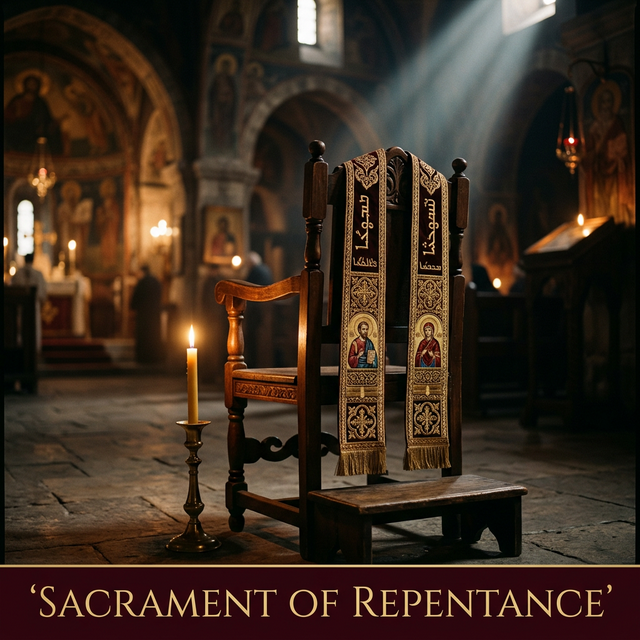
✝️Introduction
The Sacrament of Confession, also called the Sacrament of Repentance or Penance, is one of the seven
Holy Sacraments of the Syriac Orthodox Church. It is through this mystery that the faithful, having
fallen into sin after Baptism, are reconciled with God and the Holy Church by confessing their sins
with a repentant heart before a priest, who acts in the authority of Christ.
In Syriac, the sacrament is known as "Tesho'bo" (ܬܫܽܘܒܳܐ), meaning "return" or "turning back." It
signifies the believer's return to God, a spiritual homecoming to the Father's love—like the
prodigal son who came back and was embraced again (Luke 15:11–32). Confession is not a sacrament of
fear, condemnation, or legalistic judgment; rather, it is the compassionate and healing embrace of
God's boundless mercy.
In the economy of God's salvation, Baptism is the washing away of original sin and the entry into
new life. But because believers remain subject to temptation and the weakness of the flesh, they may
fall into sin even after receiving the grace of the sacraments. Confession exists precisely to
restore the grace that is lost through sin, to heal the wounds that sin inflicts upon the soul, and
to reconcile the sinner with God and the Church. Through Confession, no believer is ever truly
abandoned or cut off from God's mercy.
🕊️The Biblical Foundation
The sacrament of Confession is firmly rooted in the Holy Scriptures and established by Christ
Himself. Our Lord not only taught about forgiveness but instituted the sacrament and gave to His
Church the power to forgive sins in His name. This authority is not a human invention but a divine
gift granted by Christ to His apostles and, through them, to all bishops and priests throughout
history.
Christ's Institution of the Sacrament (John 20:22–23)
Our Lord Jesus Christ instituted Confession after His Resurrection when He appeared to the apostles
in the locked room. This was not a private appearance but a solemn moment of commissioning and
empowerment. The Gospel of St. John records:
"He breathed on them and said to them, 'Receive the Holy Spirit. If you forgive the sins of
any, they are forgiven them; if you retain the sins of any, they are retained.'"
Several profound truths emerge from these words. First, Christ breathed upon the apostles—recalling
the creation account where God breathed into Adam the breath of life. Here, the Risen Christ
breathes upon them the Holy Spirit, giving them a new life, a new authority, a new mission. Second,
Christ grants them the power to forgive sins—not by their own authority or human wisdom, but by the
authority of Christ Himself. Third, this power is connected to the Holy Spirit; it is not a merely
human or administrative function but a spiritual reality effected through the Spirit.
The language "if you forgive... they are forgiven; if you retain... they are retained" does not
suggest arbitrary or capricious judgment, but rather indicates that the priest, in hearing
confession and discerning the sincerity of repentance, either declares forgiveness or indicates that
further repentance is needed. The priest judges not the sinner's worth but the condition of the
sinner's heart. The divine authority granted is not to condemn but to forgive through the power of
the Spirit.
St. James the Apostle (James 5:16)
St. James the Apostle commands the faithful in his epistle:
"Confess your sins to one another and pray for one another, that you may be healed."
This passage emphasizes the healing aspect of confession. Sins are not merely legal violations to be
punished; they are spiritual illnesses that wound the soul. Confession is presented as medicine for
the soul, bringing healing and restoration. The word "healed" suggests that sin damages the
spiritual health of the person, and confession restores that health. Furthermore, James speaks of
confessing to one another and praying for one another—indicating that the community's intercessory
prayer is part of the healing process.
St. John the Evangelist (1 John 1:8–9)
St. John writes with profound clarity about repentance and forgiveness:
"If we claim to be without sin, we deceive ourselves and the truth is not in us. If we
confess our sins, he is faithful and just to forgive us our sins and to cleanse us from all
unrighteousness."
John's teaching affirms two essential truths. First, all believers are subject to sin; the claim to
sinlessness is itself a deception and a form of spiritual blindness. No one, in this life, is exempt
from temptation and the possibility of sin. Second, God is faithful and just to forgive when we
confess. This is not a matter of God's uncertain mercy or temperamental forgiveness; it is a matter
of God's very nature and justice. God is faithful—He keeps His promises—and He is just—He operates
according to His nature, which is love and mercy toward the repentant.
Thus, Confession is not merely a private prayer of self-condemnation or an emotional relief valve.
It is a sacramental act—a divinely ordained mystery—performed within the Church, through which
divine forgiveness is truly granted by the authority of Christ and the power of the Holy Spirit. The
priest is not the ultimate judge; God is. The priest is the instrument and witness of God's
forgiveness, acting in Christ's stead.
💧The Nature and Meaning of Confession
Confession in the Syriac Orthodox Church is understood as a spiritual medicine—a means of healing
the soul that has been wounded by sin. This understanding permeates all the Church's teaching on
repentance, distinguishing it from a purely juridical or punitive approach. Confession is both
judicial and therapeutic, both accounting and healing, both acknowledgment of fault and restoration
to wholeness.
The confession that takes place before a priest is not confession in the sense of mere admission or
declaration of guilt—as one might "confess" a crime to a judge. Rather, it is a profound spiritual
act in which the sinner, with genuine contrition and heartfelt sorrow, opens their heart before God
(represented by the priest), acknowledges the ways in which they have violated God's commandments
and wounded themselves through sin, and humbly seeks God's mercy and restoration.
The priest, in this sacred moment, serves as a witness and spiritual father—not as an authority
figure wielding power over the penitent, but as a compassionate guide representing Christ's healing
presence. The priest listens in silence, without judgment, and with the ear of spiritual wisdom
developed through prayer, ascetical practice, and pastoral experience. The priest is not there to
shame or to punish, but to guide the penitent toward genuine repentance and to assure them of God's
mercy.
The purposes of Confession are multifold:
- Forgiveness of sins committed after Baptism — Through the absolution pronounced
by the priest, the grace of Christ washes away the guilt of sin and restores the sinner to a
state of grace.
- Reconciliation with God and the Church — Sin ruptures the believer's
relationship with God and creates a breach in their communion with the Church. Confession
repairs this rupture and restores the sinner to full participation in the Church's sacramental
life.
- Restoration of inner peace and grace — The conscience that has been troubled by
guilt finds peace through absolution. The grace that was lost through sin is restored, and the
soul is filled with the joy of God's forgiveness.
- Spiritual growth through repentance and self-examination — The process of
confessing one's sins necessarily involves looking honestly at one's life and motivations. This
self-examination, guided by the priest's counsel and the Church's moral teachings, leads to
deeper spiritual maturity and understanding of one's own weakness and God's strength.
St. Isaac the Syrian, one of the great mystical theologians of the Syriac tradition, beautifully
wrote:
"Repentance is the door of mercy opened to those who seek it. Through this door we enter
into the mercy of God, and without it, we cannot find His love."
This image of repentance as a door emphasizes its transitional character. Repentance is not a
destination but a passage—a movement from the darkness of sin to the light of forgiveness, from
alienation to reconciliation, from death to life. And only through this door—through genuine
repentance and confession—can one truly enter into the experience of God's mercy.
🕯️The Steps of True Repentance
In Syriac Orthodox teaching, Confession is not a single, isolated act but a spiritual journey—a
process of conversion that consists of several interconnected stages. Each stage is essential, and
the omission of any one of them undermines the authenticity and efficacy of the whole. Understanding
these stages helps the believer approach the sacrament with proper intention and with genuine
expectation of grace.
1. Self-Examination
The journey of repentance begins with honest self-examination—reflecting on one's life in light of
the commandments of God and the teachings of Christ. This is not mere introspection or psychological
self-analysis. Rather, it is a prayerful examination of conscience in which the believer looks at
their thoughts, words, and actions through the lens of God's law and God's love.
The Ten Commandments, the Beatitudes, and the teachings of Christ provide the standard by which one
examines one's life. The believer asks: Have I loved God with all my heart? Have I honored His name?
Have I kept His commandments? Have I treated my neighbor with the respect and love due them? Have I
been truthful, just, merciful, and pure? In this examination, one's habitual sins are brought to
light, as are the subtle ways in which pride, selfishness, anger, or lust manifest themselves in
one's behavior.
2. Contrition
Contrition is genuine sorrow for having offended God's love and having violated God's commandments.
This is not mere regret at having been caught, nor is it fear of punishment. Rather, it is a
heartfelt sorrow that arises from understanding how profoundly one has wounded oneself through sin
and how one has, in a small way, conspired against the redemptive work of Christ.
True contrition involves recognizing that sin is not merely a mistake or a failure but a violation
of love—a turning away from God who loves us infinitely and who desires only our good. When Peter
wept bitterly after denying Christ, his tears flowed from contrition—from the sudden, devastating
awareness of having betrayed the One he loved most. This is the contrition that must accompany true
repentance.
3. Firm Resolution
Firm resolution is the sincere decision to turn away from sin and to pursue a different path—a
commitment to amend one's life and to grow in holiness. This is not a shallow promise that is
quickly forgotten, but a determination to resist temptation in the future and to live according to
the Gospel.
Firm resolution does not require sinless perfection going forward—the believer knows that they
remain subject to temptation and weakness. Rather, it is a resolute turning of the will toward God,
a commitment to strive against habitual sins, and a readiness to return to confession and repentance
if one should fall again. It is the difference between momentary guilt and genuine change of
direction.
4. Verbal Confession
Verbal confession is the humble confession of sins before the priest—the representative of Christ
and the Church. This is the sacramental moment in which the internal journey of repentance finds its
external expression and, through the priest's mediation, encounters God's grace in a concrete and
sacramental way.
The act of speaking one's sins aloud before another person—before a priest who represents
Christ—requires profound humility. It shatters the isolation and secrecy that often surrounds sin.
By confessing aloud, the penitent admits the reality of their sin and accepts that it cannot be
hidden from God. The verbal confession also allows the priest to understand the spiritual condition
of the penitent and to offer appropriate counsel.
5. Absolution
Absolution is the pronouncement of God's forgiveness through the priest, who acts with Christ's
authority and the power of the Holy Spirit. The priest, having heard the confession, pronounces the
prayer of forgiveness, assuring the penitent of God's mercy and restoring them to a state of grace.
The words of absolution are not a human invention but words given by the Church's tradition and
authorized by Christ. Through these words, the grace of forgiveness becomes operative in the
penitent's soul. The burden of guilt is lifted; the rupture with God and the Church is healed; the
grace that was lost through sin is restored.
6. Penance
Penance consists of acts of prayer, fasting, or mercy prescribed by the priest as spiritual medicine
for renewal and healing. Penance is not punishment inflicted by an angry God or a harsh priest.
Rather, it is therapeutic—it helps the penitent reorient their life toward God and guards against
the return to sin.
Penance might include recitation of certain prayers, participation in fasting, performance of
charitable works, or other acts that help strengthen the soul and deepen the believer's commitment
to amendment of life. Through penance, the penitent actively participates in their own healing and
spiritual renewal, rather than being passive recipients of forgiveness.
✝️The Role of the Priest
In the Syriac Orthodox Church, the priest serves a sacred role in Confession—as witness, spiritual
father, and minister of grace. It is crucial to understand that the priest does not forgive sins by
his own power or authority. The priest is merely an instrument through whom God's grace operates.
The ultimate power to forgive belongs to God alone, and the priest acts as God's representative,
wielding the authority that Christ gave to His Church.
The priest comes to the confessional bearing the weight of his ordination—he has been set apart by
the Church and by the laying on of hands of the bishop to minister the sacraments. This ordination
is not a human appointment but a gift of the Holy Spirit conveyed through apostolic succession. When
the priest pronounces absolution, he does so not as a human voice but as Christ's voice speaking
through him.
The priest's role encompasses several dimensions:
- Witness — The priest is the Church's witness to the penitent's confession and
repentance. By confessing before the priest, the penitent is confessing before the entire
Church, for the priest represents the Church community.
- Spiritual Father — The priest serves as a spiritual guide and counselor,
helping the penitent understand their sins, their causes, and the path toward genuine amendment
and growth.
- Healer — The priest, as a healer of souls, applies the balm of God's mercy to
the penitent's wounded conscience. The priest's role is to soothe, to encourage, to strengthen,
and to guide toward healing.
- Minister of Absolution — The priest pronounces the words of forgiveness,
through which God's grace is conveyed and the penitent's sins are truly forgiven.
In the Syriac Orthodox practice, the priest listens in compassion and without condemnation. The
priest does not pronounce judgment on the penitent or shame them for their sins. Rather, the priest
receives the confession with understanding and offers counsel drawn from Scripture, the Church's
tradition, and pastoral wisdom. Having heard the confession, the priest then offers the prayer of
forgiveness, saying:
"May God, who loves mankind, forgive you all your sins,
and by the authority given to me by our Lord Jesus Christ,
I absolve you from all your transgressions,
in the name of the Father, and of the Son, and of the Holy Spirit. Amen."
Through these words, the mercy of God flows to the penitent soul. The sinner, who moments before was
burdened by guilt and alienation, now rises with a lightened heart, reconciled to God and to the
Church, renewed by grace, and strengthened for the spiritual journey ahead.
🔥Confession in Liturgical and Spiritual Life
Confession is not an isolated sacrament but is intimately connected to the entire liturgical and
spiritual life of the Church, particularly to the celebration of the Holy Eucharist. The connection
between Confession and the Eucharist is so profound that one cannot truly understand either without
understanding both.
Before receiving the Body and Blood of Christ in the Holy Qurbana (Divine Liturgy), the faithful are
urged to confess their sins and to make peace with all. The Church's practice and teaching emphasize
that one should not approach the Eucharistic table with a guilty conscience or with unresolved
conflicts. To do so would be to approach unworthily and to invite judgment upon oneself. St. Paul
writes, "Whoever eats the bread or drinks the cup of the Lord in an unworthy manner will be guilty
of sinning against the body and blood of the Lord" (1 Corinthians 11:27).
This does not mean that one must be sinlessly perfect to receive Communion—if that were the
requirement, no one could receive! Rather, it means that one should receive the Eucharist with a
sincere desire to grow in holiness, with a genuine attempt to live according to God's commandments,
and with a contrite heart that mourns past sins and seeks forgiveness. Confession before Communion
ensures that one approaches the Holy Mysteries with this proper disposition.
In many parishes, Confession is offered regularly before feast days and before the Holy Qurbana.
During the season of Great Lent especially, the Church calls all believers to renewal and
repentance, and the practice of Confession becomes particularly frequent and important. The faithful
gather to hear the Liturgy of the Presanctified Gifts, and many confess their sins, receive
absolution, and then participate more fully in the Church's life and worship.
Confession also plays an important role in the believer's daily spiritual struggle. Just as one
bathes the body regularly to remove physical dirt, so the soul should regularly be cleansed of the
spiritual stains of sin through Confession. The believer who confesses regularly develops an
increased awareness of their spiritual condition and a greater sensitivity to sin. Rather than
allowing oneself to accumulate a burden of unforgiven sins, the believer who practices regular
Confession maintains a continuous relationship of repentance and grace.
Furthermore, Confession is often part of the Church's response to times of personal crisis, grave
sin, or spiritual difficulty. When a believer has fallen into serious sin—whether through anger,
sexual transgression, theft, deception, or other grave violations of God's law—Confession provides
the means of restoration. There is no sin, no matter how grave, that cannot be forgiven if the
sinner comes with genuine repentance and a sincere desire for amendment.
🌿Private and General Confession
The Syriac Orthodox Church recognizes two forms of Confession, each with its own significance and
role in the Church's sacramental life:
Private (Individual) Confession
In Private Confession, the penitent confesses personally and privately before a priest, usually in
the confessional or in some private place in the church. The penitent recounts their sins, the
priest listens in confidence, and then the priest pronounces absolution. This form of Confession
allows for individual accountability, personal spiritual guidance, and a direct, intimate encounter
between the sinner and God's mercy as mediated through the priest.
Private Confession creates space for the priest to know the spiritual condition of the penitent over
time, to offer tailored counsel based on the particular struggles and circumstances of that
individual's life, and to guide them according to their spiritual needs. The privacy also allows the
penitent to speak freely and without shame, knowing that whatever is confessed will remain
confidential.
General Confession
In General Confession, a communal prayer of repentance is said by all the faithful during certain
services (often during Great Lent or before major feast days). The priest leads the entire
congregation in prayer, acknowledging their sinfulness before God and seeking God's mercy. This is
followed by a general absolution pronounced by the priest for all who participate.
General Confession is valuable because it emphasizes that all are sinners, that repentance is a
communal act as well as an individual one, and that God's mercy extends to the entire Church.
However, the Church teaches that General Confession, while beneficial for spiritual renewal, is not
a substitute for Private Confession, which remains the normal and complete form of the sacrament.
The Syriac Orthodox Church maintains that Private Confession remains the norm and the fullest form
of the sacrament because it involves personal accountability before a priest, allows for specific
spiritual guidance, and ensures that the penitent's individual situation is properly understood and
addressed. However, the practice of General Confession acknowledges that the Church's mercies are
not restricted to those who can access a priest for individual confession, and it provides a way for
all the faithful to participate in the grace of the sacrament, especially in times when individual
confession may be difficult or impossible.
🕊️Frequency and Necessity
The Church encourages believers to confess regularly, not only when grave or mortal sins occur. This
encouragement reflects a profound understanding of the spiritual life—that holiness is not achieved
through a single act of conversion but through a continuous process of repentance, grace, and
growth.
Regular Confession keeps the soul humble and watchful, preventing one from becoming complacent about
sin or indifferent to one's spiritual condition. When one confesses regularly—perhaps monthly, or
during the liturgical seasons, or whenever a serious sin occurs—one remains aware of one's constant
need for God's mercy. This awareness counteracts the pride and self-righteousness that can so easily
creep into the heart.
Furthermore, regular Confession opens one to divine grace in a continuous way. The grace received in
one confession is not meant to last a lifetime; it must be renewed and deepened through repeated
encounters with God's forgiveness. Just as the body requires regular nourishment, so the soul
requires regular renewal through the sacraments.
St. Ephrem the Syrian, one of the greatest theologians and poets of the Syriac Church, taught:
"If a man keeps the medicine of repentance close to his heart,
he will not die from the poison of sin."
Ephrem's teaching emphasizes that repentance is a medicine—a constant remedy available to the
believer. To keep this medicine close is to maintain a regular practice of confession and
repentance, so that if one should fall into sin, the antidote is immediately at hand. To neglect
this medicine is to leave oneself vulnerable to the poison of sin, which—if left unchecked—can
spiritually destroy a person.
As for the frequency of Confession, there is no fixed rule applicable to all. Different people, at
different stages of spiritual development, with different struggles and temptations, will benefit
from different frequencies of Confession. A person newly converted or struggling with a habitual sin
might confess monthly or even more frequently. A more experienced believer might confess less
frequently but should never abandon the practice entirely. The key is to maintain a living,
conscious relationship with the grace of Confession and to use this sacrament as a tool for
continuous spiritual growth and renewal.
🌸Effects of the Sacrament
Through the Sacrament of Confession, the believer receives multiple graces and effects—blessings
that transform not only the legal status before God but also the spiritual and psychological
condition of the penitent. These effects are not merely internal or psychological; they are real
graces conveyed by God through the Church's sacramental ministry.
- Forgiveness of sins through divine mercy — Through absolution, the guilt of sin
is removed, and the sinner is declared forgiven by God. The eternal consequences of unforgiven
sin—separation from God—are averted, and the sinner is restored to a state of grace.
- Reconciliation with God and the Church — Sin ruptures the relationship between
the believer and God, and also creates a breach in the believer's communion with the Church.
Confession repairs this rupture. The believer is reconciled not only to God but also to the
Church community, and is restored to full participation in the Church's sacramental life.
- Peace and renewal of heart — The conscience that has been burdened by guilt
finds profound peace. The psychological weight of unforgiven sin is lifted, and the heart is
renewed in peace—the peace that "transcends all understanding" (Philippians 4:7). This peace is
not merely an emotional relief but a spiritual reality, a restoration of harmony between the
soul and God.
- Strength to resist temptation — Through the grace received in Confession, the
believer is strengthened to resist the temptations and passions that led to sin. The grace is
not magical—it does not remove free will or guarantee that one will never sin again. Rather, it
provides divine assistance that makes resistance to temptation possible and gives the soul
courage to turn away from evil.
- Restoration of the grace lost by sin — Sin, while not destroying one's status
as a member of the Church (except in extreme cases of public, unrepented grave sin), does
diminish one's access to grace. Confession restores the grace that was lost or diminished. The
believer rises spiritually renewed, like the prodigal son who was clothed again in the robe of
grace, adorned with the signet ring, and welcomed into the father's house.
The effects of Confession extend not only to the forgiveness of the past but also to the
transformation of the future. The penitent who arises from Confession is not the same person who
entered the confessional. They have been touched by God's mercy, restored to grace, and empowered to
live differently. This is why the Church celebrates Confession not as a grim necessity but as a
manifestation of God's inexhaustible love.
📜Scriptural Examples of Repentance
The Holy Bible is filled with examples of true repentance—with men and women who fell into sin and
then, through genuine repentance, were restored to God's grace. These biblical examples are not mere
historical narratives; they are spiritual lessons for all believers, demonstrations that no sin is
beyond God's mercy when one repents sincerely.
King David (2 Samuel 12:13)
King David, a man after God's own heart, fell into grave sin. He committed adultery with Bathsheba
and then, to cover his sin, caused her husband Uriah to be killed in battle. For a time, David tried
to hide his sin. But when the prophet Nathan confronted him, David did not defend himself or make
excuses. He confessed: "I have sinned against the Lord." And through his repentance, he received
forgiveness. Though the consequences of his sin remained—the child born of the adulterous union
died—David himself was restored to grace. The Psalms attributed to David, particularly Psalm 51,
express the depth of his repentance and the joy of his restoration.
The Prodigal Son (Luke 15:21)
In the parable of the Prodigal Son, a young man took his inheritance and squandered it in reckless
living. When he found himself destitute, working as a swine herder, he came to himself and decided
to return to his father's house. He said, "Father, I have sinned against heaven and before you. I am
no longer worthy to be called your son." But his father, seeing him from afar, ran to him with joy,
embraced him, and welcomed him back into the family. This parable, which could be called the "Gospel
in miniature," illustrates the nature of God's mercy toward the repentant sinner and teaches that
repentance is the only requirement for restoration to God's family.
St. Peter (Luke 22:62)
St. Peter, the chief of the apostles and the one to whom Christ entrusted the keys of the kingdom,
denied knowing Christ three times when Christ was on trial. At that moment, Jesus looked at Peter,
and "Peter remembered the word the Lord had said to him... And he went outside and wept bitterly."
This was the beginning of Peter's repentance. Though his betrayal seemed to be among the worst of
sins—a public denial of Christ himself—Peter's repentance was genuine, and Christ not only forgave
him but restored him to his position of leadership. After the Resurrection, Jesus asked Peter three
times, "Do you love me?" and three times Peter affirmed his love. Through repentance, Peter was
restored and became even more devoted to Christ.
The Penitent Thief (Luke 23:43)
Two criminals were crucified alongside Christ—two men who, by any earthly measure, were beyond
redemption. One of them mocked Christ, but the other rebuked his companion and acknowledged Jesus:
"Jesus, remember me when you come into your kingdom." At that moment, hanging on a cross, facing
imminent death, this man made a sincere act of repentance and faith. And Jesus said to him, "Today
you will be with me in paradise." Here is the ultimate testimony to God's mercy: even at the very
moment of death, even in the most desperate circumstances, if one repents sincerely, God receives
that repentance and grants salvation.
These biblical examples remind the faithful that no sin is beyond God's mercy when one repents
sincerely. Whether one's sin is as grave as David's, as reckless as the Prodigal Son's, as tragic as
Peter's, or as final as the thief's, God stands ready to forgive and to restore. The invitation to
repentance is always open; the door of mercy is never locked.
📋Summary of the Sacrament
|
Aspect |
Syriac Orthodox Understanding |
| Name |
Tesho'bo (Repentance / Confession) |
| Minister |
Priest or Bishop (acting with Christ's
authority) |
| Matter |
Verbal confession of sins with genuine
contrition and sorrow |
| Form |
Absolution prayer: "May God, who loves
mankind, forgive you all your sins... I absolve you from all your transgressions, in the
name of the Father, and of the Son, and of the Holy Spirit. Amen." |
| Effect |
Forgiveness of sins, reconciliation with
God and the Church, restoration of grace, peace and spiritual renewal |
| Frequency |
As often as needed; the Church recommends
regular confession for spiritual growth |
| Connection |
Prepares the faithful for Holy Eucharist;
connected to all liturgical seasons |
✨Conclusion
In the Holy Syriac Orthodox Church, Confession is a sacrament of love and healing, not of fear or
judgment. It is the tender embrace of the merciful Father, who restores His children to grace and
joy. Each confession is a new beginning, a step back into the light of Christ—a return (tesho'bo) to
the Father's house, where the believer is welcomed not as a condemned criminal but as a beloved
child.
The psalmist expresses the joy of one who has received forgiveness:
"Blessed is he whose transgression is forgiven,
whose sin is covered.
Blessed is the man to whom the Lord imputes no iniquity,
and in whose spirit there is no deceit."
This blessing belongs to all who approach the sacrament of Confession with sincere repentance and
genuine desire for amendment. No matter how far one has fallen, how grievous one's sins, how deep
one's shame—God's mercy is greater, His love is more powerful, and His willingness to forgive is
unlimited.
Through sincere repentance and humble confession, the believer experiences the joy of salvation and
walks again in communion with God. The grace received in Confession is not a one-time gift but the
beginning of a renewed relationship with God—a relationship nourished by ongoing participation in
the Church's sacraments, prayer, and spiritual life.
The Prayer of the Repentant
"Confession is the key that opens the door of paradise;
repentance is the path that leads us home to God.
In the embrace of God's mercy,
we find healing for our wounded souls,
restoration of broken relationships,
and the strength to begin anew in Christ."