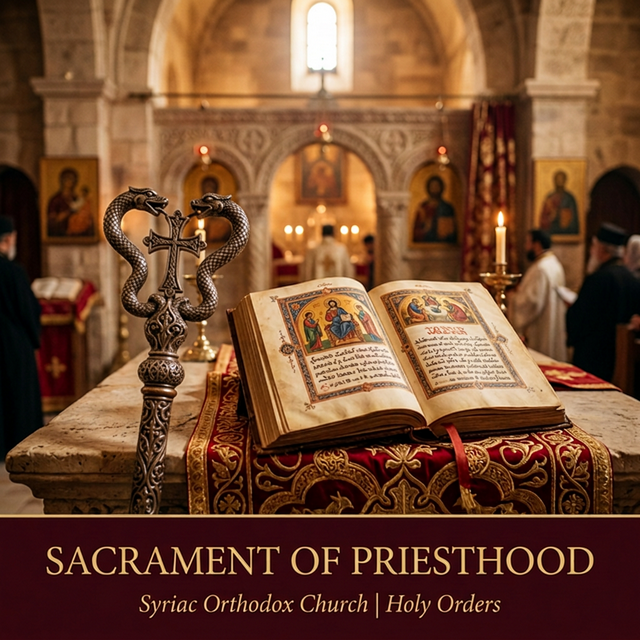
✝️Introduction
The Sacrament of Priesthood, also called Holy Orders or Sacred Orders, is one of the Holy Sacraments
of the Syriac Orthodox Church. It is through this sacrament that the Church continues the apostolic
ministry instituted by our Lord Jesus Christ Himself during His earthly ministry and confirmed after
His Resurrection. Priesthood is not merely a human office or profession—it is a divine vocation and
sacred commission to serve God and His people, to administer the sacraments, and to shepherd the
flock of Christ in truth, love, and holiness.
The priesthood stands at the heart of the Church's sacramental life. Without ordained clergy to
celebrate the Eucharist, to hear confessions, to baptize, to perform marriages, and to shepherd
souls, the Church could not fulfill her mission of bringing salvation and grace to humanity. Yet the
priesthood is not an end in itself; rather, it is a means through which Christ's redemptive work is
made present and effective in the life of the Church and the world.
In the Syriac Orthodox tradition, the priesthood is understood not as a position of privilege or
worldly power, but as a calling of profound responsibility and spiritual struggle. The priest is
called to die to himself daily, to take up his cross, and to follow Christ with absolute fidelity.
The priest is both servant and mediator, both shepherd and under-shepherd, both minister and
minister of mysteries. This paradoxical nature of priesthood—that the one who exercises authority
must do so in humility and love—reflects the very nature of Christ's own ministry.
👑Institution by Christ
The origin of the priesthood lies in the life and ministry of Jesus Christ Himself. Our Lord is the
High Priest (Hebrews 4:14–15), the supreme mediator between God and man. In the order of
Melchizedek, Christ is the eternal Priest who offers the perfect and complete sacrifice for the sins
of the world. All priesthood in the Church flows from and participates in this eternal priesthood of
Christ.
Christ's Appointment of the Apostles
During His earthly ministry, Jesus Christ chose twelve apostles to be His closest companions and to
share in His ministry. He gave them specific powers and authority: "And when he had said this, he
breathed on them and said to them, 'Receive the Holy Spirit. If you forgive the sins of any, they
are forgiven them; if you retain the sins of any, they are retained'" (John 20:22–23).
The Authority to Bind and Loose
Christ granted this authority not arbitrarily or whimsically, but as a manifestation of divine power
to bind and loose sins. This is the power to forgive sin—a power that belongs to God alone but which
Christ, in His mercy, conveyed to His apostles and to the Church. The apostles are authorized not
only to hear confessions and pronounce forgiveness but also, in cases of grave sin and impenitence,
to withhold forgiveness and retain sin. This is not a power exercised harshly or punitively but with
the wisdom of spiritual discernment and the goal of leading the sinner to repentance.
This act instituted the apostolic priesthood—a ministry that was not meant to end with the apostles
themselves but to continue in the Church through their successors. The laying on of hands (called in
Syriac Sleebo D'Yado) became the means through which this apostolic authority and the grace of the
priesthood were transmitted from generation to generation. When a bishop lays his hands on a
candidate for priesthood, he is transmitting the same grace that the apostles received from Christ,
continuing an unbroken chain of succession that stretches back to the apostolic age.
🔗Apostolic Succession
Apostolic succession is a foundational doctrine of the Syriac Orthodox Church. It means that every
bishop, every priest, every deacon in the Church stands in an unbroken line of succession from the
apostles and, through them, from Christ Himself. This is not merely a historical claim; it is a
theological affirmation about the validity and efficacy of the Church's sacraments and the
legitimacy of her ministers.
The Syriac Orthodox Church traces its apostolic succession directly through St. Peter, the Chief of
the Apostles, who was commissioned by Christ to "feed my lambs" and "feed my sheep" (John 21:15–17).
St. Peter established the Holy See of Antioch, which became the patriarchal seat of the Church in
Syria and the East. The Patriarchs of Antioch, beginning with St. Peter himself and continuing
through the centuries, have received and transmitted the apostolic authority and grace through the
laying on of hands.
The significance of apostolic succession goes beyond merely human organization. When the Church
ordains clergy through apostolic succession, she ensures that the sacraments they administer are
valid and efficacious, rooted in the very authority given by Christ to His apostles. When a priest
celebrates the Eucharist, stands in the confessional to hear confession and pronounce absolution,
baptizes an infant, or performs any other sacramental act, the validity and grace-bearing character
of that act depend on the priest standing in apostolic succession.
Every bishop and priest in the Syriac Orthodox Church is ordained by a bishop who stands in this
continuous line of apostolic authority. This unbroken chain of succession—unbroken through
persecutions, schisms, and all the vicissitudes of history—is a testimony to God's faithfulness to
His Church and to the preservation of the apostolic faith and ministry across the centuries.
📊Degrees of Priesthood
In the Syriac Orthodox Church, the priesthood has three primary degrees or orders, reflecting the
hierarchical structure found in the early Church. Each degree has specific roles, responsibilities,
and sacramental powers. This threefold structure has proven to be effective and biblical, as it is
grounded in the New Testament and has been maintained throughout the history of the Church.
|
Degree |
Role
and Responsibilities |
Sacramental Powers |
Bishop
(Episcopos)
|
Fullness of priesthood; successor of the
apostles; oversees a diocese; ordains clergy; consecrates altars and churches; confirms
faith (chrismation) |
All sacramental powers; authority to
ordain priests and deacons; exclusive power to create bishops |
Priest
(Kahno) |
Spiritual father to the faithful;
celebrates Eucharist; administers sacraments; teaches; leads parish or community; hears
confessions |
Power to celebrate Eucharist; hear
confessions and pronounce absolution; baptize; perform marriages; anoint the sick |
Deacon
(M'shamshono)
|
Assists bishop and priest; reads Gospel;
prepares altar; distributes communion; serves the poor and marginalized |
Power to assist in sacraments; distribute
communion; preach; baptize in emergencies; assist at funerals |
The Bishop (Episcopos)
The bishop is the fullness of the apostolic ministry and holds the highest degree of priesthood in
the sacramental order. A bishop is a successor of the apostles, directly continuing their apostolic
authority and mission. The bishop is empowered to ordain other clergy, to consecrate altars and
churches, to administer chrismation (confirmation), and to govern the Church in his diocese with
pastoral care and spiritual authority.
In the Syriac Orthodox Church, bishops are typically chosen from among celibate or monastic clergy,
allowing them to dedicate themselves fully to the Church without the responsibilities of maintaining
a family. The bishop represents Christ to the people and the people to Christ. As St. Ignatius of
Antioch taught, "The bishop is in the place of God the Father."
The Priest (Kahno)
The priest is ordained by a bishop and stands as a spiritual father to the faithful. The priest's
primary role is to celebrate the Holy Eucharist, offering the Church's worship and the people's
prayers to God. The priest also administers the other sacraments, hears confessions and pronounces
forgiveness of sins, teaches the faith, leads the community in prayer, and provides pastoral care to
those under his spiritual direction.
The priest is called to be a shepherd of souls—to know his flock, to pray for them, to guide them in
spiritual matters, and to be present with them in times of joy and sorrow. The priest's hands become
instruments through which the grace of God is conveyed: in baptism, in the anointing with chrism, in
the celebration of the Eucharist, in the anointing of the sick. The priest bears a sacred
responsibility to exercise this priestly ministry with holiness, wisdom, and love.
The Deacon (M'shamshono)
The deacon is ordained to assist the bishop and priest in liturgical and pastoral ministries. The
word "deacon" comes from a Greek word meaning "servant," and the deacon's role is fundamentally one
of service. The deacon reads the Gospel during the Eucharist, prepares the altar, distributes
communion to the faithful, and assists in other liturgical functions.
Beyond liturgical service, deacons have a particular responsibility to serve the poor and the
marginalized. In the early Church, deacons were entrusted with the Church's charitable work and with
caring for widows, orphans, and the sick. This tradition continues in the Syriac Orthodox Church.
There are several orders of deacons, with different ranks and responsibilities, allowing the Church
to utilize the gifts and callings of many individuals in service to God and God's people.
🙏The Rite of Ordination
The Ordination Service, called in Syriac Kthobo D'Kahno or Kthobo D'M'shamshono (depending on the
degree being conferred), is one of the most solemn and sacred ceremonies in the Church. It is
performed during the Holy Qurbono (Divine Liturgy), typically at a specially designated time when
the bishop is present to perform the ordination. The ceremony emphasizes that ordination is not
merely a human appointment but a divine mystery through which the Holy Spirit confers grace and sets
apart an individual for sacred ministry.
The Process of Ordination
Before the ordination takes place, the candidate has typically undergone a period of discernment and
preparation. The candidate must demonstrate a sincere calling to the priesthood or diaconate, must
have received appropriate theological and spiritual formation, and must be approved by the bishop
and the Church community.
During the ordination service, the candidate is presented before the altar and kneels in a posture
of humility and submission to God's will. The bishop then lays his right hand upon the candidate's
head while invoking the Holy Spirit to descend upon him. The bishop prays that the Holy Spirit would
empower the newly ordained to exercise his ministry with faithfulness, wisdom, and holiness.
The anointing with the holy Muron (sacred chrism) follows, and the bishop anoints the candidate on
the forehead and hands—the same regions that were anointed in the candidate's chrismation after
baptism, but now with a renewed and deepened significance. The anointing marks the candidate as set
apart for sacred ministry, sanctified by the Spirit for the work of the priesthood.
Finally, the candidate is vested with the priestly garments—the stole (epitrachelion), and other
vestments appropriate to the degree of ordination. Each vestment has spiritual significance. The
stole, worn around the shoulders, symbolizes the yoke of Christ and the burden of pastoral care that
the priest assumes. The other vestments signify the beauty of holiness and the authority delegated
by the Church for the exercise of sacramental ministry.
💫The Spiritual Meaning of Priesthood
The priesthood is a sacred calling—a life of sacrifice, humility, and service. It is not a position
one should seek for honor, prestige, or material gain. Rather, it is a vocation to which one is
called by God and to which one responds in faith, trusting that God will provide the grace necessary
to fulfill the responsibilities of the office.
A priest stands as a mediator between God and His people. This does not mean that the priest
replaces the unique mediation of Christ or diminishes the access of believers to God. Rather, the
priest serves as an instrument through whom Christ's priestly ministry is made visible and effective
in the Church. The priest offers prayers, sacrifices (especially the Eucharist), and sacraments for
the sanctification of the faithful.
- A Shepherd — The priest is called to be a shepherd who must lead his flock in
love and truth. Like the Good Shepherd, Christ, the priest knows his sheep by name, tends them
with care, protects them from danger, seeks the lost, and guides them to green pastures. The
priest bears responsibility for the spiritual welfare of those entrusted to his care.
- An Intercessor — The priest prays for the living and the departed, carrying
their needs and requests before God. In the Divine Liturgy, the priest makes intercession for
the entire Church—the bishops, the faithful, those in authority, those afflicted with disease or
distress, those who have died in the faith. The priest's intercessory prayer is a vital part of
his priestly ministry.
- An Administrator of the Sacraments — The priest's hands become the instruments
through which the grace of God is bestowed upon the faithful. In Baptism, the priest immerses
the candidate and serves as God's instrument in welcoming a new member into the Church. In
Eucharist, the priest calls down the Holy Spirit upon the bread and wine, and they become the
Body and Blood of Christ. In Confession, the priest proclaims absolution and restores the
penitent to grace. In Marriage, the priest blesses the couple and joins them in the Sacrament of
Matrimony. In the Anointing of the Sick, the priest anoints and prays for the healing and
consolation of the afflicted. Through all these sacraments, the priest is the visible channel of
invisible grace.
- A Teacher of the Faith — The priest is called to preach the Gospel, to
interpret Scripture, and to transmit the faith of the Church to both young and old. The priest
must be knowledgeable in theology, scripture, and the traditions of the Church, so that he can
guide his flock in truth and refute error.
- A Witness to Holiness — The priest, through his own life of prayer, fasting,
and virtue, must be a living witness to the possibility of living a holy life. The priest cannot
preach virtue while practicing vice. His life must manifest the fruits of the Spirit: love, joy,
peace, patience, kindness, goodness, faithfulness, gentleness, and self-control.
💍Celibacy and Marriage of Clergy
In the Syriac Orthodox tradition, celibacy is not mandatory for all clergy, as it is in the Roman
Catholic Church. Married men may be ordained as priests, and many priests in the Syriac Orthodox
Church are married men with families. This allows the priesthood to be accessible to a broader range
of men and allows married men to exercise their priestly vocation while also fulfilling their
responsibilities as husbands and fathers.
However, there is an important discipline: once a man is ordained to the priesthood, he cannot marry
again if his wife dies. Furthermore, if a married priest becomes a widower and wishes to be promoted
to the rank of bishop, he must withdraw from married life and enter a monastic community. This
discipline ensures that bishops can devote themselves entirely to the Church without the
responsibilities of maintaining a family.
Additionally, many men in the Syriac Orthodox Church choose to follow the monastic life—taking vows
of celibacy, poverty, and obedience. These monastic clergy often serve as spiritual guides for the
entire Church, and bishops are typically chosen from among the monastic clergy. The monastic
tradition provides a place for those called to a more intensive ascetical and contemplative life,
while the pastoral priesthood allows for the exercise of priestly ministry within the context of
family and community life.
This balanced approach—allowing both married and celibate clergy, but maintaining particular
disciplines—reflects the Syriac Orthodox understanding that there are different spiritual charisms
and callings within the Church. Some are called to marriage and family life; others are called to
the monastic life. The Church honors and supports both vocations, recognizing that God calls people
in different ways to serve Him.
✨Priesthood as a Reflection of Christ
The priest acts "in persona Christi"—in the person of Christ. This profound theological reality
shapes the entire understanding of Christian priesthood. When the priest celebrates the Eucharist,
he does not do so as a private individual performing a ritual; rather, he acts as Christ, offering
the sacrifice of the New Covenant. When the priest pronounces absolution in confession, it is
Christ, through the priest, who forgives sins. When the priest baptizes, it is Christ, through the
priest, who baptizes.
This acting in the person of Christ does not mean that the priest has personal holiness sufficient
to his task. Rather, it means that the priest is an instrument—a conduit through which Christ's
grace flows. The efficacy of the sacraments does not depend on the personal virtue of the priest but
on the grace of Christ and the authority of the Church. This is why the Church teaches that even if
a priest falls into grave sin, the sacraments he celebrates remain valid. The grace is Christ's, not
the priest's.
Yet the priest is also called to reflect Christ in his life. The priest represents Christ, who is
both Priest and Victim, both Shepherd and Servant. Christ is the eternal High Priest who offers
Himself as a sacrifice for the sins of the world. Christ is the Good Shepherd who lays down His life
for the sheep. Christ is the Servant who washes the disciples' feet and teaches them to serve one
another. The priest is called to embody these characteristics of Christ: to be willing to sacrifice
himself for the flock, to serve humbly, to love unconditionally, and to guide others toward
salvation.
St. Ignatius of Antioch, a great Church Father of the Syriac tradition, expressed this understanding
profoundly:
"The bishop is in the place of God the Father, the presbyters in the place of the council of
the apostles,
and the deacons entrusted with the ministry of Jesus Christ."
This teaching shows that the priesthood, in all its degrees, is understood as a participation in
Christ's own ministry and as a visible representation of the Church's communion with God. Thus,
priesthood in the Syriac Orthodox Church is not merely a position or a job; it is a sacred ministry
through which the love, grace, and presence of Christ are made visible and effective in the Church
and the world.
🕊️The Role of the Faithful
The priesthood is not only hierarchical and institutional; it is also communal. The Church
recognizes that priesthood operates on multiple levels: the ordained priesthood (bishops, priests,
and deacons) and the universal priesthood of all believers. These two levels of priesthood are not
opposed to one another; rather, they complement and support one another.
Every baptized believer shares in what is called the "royal priesthood" (1 Peter 2:9). This
universal priesthood means that all believers are called to be priests in their own lives—called to
witness to Christ, to serve one another, to offer spiritual sacrifices, and to intercede for the
world. The royal priesthood of the baptized is expressed through their participation in the
sacraments, through their daily work and relationships, through their prayers and charitable
service, and through their witness to the Gospel.
However, the sacramental priesthood—the ordained priesthood of bishops, priests, and deacons—is
distinct from the universal priesthood of the baptized. The sacramental priesthood is set apart for
specific liturgical and sacramental functions that only the ordained can perform: celebrating the
Eucharist, hearing confession and pronouncing absolution, ordaining new clergy. This distinction
does not create a separation between clergy and laity but rather establishes an order that reflects
the structure of the early Church and the pattern of Christ's commissioning of the apostles.
The faithful are called to support their priests through prayer, respect, and obedience. When the
faithful obey their spiritual father, they are ultimately obeying Christ, who speaks through him.
The faithful are also called to hold their clergy accountable, to pray for them, and to assist them
in their ministry. Through the cooperation of ordained clergy and faithful laity, all working
together in the communion of the Church, the entire Church fulfills her mission of bringing the
Gospel to the world and leading believers toward salvation and holiness.
🏛️Summary of the Sacrament
|
Aspect |
Syriac Orthodox Understanding |
| Name |
Kahnoyo / Qurdinuto Qdisho (Priesthood /
Holy Orders) |
| Minister |
Bishop (with apostolic authority and
succession) |
| Matter |
Laying on of hands (Sleebo D'Yado) |
| Form |
Prayer of ordination and invocation of
the Holy Spirit by the bishop |
| Effect |
Indelible character conferred; grace to
exercise priestly ministry; authority to administer sacraments (according to degree)
|
| Degrees |
Bishop (Episcopos), Priest (Kahno),
Deacon (M'shamshono) |
| Frequency |
Once in a lifetime; confers an indelible
character that cannot be removed |
| Connection |
Continues Christ's apostolic ministry;
enables administration of all other sacraments |
✨Conclusion
The priesthood in the Holy Syriac Orthodox Church is the continuation of Christ's own ministry
through His apostles and their successors. It is a divine mystery of grace and service—rooted in
love, expressed through sacrifice, and sustained by the Holy Spirit. The priesthood is not an
achievement of human ambition but a gift of God's calling and a response of faith.
Through the faithful ministry of the clergy—bishops, priests, and deacons—the Church remains the
living Body of Christ on earth, continuing His work of redemption and leading the faithful toward
salvation and eternal communion with God. The priest stands as a bridge between the divine and
human, serving as a channel through which Christ's grace flows to His people and through which the
people's prayers and offerings ascend to God.
The priesthood demands much: holiness, humility, self-sacrifice, dedication to prayer and study,
pastoral sensitivity, and unwavering fidelity to the faith. Yet it also grants much: the privilege
of standing in Christ's stead, of administering the mysteries of salvation, of shepherding souls, of
leading people to God. For those called to this vocation, no greater honor or responsibility exists
than to serve as a priest of the Church, continuing the apostolic ministry that Christ instituted
and that has been faithfully transmitted across the centuries.
"O Lord, Thou hast called us to the priesthood,
a holy calling and sacred trust.
Grant us the grace to serve Thee faithfully,
to shepherd Thy flock with love and truth,
to administer the mysteries of Thy salvation,
and to lead Thy people toward Thee.
Make us instruments of Thy grace,
humble servants of Thy Church,
and faithful ambassadors of Thy Gospel,
that through our ministry, Thy kingdom may come
and Thy will may be done on earth as it is in heaven."