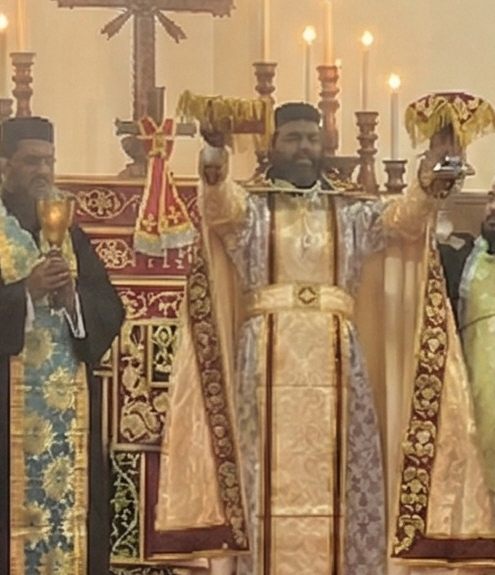
✝️Introduction
The Holy Qurbana (ܩܽܘܪܒܳܢܳܐ ܩܰܕܺܝܫܳܐ – Qurbono Qadisho) in Syriac, is the central act of worship and
the
supreme Sacrament of the Syriac Orthodox Church. It is the Mystery of Mysteries, the Sacrament of
Sacraments, through which the faithful partake in the true Body and Blood of our Lord Jesus Christ
under the form of bread and wine. This is not a mere memorial, not merely a symbol, but the living,
mystical presence of Christ Himself, offered for the salvation and sanctification of all who
approach with faith and reverence.
The Holy Eucharist is the source and summit of Christian life. All the other sacraments lead to it or
flow from it, for in the Eucharist, we encounter Christ Himself—living, sacrificed, and risen—who
gives Himself as spiritual food and drink for the salvation of the world. Just as natural food
sustains the physical body, the Eucharist sustains the spiritual life of the believer and unites
them to the life of God.
In the celebration of the Holy Qurbana, the earthly Church is lifted up to heaven; the faithful
become partakers of the worship of the angels and saints; and the boundary between time and eternity
becomes transparent. The Eucharist is not simply something the Church does on Sundays; it is the
beating heart of the Church, the very center around which all of Christian life revolves.
🕊️Meaning of the Word "Qurbana"
The term Qurbana comes from the Syriac word Qurbono (ܩܽܘܪܒܳܢܳܐ),
The term Qurbana comes from the Syriac word Qurbono (ܩܽܘܪܒܳܢܳܐ), meaning "offering" or "sacrifice."
This etymology is highly significant for understanding the theological meaning of the Eucharist in
the Syriac Orthodox tradition. The Eucharist is not merely a communal meal or a memorial; it is
fundamentally an offering—an act of worship in which the Church presents gifts to God and offers
itself in union with Christ's eternal sacrifice.
In the Holy Eucharist, the Church offers to God the bread and wine—fruits of the earth and work of
human hands—and through the action of the Holy Spirit, they are transformed into the Body and Blood
of Christ. This offering is not a new sacrifice distinct from Christ's sacrifice on Calvary; rather,
it is a mystical re-presentation (not a repetition) of Christ's one perfect and eternal sacrifice on
the Cross, made present on the altar in a mystical, bloodless manner.
Thus, the Qurbana is both a thanksgiving (Eucharistia) and a sacrifice. It is an act of gratitude in
which the Church gives thanks to God for all His mercies, for creation, for redemption, for
sanctification, and for the hope of resurrection. It is simultaneously a sacrifice in which the
Church, united with Christ, offers herself to God—offering praise, thanksgiving, and intercession
for all humanity. Every celebration of the Qurbana is a participation in the one eternal sacrifice
of love that Christ offered on the Cross for the redemption of the world.
📜Biblical Foundation
The institution of the Holy Eucharist comes directly from our Lord Jesus Christ during the Last
Supper:
"He took bread, blessed and broke it, and gave it to them, saying, 'This is My Body which is
given for you; do this in remembrance of Me.' Likewise He took the cup, saying, 'This cup is
the new covenant in My Blood, which is shed for you.'" (Luke 22:19–20)
The Church obeys this command of the Lord—"Do this in remembrance of Me"—by celebrating the Holy
Qurbana continually from the time of the Apostles. The Eucharist is also prefigured in the Old
Testament: The Passover Lamb foreshadowed Christ; the Manna in the wilderness prefigured the
heavenly bread; and the sacrifice of Melchizedek symbolized the Eucharistic offering.
🕯️The Divine Liturgy in the Syriac Orthodox
Church
The Eucharistic celebration in the Syriac Orthodox Church is called the Holy Qurbono Qadisho, most
often celebrated using the Anaphora of St. James the Apostle, the first bishop of Jerusalem and one
of the earliest liturgical forms of Christianity.
The Structure of the Qurbana:
- Preparatory Prayers and Hymns The celebrant and deacons
prepare spiritually with confessions and vesting prayers. The curtain is closed at the beginning
and opened later, representing the revelation of divine mysteries.
- Service of the Word Includes readings from the Old and New
Testaments, Psalms, Epistles, and the Holy Gospel. A sermon or homily may follow.
- Offertory and Anaphora Bread and wine are offered upon the
altar. The priest prays the Anaphora (Eucharistic Prayer), invoking the Holy Spirit to descend
upon the gifts.
- Consecration Through the power of the Holy Spirit, the bread
and wine become the true Body and Blood of Christ. The priest proclaims: "This is truly the Body
and Blood of our Lord and God and Savior Jesus Christ."
- Intercessions and the Lord's Prayer The Church prays for the
living and the departed, uniting the entire Body of Christ.
- Holy Communion The faithful approach reverently to receive
the sanctified Body and Blood, uniting themselves with Christ and with all members of the
Church.
- Dismissal and Blessing The faithful are sent forth with peace
and joy to live out the mystery they have received.
🔥Theology of the Eucharist
The Syriac Orthodox Church firmly teaches the Real Presence of Christ in the Holy Eucharist. After
consecration, the bread and wine are not mere symbols, but truly become the Body and Blood of
Christ, though their outward appearances remain. St. Severus of Antioch wrote:
"It is not mere bread and wine that we receive, but the very Body which was nailed to the
Cross and the very Blood which flowed from His side."
Thus, the Eucharist is: A Sacrament of Unity—uniting believers with Christ and with one another; A
Sacrifice—a mystical participation in the one sacrifice of Christ on the Cross; A Communion—sharing
in the divine life of Christ, the Bread of Life.
🕊️Preparation and Worthiness
The faithful are called to approach the Holy Qurbana with repentance, fasting, and purity of heart.
Before receiving Holy Communion, one must reconcile with others, confess sins, and believe
wholeheartedly in the mystery being received. "Let a man examine himself, and so let him eat of the
bread and drink of the cup." (1 Corinthians 11:28)
🌿Frequency and Obligation
The Syriac Orthodox Church encourages participation in the Holy Qurbana as often as possible,
especially on Sundays and feast days. The Divine Liturgy is not merely a memorial but a living
encounter with the crucified and risen Christ. Each celebration renews the covenant between God and
His people.
🌺Symbolism in the Liturgy
Altar
Symbol of Christ Himself and His eternal throne
Curtain
Separation between heaven and earth, opened in Christ
Bread and Wine
Humanity and divinity of Christ offered for salvation
Incense
Prayers of the saints ascending to heaven
Candles
The presence and light of Christ
Cross
The sign of victory and redemption
⛪Historical and Apostolic Continuity
The Syriac Orthodox Church traces its liturgical heritage directly to the Church of Antioch, where
St. Peter and St. Paul preached. The Anaphora of St. James, still in use today, is one of the most
ancient Eucharistic liturgies in Christendom—a living link with the Apostolic era. For the Syriac
Orthodox faithful, participating in the Qurbana is entering the timeless worship of heaven, joining
the angels and saints around the throne of God.
✨Spiritual Effects of the Eucharist
Through participation in the Holy Qurbana, the believer receives: Forgiveness of sins and spiritual
healing; Union with Christ and the Church; Strength to live a holy life; Foretaste of the Kingdom of
Heaven.
The Eucharist is thus the bread of immortality, as our Lord said: "He who eats My flesh and drinks My
blood abides in Me, and I in him." (John 6:56)
📋Summary of the Sacrament
Name
Holy Qurbana (Holy Eucharist)
Minister
Bishop or Priest
Form
Words of Institution and Invocation of the Holy Spirit
Effect
Real Presence of Christ, forgiveness of sins, union with God
Frequency
Regularly, especially Sundays and feast days
🙏Conclusion
The Holy Eucharist is the heart of Syriac Orthodox faith and worship. It is where heaven and earth
meet, where the faithful encounter the living Christ, and where the mystery of salvation is made
real in every generation.
Through the Holy Qurbana, the Church becomes one body with her Lord—offering praise, thanksgiving,
and herself in union with the eternal sacrifice of love.
The Prayer of the Faithful
"This Qurbana is the life of the Church;
its altar is the cross,
its fire is the Holy Spirit,
and its food is Christ Himself—
the Bread of Life and the Cup of Salvation."